

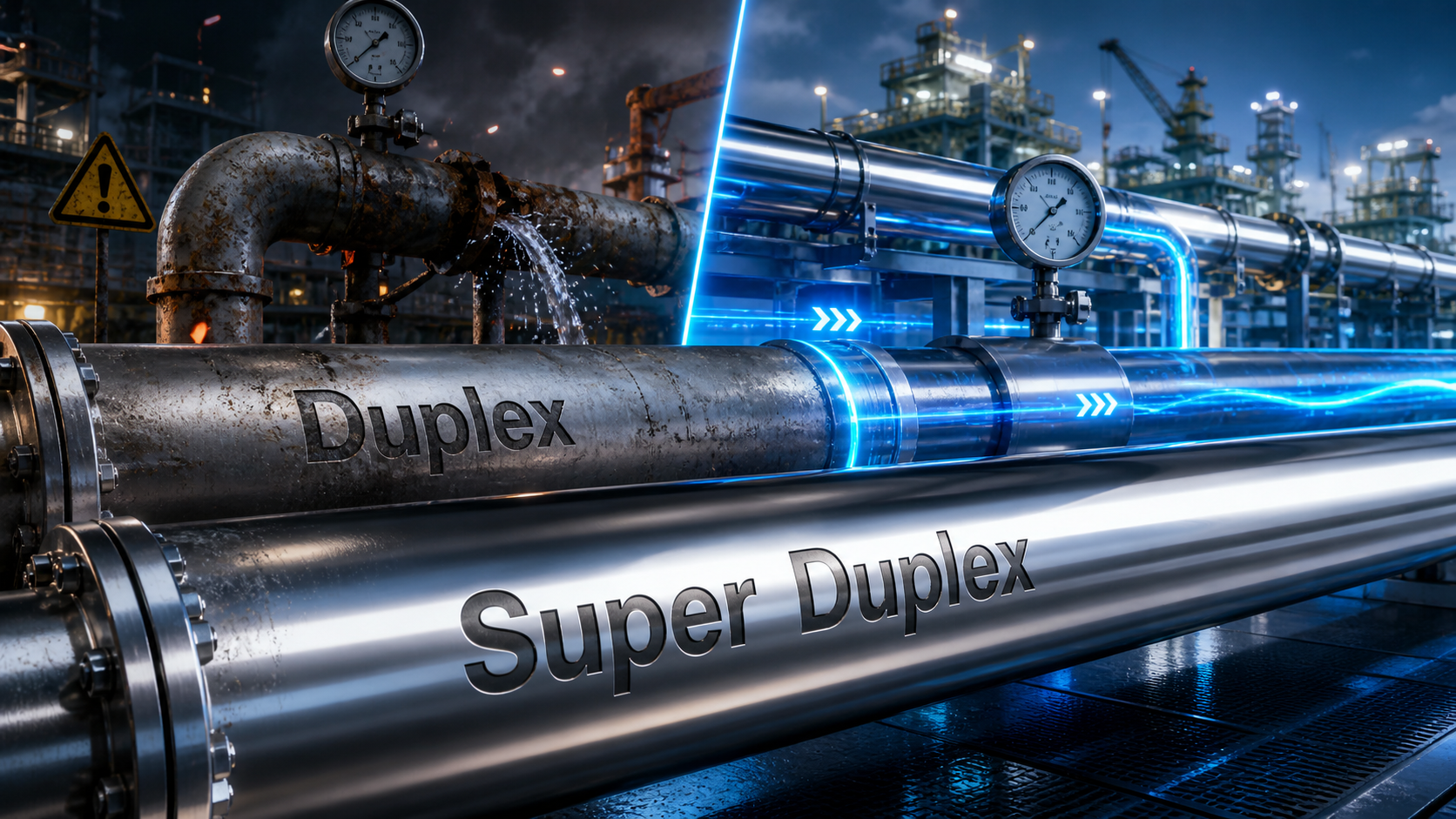
Somewhere around 35°C of warm seawater, standard duplex pipe starts losing an argument that super duplex keeps winning to 50°C and beyond. That temperature gap — and the roughly 25–40% price gap that comes with it — is the entire duplex vs super duplex decision, and buyers who understand it stop paying for corrosion resistance their service will never use.
The short answer: duplex stainless steel pipe (typically grade 2205, UNS S32205/S31803) and super duplex pipe (typically grade 2507, UNS S32750) share the same dual austenitic-ferritic structure that gives both roughly twice the strength of 316L. The difference is chloride-fighting alloy content — super duplex carries more chromium, molybdenum, and nitrogen, pushing its pitting resistance number (PREN) above 40 versus around 34–36 for duplex. Choose 2205 for most chemical, process, and moderate-chloride service; step up to 2507 for hot seawater, high-chloride brines, and offshore duty where duplex’s limits are genuinely exceeded.
Below: the chemistry behind that summary, the comparison numbers in one table, where each grade actually gets specified, the shared limitations both grades carry, and what to verify when buying either.
What Makes a Steel “Duplex” in the First Place
Ordinary austenitic stainless (304, 316L) has one crystal structure. Duplex grades are engineered to solidify as roughly half austenite, half ferrite — and each phase covers the other’s weakness. The ferrite contributes high strength and resistance to chloride stress-corrosion cracking (austenitic steel’s classic failure); the austenite contributes toughness and general corrosion performance.
The practical results, for both duplex and super duplex:
- Minimum yield strength around 450–550 MPa — roughly double 316L — which is why duplex lines are often specified one or two schedules thinner than the austenitic pipe they replace
- Strong resistance to chloride stress-corrosion cracking, the mechanism that quietly retires 316L in warm chloride service
- Good weldability and toughness, provided fabrication respects the rules covered below
The family’s economics surprise first-time buyers: because of the strength advantage and lower nickel content, 2205 duplex pipe frequently lands cheaper per installed metre than 316L for the same duty — a rare case of upgrading metallurgy and saving money simultaneously.
S32205 vs S32750: The Numbers That Matter
| Property | Duplex 2205 (S32205/S31803) | Super Duplex 2507 (S32750) |
|---|---|---|
| Chromium | ~22% | ~25% |
| Nickel | ~5% | ~7% |
| Molybdenum | ~3% | ~4% |
| Nitrogen | ~0.14–0.20% | ~0.24–0.32% |
| PREN (pitting resistance) | ~34–36 | ≥40 |
| Min yield strength (seamless pipe) | ~450 MPa | ~550 MPa |
| Chloride pitting margin (CPT, indicative) | Roughly to ~35°C in aggressive chloride tests | Roughly ~50°C+ in the same tests |
| Relative pipe cost | Baseline | Typically ~25–40% higher (market-dependent — verify current) |
| Governing pipe standard | ASTM A790 (seamless & welded) | ASTM A790 |
(PREN = %Cr + 3.3×%Mo + 16×%N — the standard index for chloride pitting resistance. Critical pitting temperatures depend heavily on the test method; use them to compare grades, not as service guarantees.)
One naming note that prevents real purchasing errors: S31803 and S32205 are both “2205,” but S32205 is the tighter modern version — higher minimum nitrogen and molybdenum. Most quality mills produce dual-certified S31803/S32205 material. If your specification says S32205, “S31803 equivalent” is not automatically compliant; check the certificate’s actual chemistry. (Also in the family: S32760 — Zeron 100-type super duplex, closely comparable to S32750 with copper and tungsten additions; many projects treat the two as alternates.)
Where Each Grade Earns Its Price
Duplex 2205 — the rational default for:
- Chemical and petrochemical process piping where 316L is marginal
- Heat exchangers and cooling circuits with moderate chlorides
- Desalination pre-treatment and brackish water systems
- Structural-plus-corrosion duty (its strength does double work)
- Oil and gas flowlines within sour-service limits (per ISO 15156/NACE MR0175 — the standard governs H₂S limits for both grades)
Super duplex 2507 — necessary, not luxurious, for:
- Hot seawater systems: offshore firewater and injection lines, cooling circuits
- High-recovery desalination sections where brine concentrates
- Umbilicals and subsea service
- Aggressive chloride process streams that sit past 2205’s pitting margin
The honest selection rule: let the chloride level and temperature make the decision, not the word “super.” We see over-specification constantly — 2507 purchased for services 2205 handles with margin, paying 30% extra for insurance the process conditions never claim. A supplier should be willing to say “2205 is enough here,” and where chlorides are genuinely mild, even that may be more than needed — our guide to the stainless seamless grades from 304 to 347H covers where ordinary austenitics still win.
The Limits Both Grades Share (Read Before Specifying)
Duplex metallurgy has boundaries that surprise buyers coming from austenitic or carbon steel:
Temperature ceiling — and floor. Sustained service above roughly 250–300°C risks “475°C embrittlement” (a ferrite-phase hardening mechanism active well below 475°C itself), and excursions into the 600–1000°C range can precipitate brittle sigma phase. Duplex is a sub-300°C family — it is never the answer for the high-temperature services covered by chrome-moly grades. At the other end, standard practice limits duplex around −40 to −50°C; deep cryogenic duty stays austenitic.
Welding discipline. The 50/50 phase balance is set in the mill’s solution anneal (~1050–1100°C, water quenched) — and every weld locally re-melts that balance. Controlled heat input, qualified procedures, nitrogen-bearing shielding gas, and no post-weld stress relief (which would trigger the embrittlement above) are standard requirements. Well within any competent fabricator’s reach — but not a carbon-steel mindset.
Common misconception: “super duplex is stronger, so it’s the safer default.” Its extra alloy actually makes it more prone to sigma formation if fabrication or heat treatment goes wrong. Higher grade means tighter discipline, not more forgiveness.
Buying Duplex or Super Duplex Pipe: What to Verify
The grades’ performance depends on mill processing you cannot see — so the documents carry the load:
- Full chemistry on the MTC, checked against the UNS number ordered (S32205’s nitrogen minimum especially — it’s the cheap element to skimp)
- Solution annealing confirmed with temperature stated; the quench is what locks the phase balance
- Ferrite content / phase balance testing where your spec requires it (typically 35–55% ferrite) — and for critical service, ASTM A923 testing to screen for intermetallic phases
- Corrosion testing (ASTM G48) available on request for seawater-class orders
- PMI at dispatch — duplex, super duplex, and 316L are visually identical, and the price gaps between them attract exactly the substitution games we catalogued in our supplier red-flags guide
- EN 10204 3.1/3.2 certification with heat numbers marked on every length
Nakoda Steel Industry supplies both families — duplex S31803/S32205 pipe and super duplex S32750/S32760 pipe — with these verification commitments stated on the quotation, not negotiated afterward.
Frequently Asked Questions
What is the difference between duplex and super duplex stainless steel pipe?
Both share a dual austenite-ferrite structure with roughly twice the strength of 316L. Super duplex (S32750) carries more chromium, molybdenum, and nitrogen than duplex 2205 (S32205), raising its pitting resistance number above 40 versus ~34–36 — which translates to reliable service in hotter, more concentrated chloride environments like seawater, at a typical 25–40% price premium.
Is duplex 2205 better than 316L?
For strength, always — about double the yield, allowing thinner walls. For chloride service, substantially — better pitting resistance and far better resistance to chloride stress-corrosion cracking. 316L retains the edge in high-temperature capability, cryogenic service, and fabrication simplicity, and remains the economical choice where chlorides are mild.
What is PREN and what values do duplex grades have?
PREN (Pitting Resistance Equivalent Number = %Cr + 3.3×%Mo + 16×%N) indexes resistance to chloride pitting. Duplex 2205 scores roughly 34–36; super duplex S32750 is defined by PREN ≥ 40. It compares alloys reliably; it does not by itself guarantee performance in a specific service.
What is the temperature limit for duplex stainless steel pipe?
Practically about 250–300°C sustained, for both duplex and super duplex, due to 475°C embrittlement of the ferrite phase — with sigma-phase risk at higher excursions. Below roughly −40 to −50°C, austenitic grades take over. Duplex is a strength-and-chlorides family, not a high-temperature one.
What is the difference between S31803 and S32205?
Both designate 2205 duplex, but S32205 is the tighter modern specification with higher minimum nitrogen and molybdenum. Most mills dual-certify; if your order specifies S32205, verify the certificate’s actual chemistry rather than accepting “S31803 equivalent.”
When is super duplex S32750 actually necessary?
When chloride concentration and temperature together exceed 2205’s pitting margin — hot seawater systems, concentrated brines, high-recovery desalination stages, and subsea/offshore duty. If your service sits comfortably inside 2205’s envelope, the 2507 premium buys nothing.
What standard covers duplex stainless steel pipe?
ASTM A790/A790M for seamless and welded pipe (A789 for tubing), with ASTM A923 for intermetallic-phase testing and ASTM G48 for pitting/crevice corrosion testing. Sour service limits for both grades are governed by ISO 15156 / NACE MR0175.
The Bottom Line
Duplex vs super duplex is not a quality ladder — it’s a chloride ladder. 2205 gives you double 316L’s strength and a wide chloride margin at a price that often undercuts the austenitic it replaces; 2507 extends that margin into hot seawater territory for a premium that’s only rational when your service actually lives there. Match the PREN to the process, verify the phase balance behind the certificate, and either grade will outlast the project around it.
Specifying duplex or super duplex pipe? Send Nakoda Steel Industry your service conditions and line list — you’ll get a grade recommendation with the reasoning stated, and a quotation with solution-annealing, testing, and PMI commitments in writing within 24 working hours.