

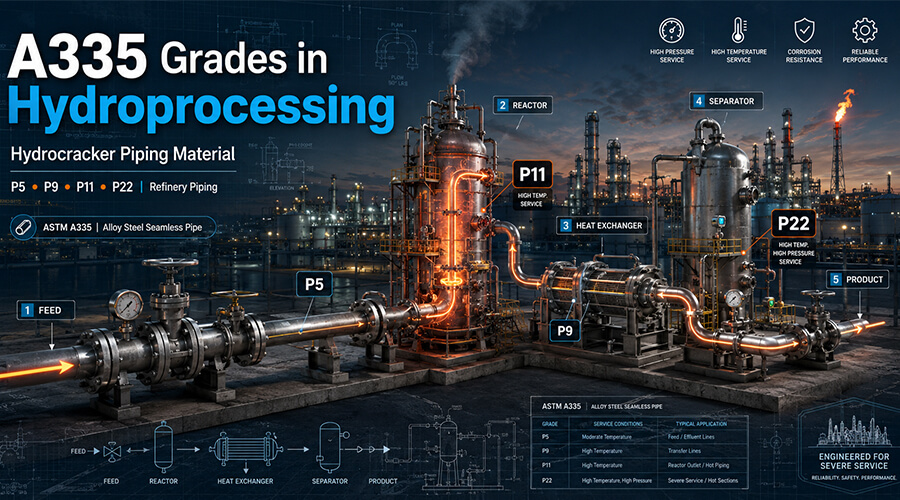
Hydroprocessing units are the hardest neighborhood in a refinery for steel. Nowhere else do hot hydrogen, hydrogen sulfide, and high pressure attack the same pipe at the same time — and a grade that survives clean steam at 500°C can be eaten alive by hydrogen at 300°C.
That’s why hydrocracker piping material can never be picked from a temperature chart alone. The rulebook changes: from ASME stress tables to API’s Nelson curves.
This guide maps the A335 chrome-moly family onto a hydroprocessing unit, circuit by circuit — which grade belongs in the feed section, the heater, the reactor loop, and the effluent train, and why. Nakoda Steel Industry supplies the full A335 range to refinery projects across the Gulf and beyond; this map reflects how those materials are actually specified in the field.
Two Enemies, Two Sets of Curves
High-Temperature Hydrogen Attack (HTHA). Above a threshold of temperature and hydrogen partial pressure, hydrogen diffuses into steel and reacts with its carbides to form methane — trapped inside the metal, cracking it from within, often with little surface warning. API RP 941 documents the failures and sets the limits. Chromium and molybdenum resist HTHA by forming stable carbides hydrogen can’t strip; more alloy means a higher safe envelope.
Hot H₂/H₂S corrosion. H₂S alone corrodes steel faster as temperature rises. Add hydrogen and rates jump further — predicted by the Couper-Gorman correlations in API RP 939-C.
The rule that organizes everything: chrome-moly content is chosen for HTHA resistance and strength; once H₂S corrosion becomes governing, the answer is usually stainless (321H/347H), solid or as cladding over a Cr-Mo backbone.
Reading the Nelson Curves in Plain English
Each steel gets a curve of temperature vs hydrogen partial pressure. Below your steel’s curve, HTHA is not expected. Above it, you’re gambling against documented failures.
Three readings matter for buyers. Carbon steel’s curve is low — its safe zone ends near 200–260°C at meaningful hydrogen pressures. C-½Mo (P1) lost its curve entirely after in-service failures; do not specify P1 for new hydrogen service, whatever older drawings show. And P11’s and P22’s curves sit progressively higher — P22’s envelope covers most reactor-loop conditions, which is why 2¼Cr-1Mo became the workhorse of hydroprocessing.
The Circuit-by-Circuit Map
(Ranges are typical; your licensor’s material selection diagram always governs.)
| Circuit | Typical conditions | Typical material |
|---|---|---|
| Cold feed, make-up H₂ | ||
| <230°C | Carbon steel (A106 Gr B) | Preheat / exchanger train | 230–370°C, rising H₂ | P11 → P22 per Nelson curve | Heater + transfer line | 370–450°C, H₂+H₂S peak | P22 minimum; 321H/347H where corrosion governs | Reactor loop / hot effluent | 340–450°C, high pH₂ | Heavy-wall P22 (+ stainless overlay/clad as needed) | REAC region | Cooling, NH₄HS salts | Specialist alloys per API 932-B — a separate discipline | Hot sour, low-H₂ circuits | 260–400°C, sulfur-led | P5 / P9 |
Walk it with the feed. Carbon steel serves while hydrogen sleeps below the Nelson threshold. Through the exchanger train, P11 takes over, stepping to P22 as temperature and hydrogen pressure climb — the switch point comes off the curve for your hydrogen partial pressure, not off temperature alone.
At the heater and reactor loop, both enemies peak together. P22 carries the pressure-boundary duty, matched to the 2¼Cr-1Mo reactors themselves for welding and PWHT compatibility. Where Couper-Gorman predicts unacceptable corrosion, the spec jumps to stabilized stainless — solid pipe on smaller bores, cladding or weld overlay on heavy walls.
Two boundaries deserve respect. The REAC inlet region corrodes by ammonium bisulfide, not hydrogen — its materials come from API 932-B, and extrapolating this map there is how expensive mistakes happen. And downstream, where hydrogen pressure drops but hot sulfur remains, you’re back on McConomy logic: P5 and P9, exactly as in crude units.
The 2¼Cr-1Mo Fine Print: Temper Embrittlement
P22 has one long-service weakness. Held at 340–575°C for years, it can slowly embrittle as tramp elements — phosphorus, tin, antimony, arsenic — segregate to grain boundaries. Strength stays; low-temperature toughness drops, which matters during cold startups and pressure tests.
The defense is chemistry control at the melt. Hydroprocessing specs impose a J-factor limit on base metal (commonly ≤100) and X-bar on weld metal. No downstream process fixes a bad heat — which is why Nakoda Steel Industry certifies residual chemistry on P22 mill certificates for hydrogen service, and why a supplier who’s never heard of J-factor is telling you which market their pipe was really made for.
“Can’t We Just Upgrade Everything to Stainless and Skip the Map?”
The tempting shortcut, and here’s why refiners don’t take it. Cost first: hydroprocessing consumes heavy-wall tonnage, and austenitic stainless multiplies the bill. Thermal expansion second: stainless grows roughly a third more than the ferritic steel around it, complicating supports and dissimilar welds. And chloride stress-corrosion cracking third — stainless imports a vulnerability chrome-moly doesn’t have.
Seventy years of refining practice settled on the split this map shows: Cr-Mo for the pressure boundary, stainless only where corrosion forces it. The map isn’t tradition. It’s optimization.
Buying Hydroprocessing Pipe: What to Verify
- Dual certification A335/SA-335 with editions stated — these scopes mix Code-stamped and B31.3 work
- Full chemistry including residuals where J-factor limits apply
- Heat-treatment furnace charts, furnished proactively
- Per-lot hardness (and NACE MR0103 compliance where wet sour service applies)
- PMI at dispatch — P11, P22, P5 and 347H on one order are four identical-looking pipes with four very different futures
- Heat numbers stamped on every length, matched to certificates
Takeaway — the map in 30 seconds
Carbon steel below ~230°C → P11 → P22 through the hot loop → 321H/347H where H₂S governs → P5/P9 in hydrogen-lean sour circuits. Never P1 for new hydrogen service. Specify J-factor on P22. Never extrapolate into the REAC. Verify residuals, furnace charts, and PMI — in hydrogen service, the paperwork is the pipe.
The Map Is Cheaper Than the Lesson
Every line on this map was drawn by a failure somewhere — a curve withdrawn, a limit tightened, a mechanism named after the unit that discovered it. Following it costs a specification clause. Ignoring it costs a turnaround.
Specifying pipe for a hydrotreater, hydrocracker, or revamp? Send Nakoda Steel Industry your line list and governing specifications — you’ll receive a circuit-matched quotation within 24 working hours, with dual certification, residual-controlled chemistry, and PMI commitments in writing.