

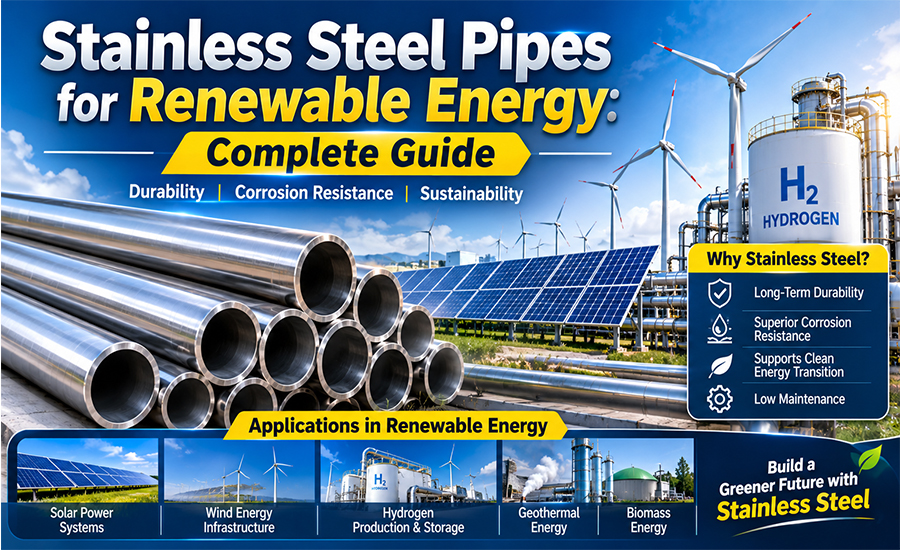
India’s power mix is changing fast. Solar capacity has grown from 2.8 GW in 2014 to about 175 GW by October 2026, and wind, hydro and green hydrogen projects are growing right beside it. Every one of these plants also depends on piping that keeps working for 25 years or more, and that is where stainless steel pipes for renewable energy come in.
In practice, these pipes carry hot molten salt in solar thermal plants, brine in geothermal wells, seawater in offshore wind systems and pure hydrogen in electrolyser skids. Choose the wrong grade, and you pay for it later through leaks, shutdowns and early replacement.
At Nakoda Steel Industry, we supply stainless, duplex and alloy steel pipes, flanges and tubes to power and process projects from our offices in Indore and New Jersey. In this guide, we break down each renewable sector, the grades that work there, the ones that fail, and a simple checklist for buying with confidence. Whether you are an EPC engineer, a plant owner or a procurement manager, you will find practical answers here.
Table of Contents
- Why Renewable Energy Projects Need Stainless Steel
- Stainless Steel Grades for Renewable Energy: The Main Families
- Stainless Steel in Solar Power Plants
- Stainless Steel in Wind Energy
- Stainless Steel in Hydropower
- Stainless Steel in Geothermal Energy
- Stainless Steel Pipes for Green Hydrogen
- Stainless Steel in Bioenergy and Waste-to-Energy
- Quick Selection Chart: Stainless Steel Pipes for Renewable Energy
- Stainless Steel vs Carbon Steel: Which Costs Less Over 25 Years?
- Buyer’s Checklist for Renewable Energy Pipe Procurement
- How Nakoda Steel Industry Supports Renewable Energy Projects
- Key Takeaways
- Frequently Asked Questions
- Conclusion
Why Renewable Energy Projects Need Stainless Steel
Renewable plants are long-term assets. Most solar and wind projects are planned for a 25-year life, so every pipe, flange and fastener must last that long with little attention.
They also sit in tough places. For example, think of desert solar parks with saline groundwater, coastal wind farms hit by salt spray, and geothermal wells full of hot brine.
Stainless steel handles these conditions because of chromium. With at least 10.5% chromium, the steel forms a thin oxide layer on its surface. When that layer gets scratched, it repairs itself in the presence of oxygen.
What stainless steel brings to a renewable plant
- Corrosion resistance: It resists rust, pitting and chemical attack without paint or galvanising.
- Strength at temperature: Heat-resistant grades hold their strength from sub-zero conditions to above 600°C.
- Low maintenance: Fewer coating cycles, fewer inspections and fewer shutdowns.
- Clean service: It does not shed rust into water, electrolyte or hydrogen streams.
- Full recyclability: It can be recycled again and again without losing quality, which fits the green goals of the project itself.
The real cost of choosing the wrong material
Here is a pattern seen on many sites. For example, a project team picks a lower grade to save on the purchase order. Two or three years later, pitting shows up near the welds, and the line has to be cut out during peak generation season.
The downtime alone can cost more than the original material saving. That is why experienced engineers choose the grade for the full plant life, not the purchase price.
Stainless Steel Grades for Renewable Energy: The Main Families
Not all stainless steel behaves the same. In practice, four families cover almost every need for renewable energy work.
1. Austenitic grades: 304/304L, 316/316L and 316Ti
These are the everyday workhorses. Grade 304L suits clean water lines and dry, inland structures. Grade 316L, however, adds 2–3% molybdenum, which gives much better resistance to the chlorides found in seawater, saline groundwater and coastal air.
The “L” means low carbon, which protects welds from intergranular corrosion. Grade 316Ti adds titanium for better stability at higher temperatures. For a side-by-side view, see our 304 vs 316 stainless steel pipe guide.
2. Heat-resistant grades: 304H, 310/310S, 310H, 321H and 347H
“H” grades such as 304H carry slightly higher carbon. As a result, they resist creep, the slow stretching that happens to metal held at high temperature for years.
Grade 310S, with about 25% chromium and 20% nickel, resists oxidation in furnaces and biomass boilers. Meanwhile, 321H and 347H are stabilised grades widely used in solar thermal plants.
3. Duplex and super duplex: S31803/S32205 and S32750/S32760
Duplex steels mix austenite and ferrite in roughly equal parts. As a result, they offer about twice the yield strength of 316L and far better resistance to chloride stress corrosion cracking.
Super duplex grades go further. That is why they are the first choice for seawater systems, offshore platforms and aggressive geothermal brines. Read our detailed comparison of duplex stainless steel pipe vs 316L to see where ordinary stainless runs out.
4. Martensitic grades: 13Cr-4Ni
These hard, tough grades are cast into hydro turbine runners and wear parts. They resist cavitation and silt erosion better than austenitic grades.
How to compare corrosion resistance quickly
Engineers use the Pitting Resistance Equivalent Number (PREN) to compare grades in chloride service. The formula is PREN = %Cr + 3.3 × %Mo + 16 × %N. In short, a higher number means better resistance to pitting.
| Grade | Typical PREN | Best fit in renewables |
|---|---|---|
| 304L | About 18–20 | Clean water, inland structures |
| 316L | About 24 | Coastal sites, hydrogen, biogas |
| Duplex 2205 | About 35 | Geothermal, brackish water, offshore support systems |
| Super duplex 2507 | 40 or more | Seawater cooling, offshore wind, harsh brines |
Stainless Steel in Solar Power Plants
Solar is now India’s largest renewable source. However, solar plants use stainless steel in two very different ways, depending on the technology.
Solar PV plants
Most PV mounting structures, however, use galvanised steel or aluminium. Stainless steel shows up in the parts that are hard to replace later:
- Fasteners, clamps and earthing hardware at coastal or high-humidity sites
- Module cleaning water lines, especially where groundwater is saline
- Cable trays and junction box hardware near the sea
- Anchoring hardware for floating solar on reservoirs
A practical tip: never mix carbon steel bolts with stainless clamps. This is because the contact sets up galvanic corrosion, and the carbon steel part rusts first.
Grade 304L works for most inland sites. For sites within a few kilometres of the coast, 316L is the safer choice.
Concentrated solar power (CSP) and solar thermal
CSP plants store heat in molten nitrate salt. In a typical two-tank system, the cold tank runs near 290°C and the hot tank near 565°C. In fact, very few materials handle that heat and that salt for decades.
Grade 347H is the established choice for hot tanks and hot salt piping. Both 347H and 321H have shown resistance to molten nitrate salts up to about 570°C.
However, the weak point is usually the weld, not the pipe. Research by NREL highlights stress relaxation cracking in 347H welds held above 540°C. So, insist on qualified welding procedures and the right heat treatment.
Solar thermal also serves industry. Dairies, textile units and food plants use solar collectors for process heat, with 304L and 316L pipes and heat exchanger tubes carrying the hot water or steam.
Stainless Steel in Wind Energy
India had 59.20 GW of wind capacity as of 29 October 2026, with about 28 GW more under implementation. Towers are mostly carbon steel, but stainless steel does critical work inside and around them.
Onshore wind turbines
- Hydraulic lines: Pitch, yaw and brake systems need clean, high-pressure tubing. Precision tubes such as SAE J525 and J524 suit dry nacelles, while 316 stainless tubing suits humid or coastal sites.
- Cooling systems: Nacelle and converter cooling loops use stainless pipe to keep the coolant clean.
- Fasteners and fittings: Stainless hardware avoids rust streaks and seized bolts during maintenance.
Offshore wind
However, offshore wind is the toughest test for any metal. In particular, salt spray, splash zones and constant wetting attack everything.
Here, duplex 2205 and super duplex 2507 or S32760 are common for seawater cooling, fire-water systems and platform piping. India has also approved a ₹7,453 crore viability gap funding scheme for its first 1 GW of offshore wind, so demand for these grades will grow.
Stainless Steel in Hydropower
Hydropower is India’s oldest renewable source, with 57.49 GW of large and small hydro installed as of October 2026. It looks simple, but the water carries a hidden enemy: silt.
Turbine runners and wear parts
Himalayan rivers carry heavy silt, especially during the monsoon. As a result, this sand blasts turbine runners, guide vanes and seal rings. That is why runners are usually cast in 13Cr-4Ni martensitic stainless steel, often with hard coatings in high-silt zones.
Pipes, cooling water and gates
Beyond the turbine, stainless steel serves in:
- Generator and bearing cooling water lines (304L or 316L)
- Penstock liners in high-velocity sections
- Gate seals, trash racks and embedded parts
- Pumped storage plants, where frequent start-stop cycles add fatigue
Stainless Steel in Geothermal Energy
Geothermal fluids are among the most corrosive in the energy world. For example, they carry chlorides, hydrogen sulphide and carbon dioxide, often above 150°C.
Indeed, older geothermal plants learned this the hard way. According to the Nickel Institute, corrosion was a major problem where carbon steel was used for pipework. Over time, 304L, 316L, 310S and 321 became the workhorse alloys across much of the industry.
Where brines are too aggressive and inhibitors cannot control corrosion, plants step up to duplex 2205 or super duplex 2507.
India’s geothermal sector is still at an early stage. Even so, the same grades serve ground-source heat pump systems at home and geothermal projects overseas.
Expert tip: Ask for a full brine analysis before you pick a grade. Chloride level, pH, temperature and oxygen content decide whether 316L is enough or whether you need super duplex.
Stainless Steel Pipes for Green Hydrogen
Green hydrogen is the fastest-growing new market for stainless steel. India’s National Green Hydrogen Mission targets 5 million tonnes of green hydrogen a year by 2030, backed by around 125 GW of new renewable capacity.
Inside the electrolyser
Electrolysers split water using renewable power. Their balance-of-plant uses stainless steel for:
- Deionised water lines, where even small amounts of rust can damage PEM stacks
- Lye (potassium hydroxide) circuits in alkaline electrolysers
- Gas separators, coolers and hydrogen outlet piping
- Instrument tubing, valves and fittings
Hydrogen embrittlement: why 316L leads
However, hydrogen atoms can enter steel and make it brittle. Austenitic stainless steels handle this far better than most metals. In fact, Type 316 ranks among the best stainless steels for resistance to hydrogen embrittlement.
Nickel content matters too. In general, the higher the nickel, the lower the risk. That is why many hydrogen specifications ask for 316L with nickel at the upper end of its range, often 12% or more.
In contrast, duplex and ferritic steels are more prone to hydrogen embrittlement at low temperatures. So, for high-pressure hydrogen, 316L remains the safe default. Design the piping to ASME B31.12, the code for hydrogen piping and pipelines.
Explore our 316/316L stainless steel pipes for hydrogen and process service.
Stainless Steel in Bioenergy and Waste-to-Energy
India had 11.75 GW of bioenergy capacity as of October 2026. Bioenergy plants are tough on metal because organic matter produces acids, ammonia and hydrogen sulphide. Many of these sites also run water treatment and waste heat recovery systems that use the same grades.
Biogas and compressed biogas (CBG) plants
- Digester internals, gas collection lines and H2S scrubbers: 304L or 316L
- Gas upgrading and compression skids: 316L tubing and fittings
- Digestate handling lines, where solids and acids attack carbon steel
Biomass and waste-to-energy boilers
Agricultural residues like rice straw contain chlorine and alkali salts. At high temperature, these then attack boiler tubes. Therefore, hotter zones often use 310S stainless or chrome-moly alloy steels such as P11, P22 and P91, depending on the design. Our P22 vs P91 guide explains where each one fits.
Ethanol plants
Ethanol distilleries use 304L and 316L for fermenters, distillation columns and process piping. The service is acidic, and the product must also stay pure.
Quick Selection Chart: Stainless Steel Pipes for Renewable Energy
Use this table as a starting point when you shortlist stainless steel pipes for renewable energy projects. The final grade always depends on the fluid, temperature, pressure and design code.
| Application | Main challenge | Common grades |
|---|---|---|
| Solar PV hardware and cleaning water lines | Humidity, saline water | 304L inland, 316L coastal |
| CSP molten salt piping and hot tanks | 290–565°C, creep, salt attack | 347H, 321H |
| Solar process heat and heat exchangers | Thermal cycling | 304L, 316L, U-tubes |
| Wind turbine hydraulics | High pressure, vibration | SAE J525/J524 tubes, 316 tubing |
| Offshore wind seawater systems | Chlorides, splash zone | Duplex 2205, super duplex 2507/S32760 |
| Hydro cooling water and gates | Silt, wet service | 304L, 316L |
| Geothermal brine lines | Chlorides, H2S, CO2, heat | 316L, duplex 2205, super duplex 2507 |
| Green hydrogen piping | Embrittlement, purity | 316L (higher nickel) |
| Biogas and CBG plants | H2S, organic acids | 304L, 316L |
| Biomass boilers | High temperature, chlorine | 310S, alloy P11/P22/P91 |
Stainless Steel vs Carbon Steel: Which Costs Less Over 25 Years?
Carbon steel usually wins on purchase price. Stainless steel usually wins on total cost of ownership. The trick, however, is knowing which question your project should ask.
When stainless steel pays for itself
- Wet, salty or chemical service, where carbon steel needs coatings and a corrosion allowance
- Lines that are hard to reach, so repairs mean long shutdowns
- Clean service, such as hydrogen or deionised water
- Sites far from repair crews, like offshore platforms and remote desert parks
When carbon steel still makes sense
Still, not every pipe in a renewable plant needs to be stainless. Dry steam, lube oil and many structural lines run well on carbon steel such as ASTM A106 Grade B or ASTM A53 Grade B. For low-temperature service, ASTM A333 Grade 6 is a common choice. To see where carbon steel reaches its limit, read our guide on A106 vs A335.
A simple lifecycle cost check
Before you finalise a material, compare these five numbers:
- Material and fabrication cost
- Coating and painting cost over the plant life
- Expected inspection and repair cost
- Cost of one day of downtime
- Scrap value at end of life (stainless steel holds a high scrap value)
Buyer’s Checklist for Renewable Energy Pipe Procurement
When you buy stainless steel pipes for renewable energy, getting the grade right is only half the job. The other half is making sure the pipe that reaches your site is exactly what you ordered. Our list of 7 red flags when sourcing alloy pipe covers the warning signs.
- Define the service clearly. List the fluid, temperature, pressure, chloride level and any H2S.
- Specify the right standard. For example, use ASTM A312 for austenitic stainless pipe, ASTM A790 for duplex pipe and ASTM A182 for flanges.
- Choose seamless or welded. Seamless suits high pressure and temperature. Welded pipe often saves cost in large diameters and low to medium pressure.
- Above all, ask for an EN 10204 3.1 mill test certificate. Check that the heat numbers on the certificate match the pipe markings.
- Do PMI testing on arrival. Mixed material, such as 304 supplied as 316, is one of the most common site problems. A handheld PMI check takes minutes.
- Check dimensions and schedule. Stainless pipe follows ASME B36.19M, while carbon steel follows ASME B36.10M.
- For duplex, ask for ferrite content and impact test results. Poor heat control during manufacturing can ruin duplex properties.
- Confirm pickling and passivation. This then restores the protective surface layer after manufacturing.
- Store stainless away from carbon steel. For example, iron dust from nearby grinding causes rust spots on stainless surfaces.
- Plan matching flanges and fittings. Order stainless steel flanges in the same grade to avoid mixed lots and galvanic problems.
How Nakoda Steel Industry Supports Renewable Energy Projects
Since 2014, Nakoda Steel Industry has supplied pipes, flanges, tubes and bars to power, process and infrastructure projects. Our range covers most of the grades in this guide:
- Stainless steel pipes in 304, 304L, 304H, 310/310S, 310H, 316/316L, 316Ti, 321/321H, 347 and 347H
- Duplex S31803/S32205 and super duplex S32750/S32760 pipes and flanges
- Alloy steel pipes (P1, P5, P9, P11, P12, P17, P22) and F91 flanges for high-temperature service
- Precision tubes, hydraulic tubes (SAE J525/J524) and heat exchanger U-tubes
- Stainless steel coils and sheets, plus bars
With offices in Indore, India and Edison, New Jersey, we serve buyers in both markets. Share your service conditions, and our team will help you match the right grade and specification. You can also explore our power generation steel solutions.
Key Takeaways
- Stainless steel pipes for renewable energy must last 25 years or more in wet, salty, hot or chemical service.
- 304L suits clean, inland service. 316L is the default for coastal sites, biogas and hydrogen.
- 347H and 321H handle molten salt in CSP plants, but weld quality is the main risk.
- Duplex and super duplex grades lead in offshore wind, seawater systems and aggressive geothermal brines.
- For green hydrogen, 316L with higher nickel resists embrittlement best. Design to ASME B31.12.
- Carbon steel such as ASTM A106 Grade B still makes sense for dry, non-corrosive lines.
- Always ask for EN 10204 3.1 certificates and run PMI tests when material arrives.
Related Reading
- Why Stainless Steel is Essential for Renewable Energy
- Emerging Applications of Stainless Steel Sheets in Renewable Energy
Frequently Asked Questions
1. Why is stainless steel used in renewable energy?
Stainless steel resists corrosion, keeps its strength at high and low temperatures, and needs little maintenance. Renewable plants run for 25 years or more in harsh conditions like salt air, brine and molten salt, so they need materials that last without frequent repair. It is also fully recyclable.
2. Which stainless steel grade is best for solar power plants?
For solar PV, 304L works at most inland sites, while 316L is better near the coast or where cleaning water is saline. For concentrated solar power with molten salt storage, 347H and 321H are the usual choices because they handle temperatures of around 565°C.
3. Is 316L stainless steel suitable for hydrogen service?
Yes. 316L is one of the most widely used materials for hydrogen piping because its austenitic structure resists hydrogen embrittlement well. Many specifications ask for nickel at the higher end of the range, often 12% or more, for high-pressure hydrogen. Design should follow ASME B31.12.
4. What stainless steel is used in wind turbines?
Wind turbines use stainless steel mainly in hydraulic lines, cooling systems, fasteners and fittings. Onshore turbines often use 304 or 316 grades. Offshore turbines and substations rely on duplex 2205 and super duplex 2507 for seawater systems and parts exposed to salt spray.
5. Why is duplex stainless steel used in offshore and geothermal projects?
Duplex stainless steel offers about twice the yield strength of 316L and much better resistance to chloride stress corrosion cracking. Offshore wind and geothermal plants both deal with high chlorides, so duplex and super duplex grades last longer where standard 316L may pit or crack.
6. What stainless steel is used for molten salt in CSP plants?
Grade 347H is the established material for molten salt hot tanks and hot salt piping, and 321H is also used. Both also resist molten nitrate salts up to about 570°C. The main risk is stress relaxation cracking at welds, so welding procedures and heat treatment need close control.
7. Is stainless steel better than carbon steel for renewable energy projects?
It depends on the service. Stainless steel costs more upfront but often costs less over 25 years in wet, salty or chemical service. Carbon steel such as ASTM A106 Grade B still suits dry steam, lube oil and many structural lines. A lifecycle cost check helps you decide.
8. Should I choose seamless or welded stainless steel pipe?
Choose seamless pipe for high pressure, high temperature or critical service, such as CSP salt loops and hydrogen lines. Welded pipe is a cost-effective option for larger diameters and low to medium pressure service like cooling water. Austenitic grades in both forms are covered by ASTM A312.
9. What certificates should I ask for when buying stainless steel pipes?
Ask for an EN 10204 3.1 mill test certificate with heat numbers that match the pipe markings. Also request PMI test results, hydrostatic or non-destructive test reports, and dimension reports. For duplex grades, ask for ferrite content and impact test results too.
10. Is stainless steel environmentally friendly?
Yes. Stainless steel can be recycled again and again without losing quality, and a large share of new stainless steel is made from scrap. Its long life also means fewer replacements and less maintenance waste over the life of a renewable energy plant.
Conclusion
Renewable energy plants are built to run for decades, and the right metal makes that possible. Stainless steel pipes for renewable energy protect solar, wind, hydro, geothermal, hydrogen and bioenergy plants from corrosion, heat and costly downtime.
The key is matching the grade to the service. 304L and 316L cover most general needs, 347H handles molten salt, duplex and super duplex fight chlorides, and 316L leads in hydrogen. Add proper certificates and PMI checks, and your piping will last as long as your plant.
Nakoda Steel Industry helps project teams make these choices with confidence, supplying stainless steel pipes for renewable energy along with duplex and alloy steel products under one roof.
Ready to Source the Right Pipes for Your Renewable Energy Project?
Send us your grade, size and quantity, or simply share your service conditions. Our team will recommend the right material and send you a competitive quote.
- Call: +91 95166 18000 (India) | (951) 661-8000 (US)
- Email: sales@nakodasteelindustry.com
- Enquire online: Contact Nakoda Steel Industry
Get your quote today, and build a renewable plant that lasts.