

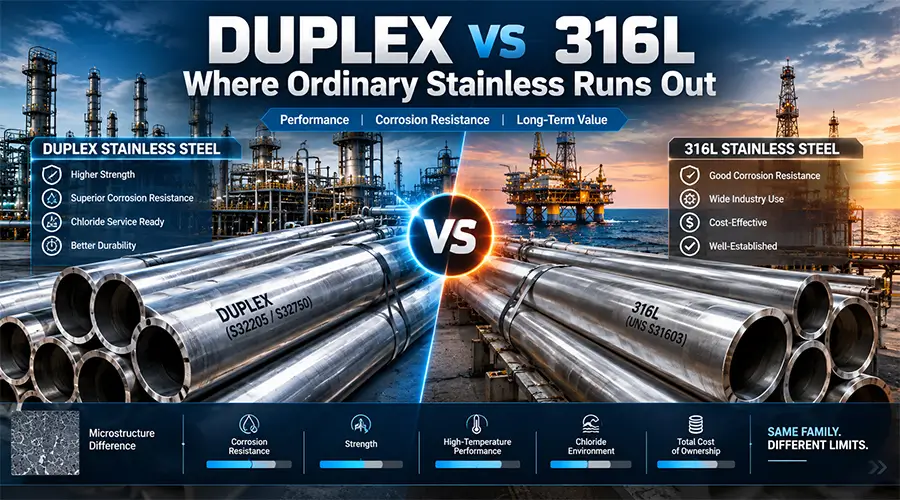
316L has a failure mode so well documented that insurers know it by heart: a warm, chloride-bearing line — often under insulation, often looking perfectly healthy — develops fine branching cracks and lets go without warning. Chloride stress-corrosion cracking has retired more “corrosion-resistant” stainless piping than rust ever did.
Duplex stainless steel pipe exists largely because of that failure mode. Grade 2205 duplex delivers roughly double 316L’s strength, far better resistance to chloride cracking and pitting — and, thanks to its lower nickel content, frequently a lower installed cost. Yet 316L remains the right answer for a wide band of services, and upgrading where it still wins wastes money and complicates fabrication.
This guide maps the boundary honestly: the three specific limits where 316L runs out, the numbers behind each, where 316L keeps the advantage, the cost arithmetic that surprises most buyers, and what to verify when purchasing either grade. Nakoda Steel Industry manufactures and exports both families from Mumbai; this comparison reflects how the choice is actually made on real line lists. (~185 words)
9. TABLE OF CONTENTS
- The Two Materials in One Minute
- Limit #1: Chloride Stress-Corrosion Cracking
- Limit #2: Pitting and Crevice Corrosion
- Limit #3: Strength and Wall Thickness
- The Comparison Table
- Where 316L Still Wins
- The Cost Arithmetic Nobody Expects
- Fabrication: What Changes When You Switch
- Buying Either Grade: Verification
- Key Takeaways
- FAQ
The Two Materials in One Minute
316L is the molybdenum-bearing austenitic workhorse: roughly 17% chromium, 10–13% nickel, 2–3% molybdenum, in a single-phase austenitic structure. It handles general chemical service, moderate chlorides, cryogenic temperatures, and hygienic applications — which is why it’s the default stainless pipe of the process industries. Our guide to the stainless seamless grades from 304 to 347H places it within the austenitic family.
Duplex stainless steel pipe — grade 2205 (UNS S32205/S31803) being the standard — is engineered to solidify as roughly half austenite, half ferrite: about 22% chromium, only 5% nickel, 3% molybdenum, plus deliberate nitrogen. Each phase covers the other’s weakness. The result: minimum yield strength around 450 MPa versus 316L’s ~170 MPa, and chloride resistance in a different class. Supply standard: ASTM A790 for duplex pipe, versus A312 for austenitics like the stainless seamless pipe range.
The short answer for the snippet hunters: choose duplex stainless steel pipe over 316L when chlorides and temperature stack up — warm seawater-adjacent service, brines, coastal cooling circuits, or any stressed chloride service above roughly 60°C — or when 316L’s low strength forces heavy walls. Keep 316L for high-temperature service above ~300°C, cryogenics, hygienic low-chloride duty, and wherever fabrication simplicity outweighs duplex’s advantages.
Now the three limits in detail — because the boundary is where the money is.
Limit #1: Chloride Stress-Corrosion Cracking — 316L’s Defining Weakness
Austenitic stainless steels share an Achilles heel: under tensile stress, in chloride environments, above roughly 50–60°C, they can crack — fast, branching, and with almost no visible corrosion beforehand. Residual welding stresses alone are enough tension; insulation that traps chloride-bearing moisture against hot pipe is the classic accelerant. This is the mechanism behind decades of failures in coastal plants, swimming-pool environments, and insulated process lines.
Duplex’s ferrite phase interrupts the cracking mechanism. Grade 2205 resists chloride SCC at temperatures and concentrations that destroy 316L — not immune at extremes, but the practical threshold moves from “warm” to “genuinely hot and concentrated.” For a Gulf-coast cooling circuit running at 70°C with chloride-bearing water, this single property is the entire decision: 316L there is not a budget option, it’s a scheduled failure.
The rule of thumb: stressed + chlorides + above ~60°C = 316L is out of its depth, whatever its pitting numbers say. SCC, not pitting, is usually the limit that bites first.
Limit #2: Pitting and Crevice Corrosion — The PREN Gap
Where SCC needs stress, pitting just needs chlorides and time. The comparative index is PREN (Pitting Resistance Equivalent Number = %Cr + 3.3×%Mo + 16×%N):
- 316L: PREN ≈ 24–26
- Duplex 2205: PREN ≈ 34–36
Ten PREN points is not an incremental improvement — it’s the difference between pitting onset in cool brackish water versus warm saline water. In critical pitting temperature testing, 2205 typically holds out to roughly 20°C higher chloride temperatures than 316L. For flange faces, backing-ring crevices, and under-deposit sites — where crevice corrosion starts earlier than open-surface pitting — the gap matters even more.
Practical reading: in low-chloride process service, 316L’s PREN is ample and duplex buys nothing. As chlorides climb toward seawater-adjacent levels, 316L pits first at crevices, then generally — and 2205 takes over. Past 2205’s own margin (hot concentrated brines, high-recovery desalination), the ladder continues to super duplex, which we’ve mapped separately in our duplex vs super duplex comparison.
Limit #3: Strength — Where 316L Costs You Tonnes
The least discussed limit is mechanical. 316L’s minimum yield strength is about 170 MPa; duplex 2205’s is about 450 MPa — 2.6 times higher. Under pressure-design rules, that difference flows straight into wall thickness: duplex lines are routinely specified one to two schedules thinner than the 316L they replace.
Thinner walls cascade through a project: less material purchased, less weight on supports and structures, smaller welds (weld volume falls roughly with the square of thickness), faster fit-up. On large-bore or high-pressure systems, the strength advantage alone can justify duplex before corrosion even enters the conversation.
Duplex 2205 vs 316L: The Comparison Table
| Property | 316L (S31603) | Duplex 2205 (S32205) |
| Structure | Austenitic | ~50/50 austenite-ferrite |
| Cr / Ni / Mo | ~17 / 11 / 2.5% | ~22 / 5 / 3% + N |
| PREN | ~24–26 | ~34–36 |
| Min yield strength | ~170 MPa | ~450 MPa |
| Chloride SCC resistance | Poor above ~60°C | Very good |
| Max service temperature | ~450°C+ (code-dependent) | ~250–300°C |
| Cryogenic capability | Excellent (to −196°C) | Limited (~−40 to −50°C) |
| Thermal expansion | High | ~30% lower (near carbon steel) |
| Pipe standard | ASTM A312 | ASTM A790 |
| Relative cost per kg | Nickel-dependent | Often comparable or lower (verify current) |
Where 316L Still Wins — and Duplex Is the Wrong Upgrade
An honest boundary runs both ways. Keep 316L (or step to other austenitics) when:
- Temperature exceeds ~300°C. Duplex’s ferrite embrittles in sustained service above roughly 250–300°C (“475°C embrittlement”). Hot service belongs to austenitics and chrome-moly grades — duplex is a strength-and-chlorides family, never a heat family.
- Service is cryogenic. 316L stays tough to liquid-nitrogen temperatures; duplex’s practical floor is around −40 to −50°C.
- Hygienic and high-purity duty — food, pharma, electropolished systems — where 316L’s surface finish ecosystem, fittings availability, and regulatory familiarity dominate.
- Chlorides are genuinely mild. Inland fresh-water and low-chloride chemical service pays duplex’s fabrication discipline for benefits it never collects.
- Fabrication network matters more than material. Every stainless shop welds 316L; duplex demands qualified procedures, controlled heat input, and phase-balance awareness. For small jobs through general fabricators, that gap is real money.
The common mistake in both directions: upgrading coastal 316L failures to… more 316L (“it lasted eight years, just replace it”), and conversely, specifying duplex for inland water duty because a brochure called it “superior.” Materials are promises matched to environments; both errors break the match.
The Cost Arithmetic Nobody Expects
Here’s the surprise that reshapes the decision: duplex 2205 often costs no more than 316L — and sometimes less.
The driver is nickel. 316L carries 10–13% nickel, duplex only ~5% — and nickel is the most volatile cost component in stainless pricing. When nickel runs high, 2205’s per-kilogram price converges with or undercuts 316L’s (market-dependent — verify current levels at quotation). Stack the strength advantage on top — one to two schedules thinner — and duplex’s installed cost frequently lands below the “cheaper” austenitic it replaces.
The honest full accounting adds duplex’s debits: stricter welding qualification, possible ferrite/A923 testing, and longer procurement for unusual sizes. For large chloride-service projects the arithmetic still favors duplex decisively; for a 40-metre utility line through a local fabricator, 316L’s simplicity can win on total cost even where duplex wins on metallurgy. Run the numbers per project — and make your supplier show both.
Fabrication: What Changes When You Switch to Duplex
Duplex welds well — differently. The 50/50 phase balance set by the mill’s solution anneal is locally re-decided by every weld, so the rules are: qualified procedures with controlled heat input, nitrogen-bearing shielding gas to hold austenite in the weld metal, interpass temperature discipline, and no post-weld stress relief (the temperatures that relieve stress are the temperatures that embrittle ferrite). Cold bending is fine; hot work is not, outside full re-solution-annealing.
None of this exceeds a competent shop’s reach — but it must be specified and audited, not assumed. A duplex system built with 316L habits can arrive with sigma phase or unbalanced welds that no visual inspection catches, which is why critical orders add ASTM A923 testing and ferrite measurement to the acceptance package.
Buying Either Grade: Verification That Matters
Visually, 316L and duplex 2205 are identical pipes — and the nickel-price games between grades make substitution profitable in both directions. The acceptance package Nakoda Steel Industry states on quotations for both families:
- EN 10204 3.1 certificates (3.2 with your agency) against the governing standard — A312 for 316L, A790 for duplex — with editions, no “equivalent” language
- Full chemistry on the MTC: for duplex, nitrogen reported (it’s the cheap element to skimp and the PREN’s multiplier); for 316L, molybdenum inside 2.00–3.00%
- Solution-annealing condition stated with temperature — for duplex, the quench locks the phase balance
- Ferrite content and ASTM A923 testing available for critical duplex service; ASTM G48 corrosion testing on request for seawater-class orders
- PMI at dispatch — the two-minute check that catches grade swaps both ways
- Heat numbers stamped on every length, matched to certificates
These mirror our supplier verification red-flags — with duplex’s phase-balance items added, because for this family the microstructure is as purchasable as the chemistry.
12. KEY TAKEAWAYS
- 316L runs out at three limits: chloride SCC (stressed + chlorides + ~60°C+), pitting (PREN ~25 vs duplex’s ~35), and strength (170 vs 450 MPa yield)
- Duplex stainless steel pipe (2205) answers all three — and lower nickel means its price often matches or beats 316L, before thinner walls are counted
- 316L keeps winning above ~300°C, in cryogenics, in hygienic service, in mild chlorides, and where fabrication simplicity rules
- Duplex’s ceiling is ~250–300°C — it is never the high-temperature answer
- Welding duplex is discipline, not difficulty: qualified procedures, nitrogen shielding, no stress relief
- Verify either grade with 3.1 certificates, stated solution anneal, nitrogen/Mo on the chemistry, A923/G48 where critical, and PMI at dispatch
13. FAQ
What is the difference between duplex stainless steel pipe and 316L?
316L is a single-phase austenitic stainless (~17Cr-11Ni-2.5Mo); duplex 2205 is half austenite, half ferrite (~22Cr-5Ni-3Mo+N). Duplex delivers roughly 2.6× the yield strength, PREN ~35 vs ~25, and far better chloride stress-corrosion cracking resistance — while 316L keeps the advantage in high-temperature, cryogenic, and hygienic service.
When should I use duplex instead of 316L?
When chlorides and temperature stack: coastal and seawater-adjacent cooling, brines, desalination circuits, stressed chloride service above ~60°C — or when 316L’s low strength forces uneconomically heavy walls. In mild-chloride, high-temperature, or cryogenic service, stay austenitic.
Is duplex stainless steel more expensive than 316L?
Often not. Duplex 2205 carries ~5% nickel versus 316L’s 10–13%, so when nickel prices are high its per-kg cost matches or undercuts 316L — and its strength permits thinner walls, lowering installed cost further. Fabrication requirements add back some cost; compare per project at current prices.
What is the temperature limit of duplex stainless steel pipe?
About 250–300°C for sustained service, limited by embrittlement of the ferrite phase, with a practical low-temperature floor around −40 to −50°C. Outside that window, austenitic grades or chrome-moly steels take over.
Why does 316L crack in chloride service?
Austenitic stainless under tensile stress — welding residual stress is enough — suffers chloride stress-corrosion cracking above roughly 50–60°C, commonly under insulation or in coastal atmospheres. The cracks branch through the wall with little visible corrosion, which is why failures arrive without warning.
What is PREN and how do 316L and duplex compare?
PREN (= %Cr + 3.3×%Mo + 16×%N) indexes pitting resistance. 316L scores about 24–26; duplex 2205 about 34–36 — roughly a 20°C improvement in critical pitting temperature, and a decisive margin at crevices and deposits.
What standard covers duplex stainless steel pipe?
ASTM A790/A790M for seamless and welded duplex pipe (A789 for tube), with ASTM A923 for intermetallic-phase testing and G48 for pitting/crevice testing. 316L pipe is covered by ASTM A312. Sour service for both follows ISO 15156/NACE MR0175.
Can duplex pipe be welded like 316L?
It welds well, but not identically: qualified procedures with controlled heat input, nitrogen-bearing shielding gas, interpass control, and no post-weld stress relief — the phase balance that defines duplex is re-decided at every weld.
What is lean duplex?
Lower-alloyed duplex grades (S32101, S32304/2304) with reduced nickel and molybdenum — PREN between 316L and 2205 — used where duplex strength and SCC resistance are wanted at minimum cost. The same fabrication rules apply.
14. CONCLUSION
The duplex-vs-316L question has a clean answer once it’s asked properly: not “which is better,” but where does ordinary stainless run out — and the three limits are specific. Stressed chlorides above ~60°C, PREN-level pitting exposure, and strength-driven wall thickness each mark a boundary past which 316L stops being economical and starts being temporary. Duplex stainless steel pipe owns the territory beyond those lines at a price that increasingly undercuts the grade it replaces; 316L owns the heat, the cold, and the simple jobs. Nakoda Steel Industry supplies both — and a supplier who stocks both sides of the boundary has no reason to push you across it unnecessarily.
15. CALL TO ACTION
Facing a chloride-service material decision — or replacing a 316L line that cracked? Send Nakoda Steel Industry your service conditions, chloride levels, and line list. Within 24 working hours you’ll receive a grade recommendation with the reasoning stated — 316L, duplex 2205, or super duplex if the numbers demand it — and a quotation with solution-annealing, testing, and PMI commitments in writing.