

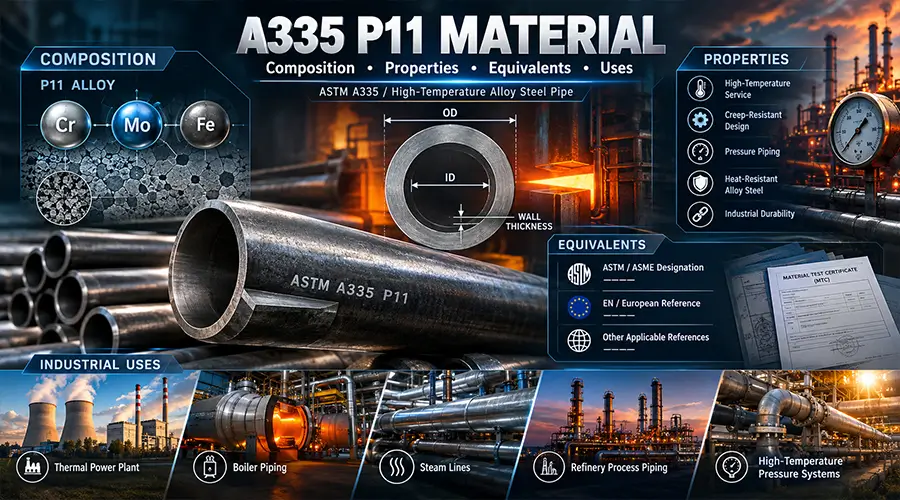
Search “P11 material” and you’ll find plenty of pages that copy the same chemistry table and stop. But P11 appears on line lists as pipe, tube, forgings, and plate — under four different ASTM specifications — and the buyers asking “what is P11?” usually need the connections, not just the numbers.
So here is the complete answer. A335 P11 material is a seamless ferritic alloy steel pipe grade containing roughly 1.25% chromium and 0.5% molybdenum, built for high-temperature service up to about 540°C. It sits one step above carbon steel on the alloy ladder and one step below P22 — and it is probably the most widely stocked alloy pipe grade in the world.
This reference covers the full chemistry and mechanical property tables, the equivalent grades across EN, DIN, and JIS systems, how P11 relates to T11 and F11, heat treatment and welding requirements, where the grade is actually used, and what to verify when buying it. Nakoda Steel Industry manufactures and exports A335 P11 pipe from Mumbai; this page reflects the specification as we certify it
What Is A335 P11 Material?
A335 P11 is a chromium-molybdenum (“chrome-moly”) alloy steel grade for seamless pipe, defined in ASTM A335/A335M, containing 1.00–1.50% chromium and 0.44–0.65% molybdenum. The chromium provides oxidation resistance and shuts down graphitization; the molybdenum provides creep strength — the ability to carry stress at temperature for decades without slow deformation.
The “P” simply means pipe within the A335 system. The same 1¼Cr-½Mo chemistry appears as T11 (boiler tube, ASTM A213), F11 (forged fittings and flanges, ASTM A182), and Grade 11 plate (ASTM A387) — one alloy, four product forms. That family view matters, because a single refinery package often contains all four.
On the alloy ladder, P11 occupies the sweet spot: meaningfully more capable than carbon steel (we mapped that boundary in our A106 vs A335 guide), cheaper and easier to fabricate than P22, and free of the sulfidation-driven logic that pushes refiners to P5 and P9.
A335 P11 Chemical Composition
Per ASTM A335/A335M (verify against the current edition you certify to)
| Element | Requirement (%) |
|---|---|
| Carbon (C) | 0.05 – 0.15 |
| Manganese (Mn) | 0.30 – 0.60 |
| Phosphorus (P) | 0.025 max |
| Sulfur (S) | 0.025 max |
| Silicon (Si) | 0.50 – 1.00 |
| Chromium (Cr) | 1.00 – 1.50 |
| Molybdenum (Mo) | 0.44 – 0.65 |
Three practical notes an engineer reads out of this table. The low, bounded carbon keeps the grade weldable while still forming the carbides that carry creep strength. The high silicon (unusual — most A335 grades allow far less) adds oxidation resistance. And the Cr-Mo windows are what PMI verification checks at dispatch: material at 0.95% Cr is not P11, however close it looks.
A335 P11 Mechanical Properties
| Property | Requirement |
|---|---|
| Tensile strength, min | 415 MPa (60 ksi) |
| Yield strength, min | 205 MPa (30 ksi) |
| Elongation, min (longitudinal) | 30% |
| Density | ~7.85 g/cm³ (same as carbon steel) |
Two things surprise first-time specifiers. At room temperature, P11’s minimums are identical to A106 Grade B carbon steel — you don’t buy P11 for ambient strength. Its entire value appears in the ASME allowable-stress tables at temperature, where P11 keeps usable stress deep past the point carbon steel’s collapses. Second, density is unchanged: alloy pipe weighs what carbon pipe weighs, so standard weight charts apply.
Heat Treatment Requirements
A335 permits P11 to be supplied full-annealed, isothermally annealed, or normalized and tempered — with a minimum tempering temperature of approximately 650°C (1200°F). Normalized-and-tempered is the common commercial condition.
This is not paperwork trivia. The heat treatment precipitates and stabilizes the carbides that deliver P11’s creep strength; chemistry alone is half a specification. The certificate should state the actual condition and temperatures — and for critical service, ask for the furnace time-temperature chart, a document only a real manufacturer possesses.
P11 Equivalent Grades: EN, DIN, JIS — and the T11/F11 Family
The cross-reference buyers actually need:
| System | Equivalent grade | Notes |
|---|---|---|
| EN 10216-2 | 13CrMo4-5 (1.7335) | The working European equivalent |
| DIN (legacy) | 13CrMo44 | Predecessor of the EN grade |
| JIS G3458 | STPA 23 | Japanese alloy pipe system |
| ASME | SA-335 P11 | Same spec, ASME adoption — required for Code-stamped work |
| Same alloy, other forms | T11 (A213 tube) · F11 (A182 forgings) · A387 Gr 11 (plate) | One chemistry, four product standards |
Two cautions that prevent real purchasing errors. “Equivalent” means comparable, not interchangeable: 13CrMo4-5 and P11 have slightly different composition windows and testing regimes, so a project specified to ASTM should be certified to ASTM — dual-certified material (A335/SA-335, sometimes with EN) is the clean solution. And F11 carries classes (F11 Class 1/2/3 differ in strength); matching flanges to P11 pipe means naming the class, not just the grade.
Temperature Limits and Where A335 P11 Material Is Used
P11’s practical service window runs from roughly 425°C — where carbon steel’s graphitization and creep problems begin — up to about 540°C, where P22’s higher creep strength takes over. (Those boundaries, and what happens at them, are the subject of our P11 vs P22 comparison, which the two grades’ allowable-stress curves decide.)
Where that window places it in the real world:
- Power plants — main steam and hot reheat piping in subcritical units, boiler headers and connecting pipework
- Refineries — furnace piping, hot oil circuits, hydrogen-service lines within P11’s Nelson-curve envelope, transfer lines in clean (low-sulfur) hot services
- Petrochemical plants — reactor and heater circuits in the 450–540°C band
- HRSGs and cogeneration — superheater and economizer interconnecting pipe
What P11 is not for: aggressively sour hot streams (that’s P5/P9 territory — see P9 vs P11), service above ~540°C (P22 upward), and wet corrosive service where stainless logic governs. A grade is a promise matched to an environment; P11’s promise is clean heat.
Welding P11
P11 welds routinely, with three disciplines: preheat (typically 150–200°C depending on thickness), matching low-hydrogen consumables (E8018-B2 class for SMAW), and post-weld heat treatment commonly in the 650–720°C range per the governing code. Unlike the 5–9% chromium grades, P11 is not severely air-hardenable — one reason it remains the default where fabrication happens in field conditions rather than controlled shops.
Buying A335 P11: The Verification Checklist
Everything above assumes the pipe is what its paper says. The checks that confirm it — standard practice at Nakoda Steel Industry and worth demanding from any supplier:
- EN 10204 3.1 certificate (3.2 with your chosen agency) stating A335/SA-335 with editions — no “equivalent” language
- Full chemistry on the MTC, with Cr and Mo inside the windows above
- Heat-treatment condition and temperatures stated; furnace charts on request
- Heat numbers stamped on every length, matching the certificate
- PMI at dispatch — P11 is visually identical to carbon steel and to every other chrome-moly grade; the two-minute XRF check is what makes a mixed order safe
- Hydrostatic/NDE per A335, with tensile and flattening results per lot
These are the same disciplines in our supplier red-flags guide — P11’s popularity makes it the most-faked grade in the family, precisely because demand is deepest.
KEY TAKEAWAYS
- A335 P11 = 1¼% Cr, ½% Mo seamless alloy pipe for high-temperature service, practically 425–540°C
- Room-temperature strength matches carbon steel; the value lives in the allowable-stress tables at temperature
- Supplied annealed or normalized & tempered, minimum temper ~650°C — the heat treatment is half the specification
- Equivalents: 13CrMo4-5 (EN), STPA 23 (JIS); same alloy as T11 tube, F11 forgings, A387 Gr 11 plate
- Welds routinely with preheat, B2 consumables, and PWHT — the most field-friendly grade in the chrome-moly family
- Verify with 3.1 certificates, stated heat treatment, stamped heat numbers, and PMI at dispatch
FAQ
What is P11 material?
P11 is a chromium-molybdenum alloy steel pipe grade (1.00–1.50% Cr, 0.44–0.65% Mo) defined in ASTM A335 for seamless pipe in high-temperature service, typically used between about 425°C and 540°C in power plants and refineries.
What is the chemical composition of A335 P11?
Carbon 0.05–0.15%, manganese 0.30–0.60%, silicon 0.50–1.00%, chromium 1.00–1.50%, molybdenum 0.44–0.65%, with phosphorus and sulfur each limited to 0.025%, per ASTM A335/A335M.
What are the mechanical properties of P11 pipe?
Minimum tensile strength 415 MPa (60 ksi), minimum yield strength 205 MPa (30 ksi), and minimum longitudinal elongation of 30% — the same room-temperature minimums as A106 Gr B carbon steel; P11’s advantage appears at elevated temperature.
What is the equivalent of P11 in European standards?
13CrMo4-5 (material number 1.7335) under EN 10216-2, descended from DIN 13CrMo44. The Japanese equivalent is STPA 23 under JIS G3458. Equivalents are comparable, not automatically interchangeable — certify to the specification your project names.
What is the difference between P11, T11, and F11?
Same 1¼Cr-½Mo alloy, different product forms and standards: P11 is seamless pipe (A335), T11 is boiler/heat-exchanger tube (A213), and F11 is forgings — flanges and fittings — under A182, where class (1, 2, or 3) must also be specified.
What is the maximum temperature for P11 pipe?
Practically about 540°C for long-term service, set by its allowable-stress curve in ASME B31.1/B31.3; above that, P22 becomes the economical choice. Always confirm against the current code tables for your exact pressure and design life.
Is A335 P11 the same as SA-335 P11?
The same specification: A335 is ASTM’s original and SA-335 is ASME’s adoption in BPVC Section II, required for Code-stamped boiler and vessel work. Quality mills supply dual-certified material covering both.
Does P11 pipe require post-weld heat treatment?
In most code applications, yes — PWHT typically in the 650–720°C range per the governing code and thickness, with preheat of roughly 150–200°C during welding and low-hydrogen B2-class consumables.
What is P11 pipe used for?
Main steam and reheat piping in power plants, refinery furnace and hot-oil circuits, petrochemical heater piping, and HRSG interconnections — clean high-temperature services in the 425–540°C band.
How do you verify genuine P11 material?
Check the EN 10204 3.1 certificate for full chemistry and stated heat treatment, match stamped heat numbers to the paperwork, and run PMI (XRF) at dispatch — P11 is visually identical to carbon steel, so only the chromium reading proves the grade.
CONCLUSION
A335 P11 material earns its position as the world’s default alloy pipe grade honestly: enough chromium to end carbon steel’s high-temperature problems, enough molybdenum to carry stress to 540°C, and a fabrication temperament forgiving enough for field conditions. The specification is simple — a chemistry window, a strength floor, a furnace requirement. The discipline is making sure the pipe in your yard actually embodies all three, which is a documents-and-PMI exercise, not a visual one. Nakoda Steel Industry certifies P11 exactly as this page describes it, because a reference is only useful if the product behind it matches.