

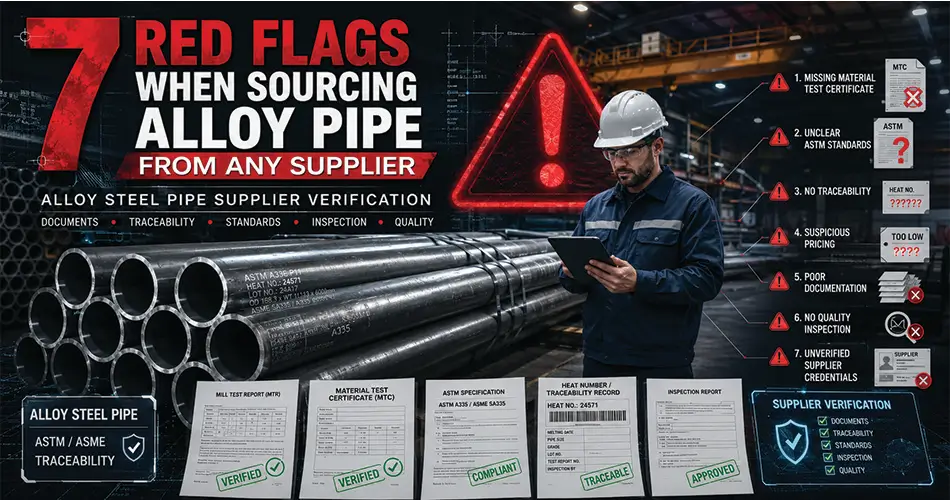
Here’s an uncomfortable truth about the alloy pipe trade: a P22 pipe and an A106 carbon steel pipe are visually identical. Same black finish, same bevels, same weight in the hand. The 2¼% chromium that justifies double the price is invisible — detectable only by a spectrometer or the twenty-year difference in how the pipe dies.
That invisibility is the business model of every bad supplier in this market. And the market knows it: fake mill certificates are common enough that PMI testing — shooting pipe with an XRF gun to check what’s actually in it — has become standard practice at serious fabricators worldwide.
The good news: every deception in this trade telegraphs itself before you pay, if you know what to look for. Below are the seven red flags we’d tell our own procurement team to watch for — and the one-email test that exposes each. Yes, Nakoda Steel Industry is a supplier telling you how to interrogate suppliers. Run every test on us too. That’s rather the point.
Red Flag #1: The Word “Equivalent” Anywhere Near a Certificate
“Equivalent to A335 P11.” “SA-335 equivalent material.” “As per equivalent standard.”
There is no such thing. A certificate states compliance with a named specification and edition, or it doesn’t — and “equivalent” is the word suppliers use when the pipe was made to something else, tested to something less, or bought from somewhere unknown. The same logic applies to grades: a spec is chemistry plus heat treatment plus testing, and “equivalent chemistry” silently drops two-thirds of that.
The test: ask, in writing, “Will the MTC state ASTM A335/A335M and ASME SA-335, with editions, with no equivalence language?” A real mill answers yes in one line.
Red Flag #2: Heat Numbers That Don’t Connect to Anything
Traceability is a chain: melt → heat number → test results → certificate → physical stamp on each pipe. Break any link and the certificate describes some pipe — just not provably yours.
Watch for certificates without heat numbers, heat numbers on paper but nothing stamped on the steel, “bundle-level” marking on a critical order, or — the classic — a certificate dated before your order that happens to match your exact quantity.
The test: ask for photos of the actual stamped heat numbers on your consignment before dispatch, and check them against the MTC line by line. Ten minutes. We photograph stamps as standard at our works; any manufacturer can.
Red Flag #3: Hesitation on Third-Party Inspection or PMI
This one is nearly diagnostic. Tell a supplier you’ll send SGS, BV, or TÜV to witness testing, or that your inspector will PMI the load at stuffing — then watch the response.
A manufacturer with real production shrugs: inspection is a normal Tuesday. A relabeling operation starts negotiating — “inspection will delay shipment,” “PMI isn’t necessary, you have the certificate,” “additional charges apply for witnessing.” Each excuse is the answer to your real question.
The test: put “third-party inspection at buyer’s option, PMI at dispatch on request” in your enquiry and see if it survives into their quotation unchanged. On Nakoda Steel Industry’s alloy pipe quotations, it’s printed before you ask.
Red Flag #4: No Furnace Charts — Because There’s No Furnace
For chrome-moly grades, heat treatment is the product. A335 requires specific normalizing and tempering; skip it or botch it and you get pipe with compliant chemistry and wrong metallurgy — hard, brittle, and primed to crack in your welder’s hands. We’ve written about why this matters grade by grade in our P11 vs P22 guide.
Here’s the sourcing implication: a trader reselling unknown pipe cannot produce time-temperature furnace records, because they never saw a furnace. So they deflect — “records are proprietary,” “not normally provided,” “available for extra cost.”
The test: one line in your enquiry: “Heat-treatment charts to be furnished with shipping documents.” A mill attaches a PDF. A middleman writes a paragraph explaining why not.
Red Flag #5: A Price That Ignores the Alloy Surcharge Arithmetic
Alloy pipe pricing has a floor made of physics. P22 contains roughly 2¼% chromium and 1% molybdenum — and molybdenum alone has traded between $25 and $40+ per kg in recent years. The alloy content, the mandatory heat treatment, and the testing regime set a real cost base above carbon steel.
So when one quote lands 25–30% under every other manufacturer’s, it isn’t negotiating skill. It’s telling you what’s missing: the chromium, the temper, the testing — or all three. Somebody’s carbon steel is about to become your “P22.”
The test: get three quotes from actual manufacturers. Treat the outlier with suspicion proportional to the gap, and PMI whatever you buy. (The same arithmetic applies to stainless — nickel doesn’t discount either, as we noted in our stainless seamless pipe guide.)
Red Flag #6: A Supplier You Can’t Actually Locate
The template is familiar: a polished website, stock photos of someone else’s mill, a “factory” address that maps to an office tower, and every request for a video walkthrough politely postponed.
None of that proves fraud. All of it prevents verification — and in this trade, unverifiable and unacceptable are the same word. Export buyers in the Gulf and Africa are the primary targets here precisely because a site visit means an international flight.
The test: ask for a live video call from the production floor showing your grade in process, or commission a local inspection agency for a one-day facility audit ($300–600 in India — the cheapest insurance in this industry). A real works says yes by return mail.
Red Flag #7: Payment Pressure Plus Paperwork Resistance
The final flag is behavioral. Watch for 100% advance payment demanded to a bank account whose name doesn’t match the company, discounts that expire “today only,” refusal to work under a letter of credit, and sudden flexibility on every technical requirement the moment you question the price. Genuine mills have credit terms, matching bank details, and no fear of documents — because an LC that pays against a 3.1 certificate, inspection release, and packing list is simply a description of doing the job properly. And the packing itself tells the same story: a supplier vague about export packing and loading photos is vague about everything upstream of it too.
The test: propose payment terms where documents trigger money. The reaction is the audit.
“This Sounds Paranoid — Won’t Suppliers Be Offended?”
The objection we hear most, especially from first-time importers. The answer: run these seven tests and observe who gets offended.
Legitimate manufacturers prefer buyers who verify — you’re cheaper to serve than buyers who claim damage later, and your PMI gun protects us from being undercut by fakes wearing our specifications. The only parties disadvantaged by verification are the ones failing it. In fifteen years of exporting, no serious buyer has lost a good supplier by asking for furnace charts. Several have lost fortunes by not asking.
Takeaway — the 7 tests, one enquiry email
- Named spec + edition on MTC, no “equivalent” ✓
- Stamped heat numbers photographed before dispatch ✓
- Third-party inspection + PMI accepted in the quotation ✓
- Furnace charts furnished with documents ✓
- Three manufacturer quotes; distrust the outlier ✓
- Video walkthrough or $500 local audit ✓
- Documents-against-payment terms accepted ✓
Total cost: one email and a phone call. Total protection: the whole order.
The Pipe Can’t Lie — But You Have to Ask It
Every fake in this industry survives on one assumption: that the buyer will trust paper over metal. The seven flags above all reduce to a single discipline — arrange things so the metal gets a vote, through stamps, spectrometers, furnaces, and inspectors, before the money moves.
Sourcing chrome-moly or stainless pipe for your next project? Send Nakoda Steel Industry your enquiry with all seven tests included — copy the checklist above straight into your email if you like. Our quotation will answer every one of them in writing, within 24 working hours. Suppliers who welcome the interrogation are the ones you were looking for.