

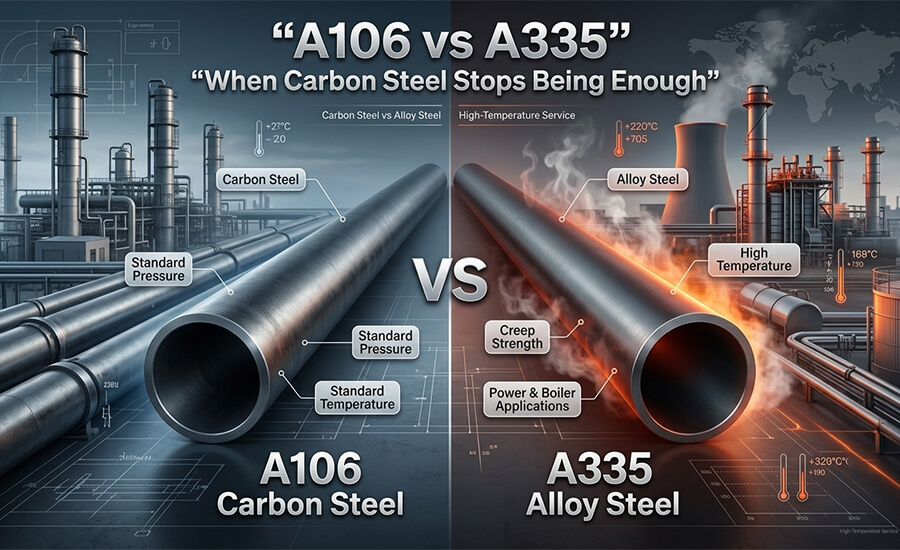
ASTM A106 is titled “Seamless Carbon Steel Pipe for High-Temperature Service.” Read quickly, that title has talked thousands of buyers into a mistake — because the standard tells you what the pipe is made of, not how hot it can safely run for twenty years.
The honest answer lives in a different document: the ASME allowable-stress tables. And those tables show carbon steel’s strength falling away steeply as metal temperature climbs past roughly 400–425°C, while a second family of problems — graphitization, oxidation scaling, creep — begins queuing up behind it.
Somewhere on that slope, A106 stops being the economical choice and starts being the risky one. This post shows you where that line sits, what actually degrades carbon steel above it, how the A335 chrome-moly grades solve each mechanism, and a temperature-band decision table you can apply to a real line list today. Nakoda Steel Industry manufactures and exports, so we have no incentive to upsell you from one to the other — only to see the right pipe in the right service.
What Each Standard Actually Covers
ASTM A106 covers seamless carbon steel pipe in Grades A, B, and C. Grade B is the global workhorse: roughly 0.30% max carbon, minimum tensile strength of 415 MPa, found in steam, water, process, and utility lines in every refinery and power plant on earth.
ASTM A335 covers seamless ferritic alloy pipe — the chrome-moly family (P1, P11, P22, P5, P9, P91 and others) — where chromium and molybdenum are added specifically to keep strength and stability at temperatures where plain carbon steel loses both.
Same seamless construction. Same pressure-piping world. Different chemistry, built for different thermal territory.
Also Read : astm-a335-alloy-steel-grade-p1-p11-p22-manufacturer-exporter/
Why Carbon Steel Fails at Temperature: Three Mechanisms
The A106-to-A335 transition isn’t one problem — it’s three arriving together.
1. Strength falls off a cliff
Steel’s allowable design stress is set by codes like ASME B31.1 and B31.3, and for carbon steel those values decline sharply beyond about 400°C. Practically: a line that needed Schedule 40 at 350°C may need dramatically heavier wall — or simply exceed code limits — a hundred degrees hotter. Above roughly 425°C, time-dependent creep begins governing, and carbon steel’s creep resistance is poor. Chrome-moly alloys hold usable strength far deeper into that range, which is why an alloy pipe at temperature can actually be thinner and lighter than the carbon-steel pipe it replaces.
2. Graphitization: the slow conversion
Hold carbon steel above roughly 425–440°C for years, and its strengthening carbides can slowly decompose into graphite nodules — often concentrated in weld heat-affected zones, creating brittle planes. API’s damage-mechanism guidance (API RP 571) flags graphitization as a known risk for carbon and carbon-moly steels in long-term service above approximately 427°C (800°F). The insidious part: the pipe looks perfect. The damage is microstructural, cumulative, and discovered either by inspection metallography or by failure. Chromium additions from about 1% upward — the P11 threshold — effectively shut the mechanism down.
3. Oxidation scaling
Above roughly 425–450°C in air or steam, carbon steel scales at an accelerating rate — losing wall thickness on the outside while the process consumes it from the inside. Chromium forms a tighter, protective oxide: 1¼% Cr (P11) improves it markedly, 2¼% (P22) more again.
Three mechanisms, one threshold band. That’s why experienced piping engineers treat ~425°C as the practical ceiling for long-term A106 service, whatever the standard’s title implies.
Also Read : p11-vs-p22-alloy-steel-pipe/
The Decision Table: Match the Band to the Grade
| Design metal temperature | Sensible specification | Why |
| Up to ~400°C | A106 Gr B | Full strength, no active degradation — alloy is wasted money here |
| ~400–425°C | A106 Gr B/C — case by case | Code-permissible; check wall economics and expected life; many buyers step up early |
| ~425–470°C | A335 P1 (C-½Mo) | Mo restores creep strength; note P1’s own graphitization ceiling near ~470°C |
| ~470–540°C | A335 P11 (1¼Cr-½Mo) | Chromium ends graphitization, adds oxidation resistance; the global mid-range workhorse |
| ~540–580°C | A335 P22 (2¼Cr-1Mo) | Higher creep-rupture strength; the superheater/reheater standard |
| Above ~580°C | P91 and beyond | 9% Cr territory — a separate selection conversation |
(Bands are practical engineering ranges. Always confirm allowable stresses against the current ASME B31.1/B31.3 edition for your exact conditions — pressure, life, and cycling move the lines.)
Two Middle East–specific notes, since Gulf refineries and power plants drive much of this decision globally:
Hydrogen service moves the line down. In hydroprocessing units, high-temperature hydrogen attack limits carbon steel well below its thermal ceiling — the API RP 941 “Nelson curves” push refiners into C-½Mo and chrome-moly grades at temperatures where strength alone would still permit A106. If your line carries hot hydrogen, the A335 conversation starts earlier.
Steam cycling counts. Combined-cycle and cogeneration plants across the region cycle daily. Thermal cycling accelerates every mechanism above; a line that survives base-load service at 420°C ages faster when it swings. Cycling plants sensibly buy the alloy margin.
Also Read : stainless-steel-bolts-vs-grade-5
What the Upgrade Actually Costs
Here’s where the sharp opinion belongs: buyers overweight the price-per-tonne difference and underweight everything else.
Yes, A335 P11 typically costs on the order of 1.5–2.5× A106 Gr B per tonne, and P22 more again — exact multiples move with alloy surcharges, size, and market. But three offsets shrink the real gap:
- Thinner walls at temperature. Higher allowable stress can cut the required schedule, clawing back tonnes.
- The piping is a fraction of the project. Line pipe is typically single-digit percent of an installed unit cost; the flanges, fittings, welding, insulation, and labor around it dwarf the material delta.
- One retrofit erases decades of “savings.” Replacing a graphitized carbon-steel steam line in a running plant — shutdown, scaffolding, PWHT, reinspection — costs multiples of having bought P11 on day one.
The cheap pipe is the one that matches the service. Sometimes that genuinely is A106 — and a supplier should say so.
“Our Plant Has Run A106 Above 425°C for Years — Nothing’s Happened”
The most common pushback, and it deserves a straight answer.
Plenty of carbon-steel lines run modestly above the threshold for years without visible trouble — because graphitization and creep are time-dependent. Twenty years of margin consumed is invisible from the outside; API 571 exists precisely because these mechanisms surface late. “Nothing has happened” and “nothing is happening” are different statements, and only metallographic sampling can tell them apart.
If you’re operating legacy A106 in that band: don’t panic, but do put those lines on an inspection program (hardness surveys, in-situ replication at welds) — and specify chrome-moly when they’re eventually replaced. If you’re designing new: the band-table above already answers the question more cheaply than any future inspection program will.
Buying Either Family: The Checks That Matter
Whether your line list says A106 Gr B or A335 P22, the verification discipline is identical, and Nakoda Steel Industry commits to it on every quotation:
- EN 10204 3.1 certificates with heat numbers marked on every length (3.2 with your chosen agency — SGS, BV, TÜV)
- Spectro-verified chemistry per heat — for A335, confirming Cr and Mo sit inside the band, not at a “close enough” edge
- Heat-treatment records for alloy grades (A335 requires specific normalizing/tempering; the furnace chart is the proof)
- PMI at dispatch on request — two minutes with an XRF gun prevents the classic mixed-bundle error where carbon and alloy pipe of the same size share a yard
- Export program : sizes , schedules , lead times , regular consignments to the UAE, Saudi Arabia, Qatar, Oman, and wider markets (verify figures before publish)
That last check deserves emphasis for mixed orders: A106 and A335 pipe look identical. Paint stripes fade. Only stamped heat numbers plus PMI keep a P11 line from being built, invisibly, out of carbon steel.
Takeaway — the 60-second A106/A335 decision
- Below ~400°C metal temperature → A106 Gr B, and keep your money
- ~425°C is carbon steel’s practical long-term ceiling: strength, graphitization, and scaling all converge there
- 425–540°C → P1/P11 by band; 540–580°C → P22
- Hot hydrogen service? Nelson curves move you to alloy earlier
- Mixed carbon/alloy order? PMI at dispatch, every time
- Legacy A106 above the line isn’t an emergency — it’s an inspection item and a replacement spec
The Title of a Standard Is Not a Design Limit
A106’s title promises high-temperature service; the stress tables define it. Somewhere around 425°C, the two quietly part company — and the buyers who know that number specify once, while the ones who don’t specify twice.
Working a line list with services on both sides of that line? Send Nakoda Steel Industry your sizes, design temperatures, and service descriptions. You’ll get a combined A106/A335 quotation within 24 working hours — with our testing, certification, and PMI commitments in writing, and an honest note anywhere carbon steel is genuinely all you need.
Sources and further reading:
- ASTM International, A106/A106M — Standard Specification for Seamless Carbon Steel Pipe for High-Temperature Service
- ASTM International, A335/A335M — Standard Specification for Seamless Ferritic Alloy-Steel Pipe for High-Temperature Service
- ASME B31.1 Power Piping and B31.3 Process Piping — allowable stress tables (current editions)
- API RP 571, Damage Mechanisms Affecting Fixed Equipment in the Refining Industry — graphitization, creep, oxidation
- API RP 941, Steels for Hydrogen Service at Elevated Temperatures (Nelson curves)