

Fire Tube vs. Water Tube Boilers: Which Type Is Right for Your Industry?
Choosing a boiler is one of the most critical long-term decisions a facility manager makes, impacting everything from daily operational efficiency to safety and capital cost. The two primary boiler architectures—Fire Tube and Water Tube—are fundamentally opposed in their design, meaning the selection process is less about which is “better” and more about which is the optimal match for your specific industrial requirements for capacity, pressure, and load profile.
At Nakoda Steel Industry, we recognize that the safety and longevity of your boiler system, regardless of its type, depend on the integrity of the core components. That includes supplying certified,
high-quality boiler tubes that withstand the demands of intense heat and pressure.
1. Defining the Core Difference in Design
The classification of a boiler is determined by where the water and the hot combustion gases are housed.
Fire Tube Boilers
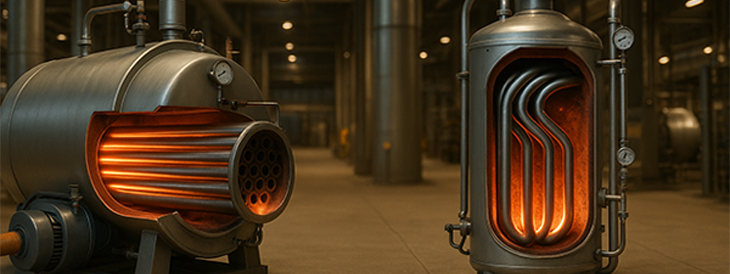
In a fire tube boiler, the hot combustion gases produced by the burner are passed through a series of small tubes. These tubes are contained within a large, pressurized cylindrical shell, which is filled with water. The heat transfers from the gas inside the tubes to the surrounding water, converting it into steam. This design dates back to the eighteenth century.
Water Tube Boilers
Water tube boilers operate in the inverse manner: water is circulated inside a network of tubes. The hot combustion gases flow around the outside of these tubes within the furnace. This inversion allows for the safe generation of higher pressures and capacities.
2. Performance and Application Comparison
The choice between the two types is governed by four primary factors: pressure, capacity, load response, and cost.
The Fire Tube Boiler: Economy and Stability
Fire tube boilers are typically the more common choice for small and medium-sized industrial applications.
Advantages:
- Lower Initial Cost: Fire tube boilers have a simple construction and manufacturing process, resulting in a lower initial capital cost.
- Simplicity and Compactness: They feature a simple design that is robust, often available as packaged systems, which makes installation simpler. They are generally more compact for lower capacitance, and maintenance is considered easier and cheaper.
- Load Handling: The large volume of water in the shell creates a significant steam reserve, allowing the boiler to handle a sudden, sharp, but temporary load surge effectively with only a minimal pressure drop.
Limitations & Applications:
Fire tube boilers are structurally limited by the large diameter of their shell, restricting them to lower operating pressures, usually below 350 psig. Furthermore, heating the large water volume means they have a relatively slow startup time, often requiring an hour or more to reach operating pressure from a cold start.
They are best suited for industries with low to medium steam demand and steady loads, such as food processing, commercial heating, hospitals, and light manufacturing like textiles.
The Water Tube Boiler: Power and Agility
Water tube boilers are the necessary choice for heavy industry and utility-scale power generation.
Advantages:
- High Pressure and Capacity: Due to the small diameter of the tubes, water tube boilers can withstand much higher internal pressures. They routinely operate at pressures up to 160 bar and can reach 5,000 psig or higher in power generation. They are the only choice for applications requiring massive steam output (well over 1,500,000 lb/hr) or superheated steam.
- Rapid Response: Containing a relatively small volume of water, water tube boilers have low thermal inertia. This allows them to raise steam much faster (5 to 20 minutes from a cold start) and quickly adjust their firing rate to follow continuously fluctuating loads.
- Safety: The containment of pressure within small tubes inherently makes water tube boilers safer against a catastrophic Boiling Liquid Expanding Vapor Explosion (BLEVE), as any failure is typically localized to a single tube.
Limitations & Applications:
The complexity of the water tube design results in a significantly higher capital cost and complex, time-consuming on-site assembly for large units. Critically, water tube boilers are extremely sensitive to water quality and require sophisticated and rigorous (and often expensive) water treatment to prevent scaling and subsequent tube failure due to high heat flux.
They are necessary for applications like electric power generation, petrochemical refineries, pulp and paper mills, and large district heating systems.
3. The Nakoda Steel Industry Commitment: Quality Components for Every Boiler
Whether your facility requires the robust stability of a fire tube boiler or the high-pressure capability of a water tube system, the efficiency and safety of your operation are defined by the quality of the materials used.
The intensive conditions within any industrial boiler demand materials that meet stringent regulatory standards, such as those governed by the ASME Boiler and Pressure Vessel Code (BPVC). At Nakoda Steel Industry, we understand that these systems rely on precision-engineered boiler tubes that can handle sustained temperature and pressure without compromise.
We are leading boiler tube suppliers and a trusted boiler tube distributor, specializing in high-grade materials required for both low-pressure fire tube systems and the alloy steels necessary for high-pressure water tube applications. We offer certified boiler tubes for sale to ensure maximum heat transfer, minimal maintenance disruption, and guaranteed compliance for your facility.
Don’t compromise on the integrity of your heat exchange surface. Partner with Nakoda Steel Industry for reliable, high-performance boiler components.