

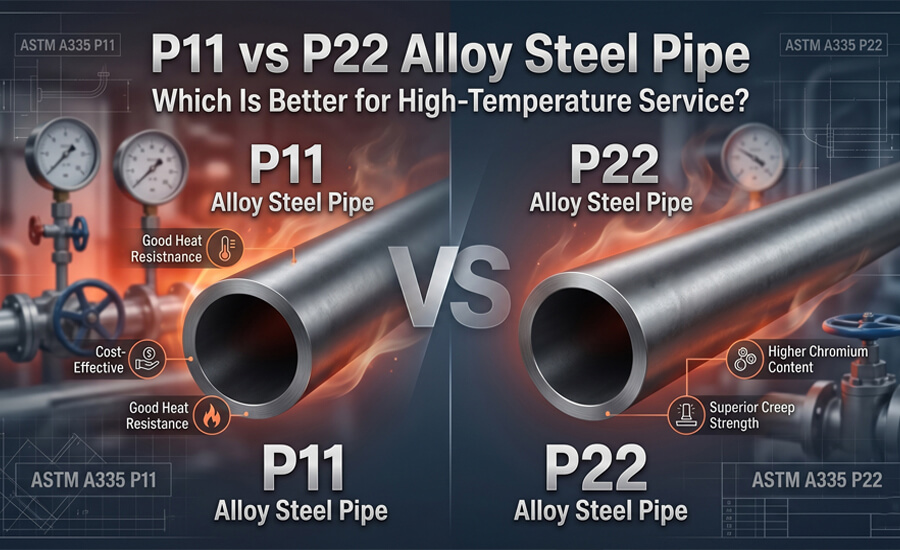
P11 vs P22 is one of the most common comparisons in alloy steel piping. Both are chromium-molybdenum steels used in high-temperature service, but they are not the same. P22 offers higher heat resistance and strength, while P11 is a more economical choice for moderate service.
If you work with boiler tubes, power plant piping, or pressure systems, this guide will help you understand the difference in simple language. It also explains how composition, heat treatment, properties, and applications affect material selection.
What Are P11 and P22?
P11 and P22 are ASTM A335 seamless ferritic alloy steel grades used in elevated-temperature service. They are both Cr-Mo steels, which means they contain chromium and molybdenum for better strength and oxidation resistance at high temperatures.
P11 is typically used in moderate temperature environments, while P22 is preferred where higher temperature and higher pressure performance are needed. In simple terms, P11 is the economical option, and P22 is the stronger option for tougher service conditions.
Chemical Composition
The main difference between P11 and P22 starts with their chemical makeup. P11 usually contains about 1.00% to 1.50% chromium and 0.44% to 0.65% molybdenum, while P22 contains about 1.90% to 2.60% chromium and 0.87% to 1.13% molybdenum.
That extra chromium and molybdenum in P22 improves oxidation resistance, creep strength, and long-term performance in heat. P11 still performs well, but it is better suited for less severe operating conditions.
Heat Treatment
Heat treatment is very important for both grades because it controls strength, toughness, and service reliability. These steels are usually normalized and tempered to refine the structure and improve mechanical performance.
P22 needs tighter heat-treatment control because it has higher hardenability due to its stronger alloy content. This means P22 can deliver better high-temperature performance, but it also demands more careful welding and post-weld heat treatment to avoid cracking or hardness issues.
Properties Compared
P11 has good weldability, decent strength, and reliable service in medium-temperature systems. It is often chosen when cost matters and the operating conditions are not too severe.
P22 provides better creep resistance, better oxidation resistance, and stronger performance at elevated temperatures. It is the better choice for long-term service where steam, pressure, and heat are all high.
Here is a simple comparison:
| Property | P11 | P22 |
| Chromium content | Lower | Higher |
| Molybdenum content | Lower | Higher |
| Heat resistance | Good | Better |
| Creep strength | Moderate | Higher |
| Weldability | Good | Good, but needs more control |
| Cost | Lower | Higher |
This is why P11 is often used for moderate duty, while P22 is used for more demanding service.
Applications
P11 is commonly used in boilers, reheaters, economizers, refinery piping, and medium-temperature steam systems. It works well when the service temperature and pressure are controlled and not extreme.
P22 is widely used in power plants, superheaters, hot reheat lines, high-pressure steam lines, and petrochemical heaters. These are areas where high heat and pressure can shorten the life of weaker materials.
For example, a plant may choose P11 for a cost-sensitive section of piping, but select P22 for the main steam line where long-term creep resistance is critical.
P11 vs P22 in Real Use
The choice between P11 and P22 depends on operating temperature, pressure, budget, and expected service life. If the system is moderate and the project needs a lower-cost solution, P11 is often enough.
If the system runs hotter, carries more pressure, or needs longer service life, P22 is usually the safer choice. That is why engineers often specify P22 for severe-duty systems and P11 for less demanding ones.
Why This Matters for Buyers
For buyers and project teams, the wrong grade can lead to poor performance, higher maintenance, or even failure. Choosing the right steel is not only a technical decision. It is also a cost and safety decision.
At Nakoda Steel Industry, this kind of material knowledge helps customers make smarter buying choices. Whether the project needs P11 or P22, the goal is always the same: safe performance, long life, and the right value for the application.
Conclusion
P11 vs P22 comes down to one simple idea: P11 is the practical choice for moderate service, while P22 is the stronger choice for hotter and tougher conditions. Both are useful, but their different composition and heat treatment make them suited to different jobs.
If you want reliable performance in boiler tubes, steam lines, or industrial piping, understanding these differences saves time, money, and risk. For this reason, P11 and P22 remain important alloy steel grades in power plants and process industries.