

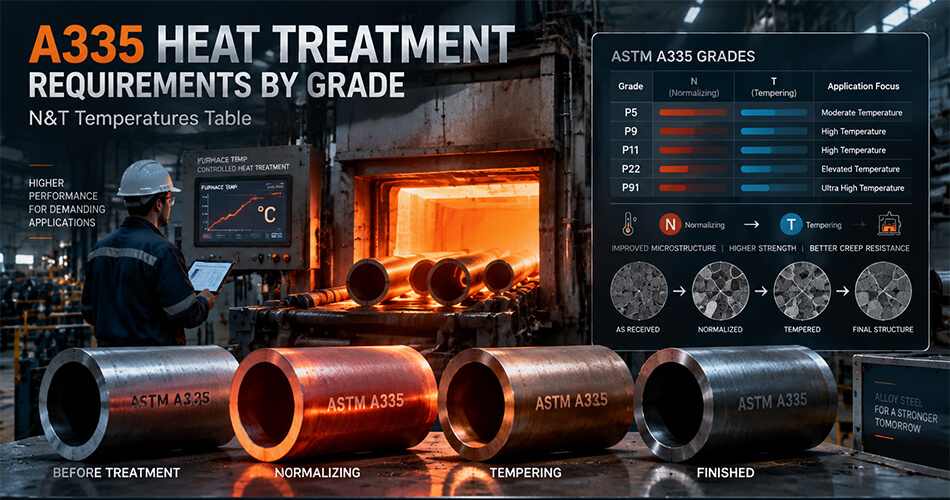
Two P22 pipes can share identical chemistry, identical dimensions, and identical-looking certificates — and one will serve thirty years while the other cracks in your welder’s hands. The difference sat in a furnace: one was tempered at the specification’s minimum temperature for the required time, and one was rushed through to save cycle cost.
A335 heat treatment is the least visible and most consequential requirement in the entire specification. Chemistry can be verified in two minutes with an XRF gun. Heat treatment can only be verified through documents and hardness — which is exactly why it’s where corners get cut.
This reference gives you the working table: what ASTM A335 requires for each grade, the normalizing and tempering temperatures that matter, why the rules tighten as chromium climbs, and the three checks that confirm your pipe actually saw the furnace its certificate describes.
The short answer: ASTM A335 heat treatment requirements specify that each grade be supplied in a defined condition — typically full annealing or normalizing-and-tempering (N&T) — with minimum tempering temperatures that rise with alloy content: roughly 650°C for the low-chrome grades (P1, P2, P11, P12), 675°C for the mid-chrome grades (P5, P9, P22), and a mandatory tight-window normalize-and-temper for P91 (normalizing ~1040–1080°C, tempering ~730–800°C). The heat treatment establishes the microstructure that delivers each grade’s creep strength and weldability — without it, compliant chemistry is not a compliant pipe.
Why A335 Legislates the Furnace, Not Just the Melt
Most buyers read a specification as a chemistry table. A335 is really two documents in one: a chemistry recipe and a microstructure recipe — and the microstructure comes from heat treatment.
Chrome-moly steels earn their creep strength from carbides — chromium and molybdenum compounds precipitated through the steel in a controlled size and distribution. Normalizing (heating above the transformation temperature and air cooling) sets a uniform, fine-grained structure. Tempering (reheating below transformation) then precipitates and stabilizes the carbides, relieves hardness, and restores toughness.
Skip or shortcut either step and the failures are predictable. Under-tempered pipe arrives hard and brittle — it cracks during bending and welding, as we warned in our air-hardenable grades discussion in P9 vs P11. Over-tempered or unnormalized pipe arrives soft, with coarse or unstable carbides — it welds beautifully and then creeps early in service, the slow-motion version of the same failure. The temperature window between those two outcomes is what the standard’s numbers protect.
The A335 Heat Treatment Table by Grade
(Working values per ASTM A335/A335M; the standard is revised periodically — always verify against the current edition and your purchase specification, which may impose tighter windows than the standard’s minimums.)
| Grade | Alloy system | Required condition | Minimum tempering temperature | Practical notes | P1 | C-½Mo | Anneal, or normalize & temper | ~650°C (1200°F) | The gentlest requirement in the family | P2, P12 | ½–1Cr-½Mo | Anneal or N&T | ~650°C (1200°F) | Same class as P11 in treatment logic | P11 | 1¼Cr-½Mo | Full/isothermal anneal or N&T | ~650°C (1200°F) | The global workhorse; N&T is the common supply condition | P22 | 2¼Cr-1Mo | Anneal or N&T | ~675°C (1250°F) | Higher alloy → higher minimum temper | P5 | 5Cr-½Mo | Anneal or N&T | ~675°C (1250°F) | Air-hardenable — the temper is safety-critical for fabrication | P9 | 9Cr-1Mo | Anneal or N&T | ~675°C (1250°F) | Same warning as P5, amplified | P91 | 9Cr-1Mo-V-Nb-N | Mandatory normalize & temper (Q&T permitted for heavy sections) | Normalize ~1040–1080°C; temper ~730–800°C | No annealing option; the narrow window is the grade — see our | All cold-drawn pipe | — | Heat treatment after final cold work | ≥ ~650°C | Cold work without a subsequent treatment voids the condition |
|---|
Three patterns worth reading out of that table.
The minimum temper climbs with chromium. More alloy means more stable carbides that need more thermal energy to precipitate properly — 650°C suffices for the lean grades, 675°C for the 2¼–9% chromium class.
P91 is a different species. Every other grade offers the mill a choice of routes; P91 mandates one, with both ends of the cycle bounded. Normalize too cool and the structure never fully transforms; temper too hot and you cross the lower transformation temperature, creating fresh untempered martensite — the root cause behind the grade’s documented early failures.
Cold drawing resets the clock. Any cold work after the final heat treatment (sizing, drawing) work-hardens the steel and requires re-treatment. A mill that cold-finishes and skips the subsequent cycle ships pipe outside the specification, whatever the chemistry says.
What “In Practice” Looks Like at the Mill
At Nakoda Steel Industry, the heat-treatment stage runs on three disciplines that any serious mill should match — and that any buyer can audit:
Calibrated furnaces with recorded cycles. Every batch generates a time-temperature chart: ramp, soak temperature, soak duration, cooling. Those charts are retained per heat-treatment lot and furnished with shipping documents on request — proactively for the air-hardenable grades (P5, P9) and P91, because your welding engineer needs them to plan preheat and PWHT.
Hardness as the cross-check. Temperature charts prove what the furnace did; hardness proves what the steel did. Per-lot hardness testing confirms the temper landed: neither the high values of an under-tempered lot nor the soft readings of an overcooked one. For P91, this becomes per-component reporting against the ~190–250 HB window.
Condition stated on the certificate. The MTC names the supply condition explicitly — “Normalized at X°C, Tempered at Y°C” — not the evasive “heat treated” that certificate-photocopy operations prefer. It’s one of the seven tells we catalogued in our supplier red-flags guide: a trader who never saw a furnace cannot produce its chart.
The Objection: “The Standard Only Sets Minimums — Doesn’t Every Mill Meet Them?”
Fair challenge, and the honest answer is: meeting the minimum temperature is easy; meeting it for the required time, uniformly, across a full furnace load is where economics bite. Furnace hours are a direct production cost. Pack a furnace too dense and the core of the load soaks at temperature for less time than the thermocouple suggests. Rush the cycle and the paperwork can still show a compliant peak temperature.
That’s why the verification trio matters together — chart plus hardness plus stated condition. Any one can be gamed; the three cross-check each other. And it’s why heat treatment, not chemistry, is where a manufacturer’s integrity is actually tested: the spectrometer catches chemistry fraud in minutes, but only your documents discipline catches a rushed temper before your service life does. The temperature-driven grade choices we mapped in A106 vs A335 and the refinery circuits in our hydrocracker material map all silently assume the heat treatment behind each grade was real.
Frequently Asked Questions
What is the heat treatment requirement for A335 P11 pipe?
A335 permits P11 to be supplied full-annealed, isothermally annealed, or normalized and tempered, with a minimum tempering temperature of approximately 650°C (1200°F). N&T is the most common commercial supply condition. The certificate should state the actual condition and temperatures used.
What is the tempering temperature for P22?
The A335 minimum tempering temperature for P22 is approximately 675°C (1250°F), following annealing or normalizing. Purchase specifications for critical service frequently require the actual tempering temperature to be reported on the mill test certificate.
Why is P91 heat treatment so strict?
P91’s creep strength comes from a tempered-martensite structure with fine vanadium-niobium precipitates, achievable only through normalizing at ~1040–1080°C followed by tempering at ~730–800°C. Tempering above the steel’s lower transformation temperature creates untempered martensite; missing the normalize leaves the structure unformed. Both errors caused documented in-service failures during the grade’s early adoption.
Does cold-drawn A335 pipe need heat treatment?
Yes. A335 requires heat treatment after the final cold-working operation (at no less than roughly 650°C), because cold drawing work-hardens the steel and destroys the supplied condition. Cold-finished pipe without a subsequent documented treatment does not comply.
How can a buyer verify A335 heat treatment was done correctly?
Three cross-checking evidences: the furnace time-temperature chart for your lot, per-lot hardness results consistent with a proper temper, and a certificate stating the explicit condition and temperatures. Request all three in the purchase order — a manufacturer produces them routinely; a reseller of unknown pipe cannot.
The Furnace Is Where the Specification Lives
Chemistry makes a grade possible; heat treatment makes it real. Every service temperature, every creep curve, every weldability assumption in the A335 family stands on the quiet assumption that somebody ran the furnace honestly — which makes the N&T table above less a metallurgical footnote than the most important page in your purchase file.
Ordering A335 pipe in any grade? Send Nakoda Steel Industry your line list — every quotation states the supply condition, and every shipment can carry its furnace charts and hardness results, because the pipe you’re paying for is the one that came out of the furnace, not the one that went into the melt.