

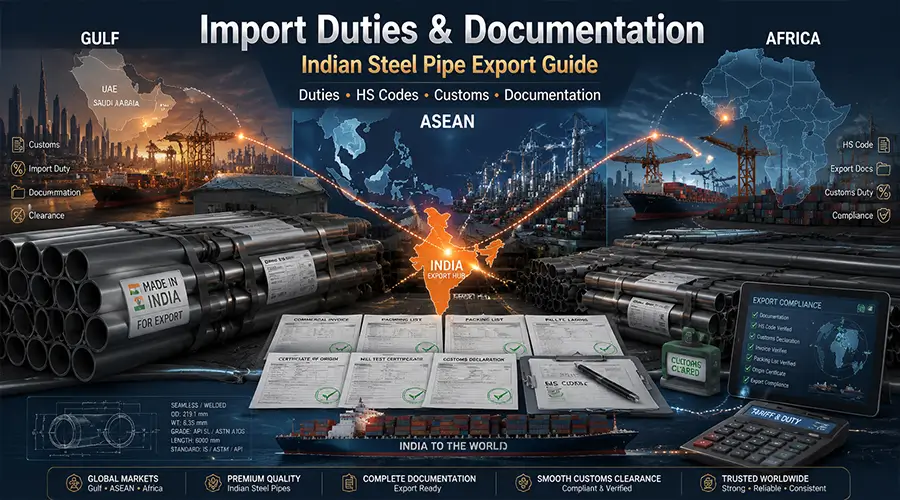
Two containers of identical P11 pipe can arrive at Jebel Ali the same week and clear customs at different total cost — sometimes by thousands of dollars. Not because of the pipe. Because one shipper filed a preferential certificate of origin under the India–UAE trade agreement and the other didn’t know it existed.
Import duty on steel pipe is one of the few project costs that’s negotiable with paperwork alone. The trade agreements are signed, the conformity schemes are published, and the documents are cheap — but only if they’re arranged before the vessel sails, because almost nothing in customs can be fixed retroactively.
This guide maps the three regions Indian pipe exports flow to most — the Gulf, ASEAN, and Africa — covering the duty logic, the certificates that reduce it, the conformity programs that block uncertified cargo entirely, and the document set Nakoda Steel Industry prepares as standard on every export consignment. One caveat runs through everything: tariff rates change; verify every figure with your customs broker against the current schedule before costing a bid. The mechanics below are stable. The percentages are indicative.
The Universal Document Set (Every Region Starts Here)
Before regional differences, the core file that travels with every steel pipe shipment:
- Commercial invoice — with HS codes (seamless alloy pipe typically falls under 7304; get the 8-digit code from your broker, because duty and anti-dumping measures attach to specific lines)
- Packing list — bundle-wise, matching heat numbers to the mill test certificates
- Bill of lading
- Certificate of origin — the ordinary chamber-issued one, plus the preferential one where an agreement applies (this is where the money is; more below)
- Mill test certificates (EN 10204 3.1/3.2) — increasingly requested by customs on alloy grades, not just by your QA team
- ISPM-15 fumigation certificate for wooden dunnage — the small stamp that quarantines whole containers when missing, as we covered in our packing and shipping guide
- Insurance certificate, per your incoterms
- Pre-shipment conformity certificate where the destination requires one (Africa’s big three, Saudi’s SABER — region by region below)
The discipline that matters: every document must tell the same story. Same quantities, same heat numbers, same HS code, same consignee spelling. Customs discrepancies are resolved in days and demurrage dollars.
Region 1: The Gulf (GCC)
Duty logic. The GCC operates a common external tariff — historically around 5% on most steel pipe lines, though Saudi Arabia has raised duties on various steel products in recent years (some lines moved to 10–15%). Verify per 8-digit code, per country, per quarter.
The game-changer: India–UAE CEPA. Since 2022, the Comprehensive Economic Partnership Agreement gives many Indian steel lines reduced or zero duty into the UAE — if the shipment carries the CEPA preferential certificate of origin and meets its rules-of-origin thresholds. That single document is often the difference in the two-containers story above. India has been negotiating similar terms with other Gulf states; ask your broker what’s in force at booking, not at arrival.
Conformity. Saudi Arabia requires product certification through the SABER platform (SASO conformity) for regulated products — shipments without the certificate of conformity don’t clear. The UAE is lighter-touch for industrial pipe but project owners (Aramco, ADNOC) impose their own approval regimes that function like private customs: being on the approved manufacturers list matters more than the tariff.
Practical note for buyers: GCC customs increasingly cross-checks declared value against alloy content. A “P22” invoice priced like carbon steel invites a valuation query — one more reason honest pricing and real certificates travel well together, a theme we’ve hammered in our supplier verification red flags post.
Region 2: ASEAN
Duty logic. The ASEAN–India Free Trade Agreement (AIFTA) reduces duties on many steel lines into Indonesia, Malaysia, Thailand, Vietnam, and the Philippines — claimed via the Form AI certificate of origin. Base tariffs vary by country and line (roughly 0–15% territory), and several ASEAN members maintain anti-dumping or safeguard measures on specific pipe categories — usually aimed at Chinese product, but written by HS code, so Indian shippers must check whether their exact line is caught.
Conformity. This is ASEAN’s real gatekeeping: Indonesia’s SNI marking, Thailand’s TISI, Malaysia’s SIRIM — mandatory product certification schemes covering certain pipe categories, requiring factory audits and testing before the trade happens. If your product line falls under a mandatory standard, no certificate means no market, at any tariff.
Practical note: ASEAN buyers should confirm three things in one email to their broker — current AIFTA rate for the 8-digit code, any live trade-remedy measure on it, and whether a mandatory standard applies. Fifteen minutes that decides whether the landed-cost math works at all.
Region 3: Africa
Duty logic. No single answer — rates run roughly 5–20% and vary by country and code. The structural story is the pre-shipment conformity programs:
- Nigeria — SONCAP: cargo needs a Certificate of Conformity from an accredited body (SGS, Cotecna, Intertek) issued before shipment, based on testing/inspection in India
- Kenya — PVoC (KEBS): same architecture; no CoC, and the options at Mombasa are destination testing at multiples of the cost, re-export, or seizure
- Egypt, Tanzania, Uganda, and others run parallel schemes
The trap is sequencing: these certificates are issued at origin. A buyer who discovers the requirement when the vessel is mid-ocean has no good options left. Book the inspection when you book production.
Practical note: because these programs bill per intervention, consolidating orders into fewer, larger shipments cuts conformity cost per tonne — worth weighing alongside the container vs break-bulk decision.
“Isn’t All This the Buyer’s Broker’s Job?”
Partly — and that’s the trap. Your broker clears what arrives; they can’t retroactively create a CEPA certificate that had to be issued in India, a SONCAP CoC that required pre-shipment inspection, or an ISPM-15 stamp on timber already at sea. The origin-side documents — preferential CoO, conformity certificates, fumigation, MTCs matching stamps — exist only if the mill arranges them before loading.
That’s the real division of labor: destination clearance belongs to your broker; origin documentation belongs to your supplier; and the purchase order is where you make the second one contractual. Nakoda Steel Industry treats the preferential-origin question as part of quotation — if a CEPA or AIFTA line can save you duty, we’d rather you know at pricing stage, because a supplier who helps cut your landed cost gets the next order too.
Takeaway — the pre-sailing checklist
- Get the 8-digit HS code confirmed by a destination broker before costing
- Ask: does a preferential agreement (CEPA, AIFTA) cover this line? Order the preferential CoO with production
- Check conformity schemes early: SABER (Saudi), SNI/TISI/SIRIM (ASEAN), SONCAP/PVoC (Africa) — all are origin-side, none are fixable after sailing
- One story across all documents: quantities, heat numbers, values, spellings
- ISPM-15 on every piece of wood, every time
- Verify every rate quarterly — this post’s percentages are indicative, your broker’s schedule is law
Paperwork Is the Cheapest Metal You’ll Ever Buy
A preferential certificate of origin costs a few thousand rupees and can erase five percent of a container’s value in duty. A missing conformity certificate costs the whole container. In no other part of this trade does so little paper move so much money — in both directions.
Planning pipe imports into the Gulf, ASEAN, or Africa? Send Nakoda Steel Industry your destination, size list, and target incoterms — your quotation arrives within 24 working hours with the applicable documentation set, preferential-origin eligibility, and conformity-scheme requirements identified up front, so your landed-cost math is real before you commit.