

P22 carries more hot, high-pressure fluid than any other alloy pipe grade on earth. Walk through a power plant’s superheater circuit or a refinery’s reactor loop, and the heavy-wall pipe doing the hardest work is almost certainly 2¼Cr-1Mo.
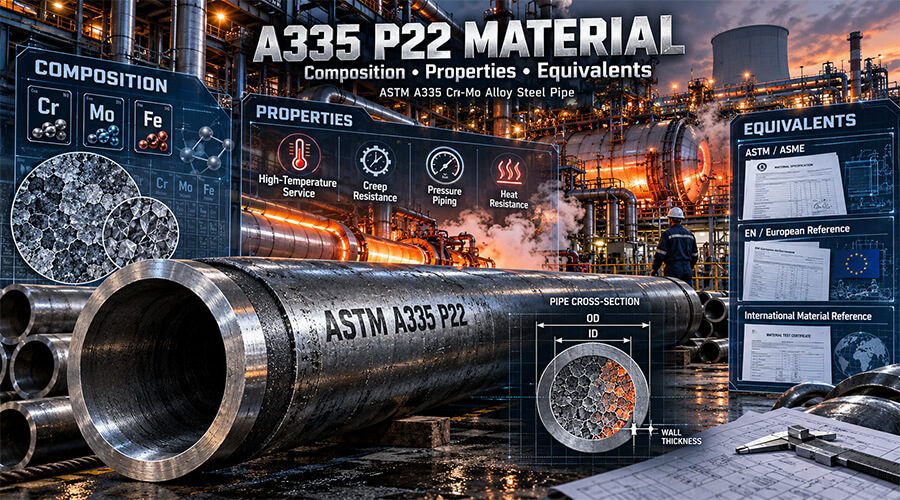
A335 P22 material is a seamless ferritic alloy steel pipe grade containing roughly 2.25% chromium and 1% molybdenum, specified for high-temperature service — practically from about 540°C, where P11 runs out of economical strength, up to around 580°C, where the 9-chrome grades take over. It also anchors hydrogen service in refineries, where its Nelson-curve envelope covers most hydroprocessing conditions.
This reference gives you the working page for the grade: full chemical composition and mechanical property tables, equivalent grades across EN, DIN, and JIS systems, the P22/T22/F22 family map, heat treatment and welding requirements, the temper-embrittlement fine print serious buyers specify against, and the verification checklist. Nakoda Steel Industry manufactures and exports A335 P22 pipe; this page states the specification exactly as we certify it.
TABLE OF CONTENTS
- What Is A335 P22 Material?
- Chemical Composition
- Mechanical Properties
- Heat Treatment Requirements
- Equivalent Grades: EN, DIN, JIS — and T22/F22
- Temperature Limits and Where P22 Is Used
- The Fine Print: Temper Embrittlement and the J-Factor
- Welding P22
- Buying P22: Verification Checklist
- Key Takeaways
- FAQ
What Is A335 P22 Material?
A335 P22 is a chromium-molybdenum alloy steel grade for seamless pipe, defined in ASTM A335/A335M, containing 1.90–2.60% chromium and 0.87–1.13% molybdenum. Compared with P11, it roughly doubles both alloying elements — and that doubling buys higher creep-rupture strength, better oxidation resistance, and a wider safe envelope against high-temperature hydrogen attack.
The “P” denotes pipe within the A335 system. The identical 2¼Cr-1Mo chemistry ships as T22 boiler tube (ASTM A213), F22 forgings and flanges (ASTM A182), and Grade 22 plate (ASTM A387) — one alloy, four product standards, usually mixed within a single project package.
On the alloy ladder, P22 is the heavy-duty middle: the step up from P11 when temperature demands it (our P11 vs P22 comparison maps that boundary), and the step before P91’s precision metallurgy when temperatures push past ~580°C.
A335 P22 Chemical Composition
Per ASTM A335/A335M (verify against the current edition you certify to):
| Element | Requirement (%) |
| Carbon (C) | 0.05 – 0.15 |
| Manganese (Mn) | 0.30 – 0.60 |
| Phosphorus (P) | 0.025 max |
| Sulfur (S) | 0.025 max |
| Silicon (Si) | 0.50 max |
| Chromium (Cr) | 1.90 – 2.60 |
| Molybdenum (Mo) | 0.87 – 1.13 |
Three details an engineer reads out of this table. First, silicon flips versus P11: P11 requires 0.50–1.00% Si, while P22 caps it at 0.50% — one of the quiet tells that distinguishes genuine certificates from copy-paste ones. Second, the bounded low carbon keeps the grade weldable while feeding the Cr-Mo carbides that carry creep strength. Third, the Cr window is what PMI checks at dispatch: a reading of 1.6% chromium is not “close to P22” — it’s a different, weaker pipe wearing the wrong stencil.
A335 P22 Mechanical Properties
| Property | Requirement |
| Tensile strength, min | 415 MPa (60 ksi) |
| Yield strength, min | 205 MPa (30 ksi) |
| Elongation, min (longitudinal) | 30% |
| Density | ~7.85 g/cm³ (same as carbon steel) |
The pattern repeats from P11 — and surprises buyers the same way. At room temperature, P22’s minimums are identical to A106 Grade B carbon steel and to P11. You do not buy P22 for ambient strength. Its entire premium lives in the ASME allowable-stress tables at temperature, where P22 holds usable design stress 30–40°C deeper than P11 before its own curve bends — and in its hydrogen and oxidation performance, which no tensile test shows. Density is unchanged from carbon steel, so standard pipe weight charts apply directly.
Heat Treatment Requirements
A335 permits P22 to be supplied full-annealed or normalized and tempered, with a minimum tempering temperature of approximately 675°C (1250°F) — a step above P11’s 650°C floor, because the richer carbides need more thermal energy to precipitate and stabilize properly.
This matters more for P22 than for any grade below it, for two reasons. The grade’s creep-rupture strength — the property you’re paying double alloy for — exists only if the temper was real. And P22 pipe is routinely ordered in heavy walls, where furnace soak time at the core of a dense load is exactly where economics tempt shortcuts. The certificate should state the actual condition and temperatures; for critical service, the furnace time-temperature chart is the document that proves them, and only a manufacturer possesses it.
P22 Equivalent Grades: EN, DIN, JIS — and the T22/F22 Family
| System | Equivalent grade | Notes |
| EN 10216-2 | 10CrMo9-10 (1.7380) | The working European equivalent |
| DIN (legacy) | 10CrMo910 | Predecessor of the EN grade |
| JIS G3458 | STPA 24 | Japanese alloy pipe system |
| ASME | SA-335 P22 | ASME’s adoption — mandatory for Code-stamped work |
| Same alloy, other forms | T22 (A213 tube) · F22 (A182 forgings) · A387 Gr 22 (plate) | One chemistry, four product standards |
Two purchasing cautions. “Equivalent” is comparable, not interchangeable: 10CrMo9-10 and P22 differ slightly in composition windows and testing; projects specified to ASTM should be certified to ASTM, with dual A335/SA-335 certification as the clean standard. And F22 flanges carry classes — F22 Class 3 (the common high-strength version) and Class 1 differ substantially in strength and heat treatment; matching flanges to P22 pipe means naming the class.
Temperature Limits and Where A335 P22 Material Is Used
P22’s practical window runs from roughly 540°C — where P11’s allowable stress becomes uneconomical — to about 580°C, beyond which P91’s doubled creep strength justifies its precision-product demands. Below 540°C, P22 still appears wherever hydrogen or margin requirements call for it.
Where the grade actually works:
- Power plants — superheater and reheater piping, main steam lines, headers: the classic home. 2¼Cr-1Mo is the defining material of conventional high-temperature steam.
- Refinery hydroprocessing — reactor loop and hot effluent piping in hydrotreaters and hydrocrackers, where P22’s Nelson-curve envelope (API RP 941) covers most hydrogen partial pressures at reactor temperatures. Our hydrocracker material map walks that unit circuit by circuit.
- Petrochemical heaters and transfer lines in clean hot services past P11’s comfort.
- HRSG high-temperature sections in combined-cycle plants.
What P22 is not for: aggressively sour hot streams (sulfidation logic sends those to P5/P9 or stainless), service past ~580–600°C (P91 territory — the trade-offs are in our P22 vs P91 comparison), and anything wet and corrosive, where stainless thinking governs.
The Fine Print: Temper Embrittlement and the J-Factor
P22 has one long-service caveat every hydrogen-service buyer should know. Held for years in the roughly 340–575°C window, 2¼Cr-1Mo can slowly lose low-temperature toughness as tramp elements — phosphorus, tin, antimony, arsenic — migrate to grain boundaries. Strength stays; cold-condition toughness drops, which matters during shutdowns and pressure tests.
The industry’s defense is purchased, not fabricated: specifications for hydroprocessing service impose a J-factor limit on base metal — a formula combining Si, Mn, P and Sn, commonly capped at 100 — because the factor is fixed when the heat is melted. No downstream process repairs a bad melt. When Nakoda Steel Industry quotes P22 for hydrogen service, residual elements are reported on the mill certificate so the J-factor can be verified — and a supplier who has never heard the term is answering a question you didn’t ask yet.
Welding P22
P22 welds reliably under three disciplines, each a notch stricter than P11’s: preheat typically 200°C or higher depending on thickness, matching low-hydrogen consumables (E9018-B3 class for SMAW), and mandatory PWHT commonly in the 680–720°C range per the governing code. The grade is moderately air-hardenable — uncontrolled cooling of a heavy-wall joint can leave hard, crack-prone structure — so interpass control and slow cooling matter in ways carbon-steel habits don’t cover. Fabricators moving up from P11 adapt easily; those moving up from carbon steel need a procedure review first.
Buying A335 P22: The Verification Checklist
P22’s price premium over carbon steel and P11 makes it a favorite target for substitution games — and it is visually identical to both. The checks that make the grade real, standard on Nakoda Steel Industry quotations and worth demanding anywhere:
- EN 10204 3.1 certificate (3.2 with your agency) stating A335/SA-335 with editions — no “equivalent” language
- Full chemistry on the MTC with Cr and Mo inside the windows above — plus residuals (P, Sn, Sb, As) reported where J-factor limits apply
- Heat-treatment condition and temperatures stated; furnace time-temperature charts on request, proactively for heavy-wall and hydrogen-service orders
- Heat numbers stamped on every length, matched line by line to the certificate
- PMI at dispatch — the two-minute XRF reading of ~2.25% Cr is the only visual-equivalent proof the grade exists
- Hydro/NDE per A335, tensile and flattening per lot; hardness reported, confirming the temper landed
These mirror the disciplines in our supplier red-flags guide — applied with the extra weight P22’s service deserves.
12. KEY TAKEAWAYS
- A335 P22 = 2¼% Cr, 1% Mo seamless alloy pipe, practically serving ~540–580°C and most refinery hydrogen conditions
- Room-temperature strength equals carbon steel and P11; the premium lives in allowable stress at temperature, hydrogen resistance, and oxidation margin
- Supplied annealed or normalized & tempered, minimum temper ~675°C — heavier walls make furnace honesty the core quality question
- Equivalents: 10CrMo9-10 (EN 1.7380), STPA 24 (JIS); same alloy as T22 tube, F22 forgings (name the class), A387 Gr 22 plate
- For hydrogen service, specify a J-factor limit and demand residuals on the certificate — it’s fixed at the melt
- Welds need ~200°C preheat, B3 consumables, and PWHT at 680–720°C; verify everything with 3.1 certs, stamps, and PMI at dispatch
13. FAQ
What is P22 material?
P22 is a 2¼Cr-1Mo chromium-molybdenum alloy steel pipe grade defined in ASTM A335 for seamless high-temperature service — the standard material for superheater, reheater and main steam piping around 540–580°C, and for refinery hydrogen service within its Nelson-curve limits.
What is the chemical composition of A335 P22?
Carbon 0.05–0.15%, manganese 0.30–0.60%, silicon 0.50% max, chromium 1.90–2.60%, molybdenum 0.87–1.13%, with phosphorus and sulfur each capped at 0.025%, per ASTM A335/A335M.
What are the mechanical properties of P22 pipe?
Minimum tensile strength 415 MPa (60 ksi), minimum yield 205 MPa (30 ksi), minimum longitudinal elongation 30% — identical room-temperature minimums to P11 and A106 Gr B; P22’s advantage appears in the allowable-stress tables at elevated temperature.
What is the equivalent of P22 in European standards?
10CrMo9-10 (material number 1.7380) under EN 10216-2, descended from DIN 10CrMo910; the JIS equivalent is STPA 24. Equivalents are comparable rather than interchangeable — certify to the standard your project names, ideally dual A335/SA-335.
What is the difference between P22, T22, and F22?
The same 2¼Cr-1Mo alloy in different product forms: P22 is seamless pipe (A335), T22 is boiler and heat-exchanger tube (A213), and F22 covers forgings — flanges and fittings — under A182, where Class 1 or Class 3 must also be specified.
What is the maximum temperature for P22 pipe?
Practically about 580°C for long-term economical service, set by its allowable-stress curve in ASME B31.1/B31.3; above that, P91 takes over. Oxidation and specific code limits can move the line — always confirm against current code tables for your pressure and design life.
Why is P22 used in hydrogen service?
Its 2¼Cr-1Mo carbides resist high-temperature hydrogen attack, giving P22 a Nelson-curve envelope (API RP 941) that covers most hydrotreater and hydrocracker reactor-loop conditions — which is why hydroprocessing reactors and their piping share this metallurgy.
What is the J-factor in P22 specifications?
A melt-chemistry formula combining silicon, manganese, phosphorus and tin, commonly limited to 100 for hydrogen service, that controls susceptibility to temper embrittlement — a slow loss of low-temperature toughness during years at 340–575°C. It can only be controlled at the mill, so it’s specified at purchase.
Does P22 require post-weld heat treatment?
In essentially all code applications, yes — typically 680–720°C per the governing code and thickness, with preheat around 200°C and low-hydrogen B3-class consumables during welding.
How do you verify genuine P22 material?
Match stamped heat numbers to an EN 10204 3.1 certificate showing full chemistry (including residuals for hydrogen service) and the stated heat-treatment condition, then PMI the load at dispatch — a chromium reading near 2.25% is the proof no stencil can fake.
14. CONCLUSION
A335 P22 material earned its place as the heavy-duty standard of high-temperature piping by solving two problems at once: enough creep strength for the hottest conventional steam, and enough carbide stability for refinery hydrogen. The specification itself is short — a chemistry window, a strength floor, a 675°C temper minimum. What separates a thirty-year pipe from a liability is whether all three are provably real, which is a certificates-residuals-and-PMI exercise rather than a visual one. Nakoda Steel Industry certifies P22 exactly as this page describes, down to the residuals — because in this grade’s services, the fine print is the product.
15. CALL TO ACTION
Specifying or sourcing A335 P22 pipe — for steam, hydrogen service, or both? Send Nakoda Steel Industry your line list and service conditions. Your quotation arrives within 24 working hours with dual A335/SA-335 certification, stated heat treatment, J-factor-ready chemistry reporting, and PMI-at-dispatch commitments in writing — and if P11 honestly covers your conditions, we’ll tell you that too.