

A boiler tube doesn’t fail politely. When a superheater line running at 550°C creeps past its limit, the pipe wall thins, bulges, and ruptures — and a single forced outage at a mid-size thermal power plant can cost upwards of US $500,000 per day in lost generation and emergency repairs. In most post-failure investigations, the root cause isn’t exotic. It’s a material that was never right for the job: wrong grade, botched heat treatment, or a mill test certificate that didn’t match the metal.
That’s the uncomfortable truth about high-temperature piping. The difference between twenty years of quiet service and a catastrophic shutdown is decided long before commissioning — at the moment you choose your grade and your manufacturer.
By the end of this post, you’ll know exactly what separates ASTM A335 Grades P1, P11, and P22, which grade fits which service condition, the five documents you should demand from any supplier before wiring a deposit, and how Nakoda Steel Industry manufactures and exports these grades to buyers across the Middle East, Europe, Southeast Asia, and Africa.
What ASTM A335 Actually Covers (and Why It Exists)
ASTM A335 is the standard specification for seamless ferritic alloy-steel pipe for high-temperature service. Two words matter most in that sentence: seamless and high-temperature.
Seamless, because welded pipe introduces a longitudinal seam — a metallurgical weak point you don’t want in a line carrying superheated steam at 100+ bar. High-temperature, because ordinary carbon steel (think ASTM A106) starts losing strength rapidly above roughly 425°C. Beyond that point, you need alloying elements — chiefly chromium and molybdenum — to resist creep, oxidation, and graphitization.
That’s why engineers call A335 pipes “chrome-moly.” The chromium fights oxidation and scaling. The molybdenum raises creep strength — the metal’s ability to resist slow, permanent deformation under stress at temperature. More of each, and the pipe survives hotter, longer.
Also Read : p11-vs-p22-alloy-steel-pipe
P1 vs P11 vs P22: The Grades in Plain Language
Every grade in the A335 family is a trade-off between temperature capability, weldability, and cost. Here’s how the three workhorses compare.
Grade P1 — the carbon-moly entry point
Chemistry: ~0.44–0.65% molybdenum, no deliberate chromium addition.
P1 is the mildest alloy in the family. The molybdenum gives it a meaningful creep advantage over plain carbon steel, making it suitable for service up to roughly 450–470°C. You’ll find it in lower-temperature boiler piping, heat exchangers, and refinery lines where A106 is marginal but P11 would be over-specification.
One caution from decades of industry experience: prolonged service above ~470°C exposes carbon-moly steels to graphitization — carbon precipitating as graphite along weld heat-affected zones, embrittling the joint. If your design temperature flirts with that ceiling, step up a grade. The material saving isn’t worth the risk.
Grade P11 — the 1¼ Chrome workhorse
Chemistry: 1.00–1.50% chromium, 0.44–0.65% molybdenum.
P11 is arguably the most widely stocked A335 grade on earth, and for good reason. That 1¼% chromium addition pushes reliable service temperature to around 540°C, kills the graphitization problem, and adds oxidation resistance — all while remaining readily weldable with standard preheat (typically 150–200°C) and post-weld heat treatment.
Typical homes for P11: main steam lines in subcritical power plants, refinery furnace piping, hydrocrackers, and hot oil circuits in petrochemical complexes.
Also Read : telescoping-tube-guide-what-size-tubing-fits-inside
Grade P22 — the 2¼ Chrome heavy-lifter
Chemistry: 1.90–2.60% chromium, 0.87–1.13% molybdenum.
Double the chromium, double the molybdenum. P22 handles sustained service up to roughly 580°C, with superior creep-rupture strength and resistance to hydrogen attack — which is why refineries specify it for hydroprocessing units and power plants use it for superheater and reheater piping.
The trade-off: P22 demands more disciplined welding. Higher preheat, mandatory post-weld heat treatment (typically around 680–720°C), and tighter control of hardness in the heat-affected zone. A supplier who understands this — and heat-treats the pipe correctly at the mill — saves you enormous grief at the fabrication stage.
Quick reference:
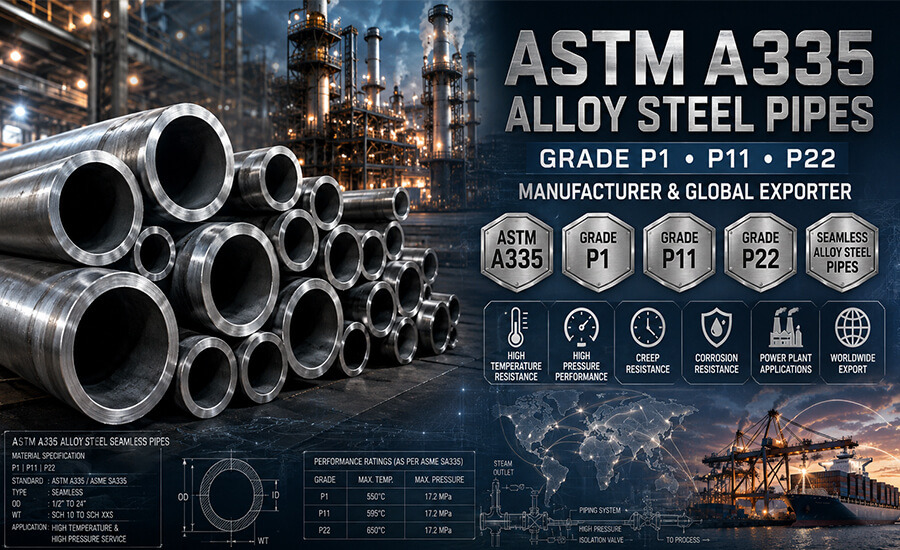
| Grade | Nominal alloy | Practical service ceiling | Typical use |
| P1 | C–½Mo | ~450–470°C | Low-temp boiler & exchanger piping |
| P11 | 1¼Cr–½Mo | ~540°C | Main steam lines, refinery furnaces |
| P22 | 2¼Cr–1Mo | ~580°C | Superheaters, reheaters, hydroprocessing |
(Service ceilings are practical engineering ranges; always confirm allowable stresses against ASME B31.1/B31.3 or your governing code for your exact design conditions.)
The Part Most Buyers Get Wrong: It’s Not the Grade, It’s the Heat Treatment
Here’s an opinion we’ll stand behind: a P22 pipe with sloppy heat treatment is more dangerous than a properly processed P11.
ASTM A335 requires these grades to be supplied in specific conditions — full annealing, or normalizing followed by tempering (with minimum tempering temperatures the standard spells out, e.g., 650°C for P11 and 675°C for P22). Get this wrong at the mill and the microstructure is compromised: hardness spikes, toughness drops, and the creep properties you paid for simply aren’t there. No site inspection will catch it. It only shows up years later — in service.
This is why the mill matters more than the trader. A stockist reselling pipe of unknown provenance can hand you a certificate; only a manufacturer controls the furnace.
Also Read : stainless-steel-bolts-vs-grade-5/
How Nakoda Steel Industry Manufactures A335 P1, P11 & P22
At Nakoda Steel Industry, we manufacture and export seamless A335 alloy pipe from our facility in Mumbai, India — and every order, whether a 2-tonne trial or a full container program, moves through the same six checkpoints:
- Traceable raw material. Every mother billet or hollow arrives with its own chemistry certificate, and we re-verify composition in-house by spectrometric analysis before it enters production. If chromium or molybdenum sits outside the ASTM band, the heat is rejected — no exceptions.
- Controlled hot working. Pipes are produced seamless via hot rolling / hot extrusion, with dimensional control to ASTM A999 tolerances across the size range we regularly export (commonly ½” NB to 24″ NB, in schedules from SCH 40 through XXS).
- Full-body heat treatment. Normalizing and tempering in calibrated furnaces, with time-temperature charts retained for every batch and furnished on request. This is the step we will never subcontract blind.
- Mandatory testing per A335. Hydrostatic testing of every pipe (or NDE alternative where the standard permits), plus tensile, hardness, flattening, and bend tests per heat lot. Ultrasonic examination is available for critical-service orders.
- EN 10204 Type 3.1 / 3.2 certification. Every consignment ships with a mill test certificate tying the physical pipe — heat number hard-stamped or stenciled on each length — to its chemistry and mechanical results. Third-party inspection (BV, SGS, TÜV, Lloyd’s) is welcomed, not tolerated.
- Export-grade packing. Bevelled ends per ANSI B16.25 where specified, varnish or black coating for sea transit, end caps, and bundling suited to container or break-bulk shipment. We routinely ship to the UAE, Saudi Arabia, Qatar, Nigeria, Kenya, Malaysia, Vietnam, and the EU.
One example of why checkpoint 1 exists: on a recent P22 export order for a Gulf refinery client, our incoming spectro check flagged a heat with molybdenum at the very bottom of tolerance. The chemistry technically passed — but for hydroprocessing service, we swapped the heat anyway and documented why. The client’s third-party inspector later told us it was the first time a mill had rejected material on their behalf. That order became a standing annual contract.
“But Imported Branded Pipe Is Safer, Isn’t It?”
Fair objection. Let’s meet it head-on.
The instinct to pay 30–40% more for a legacy European or Japanese mill brand comes from a real place: fear of fake certificates and substandard Asian material, a problem the industry has genuinely suffered from.
But the origin of the pipe was never the safeguard. The verifiability of the pipe is. A branded pipe with a photocopied certificate protects you less than an Indian pipe you can trace end-to-end. Here’s what actually protects you, from any supplier, anywhere:
- A 3.1 (or 3.2) MTC whose heat numbers physically match the stamped pipe in the yard
- Furnace charts for the heat-treatment cycle, on request
- Positive Material Identification (PMI) — a two-minute handheld XRF test your inspector can run at loading
- Third-party witness testing written into the purchase order
- The supplier’s willingness to accept all of the above before you pay
At Nakoda Steel, we put that in writing on every quotation. If a supplier hesitates on any one of these five points, that hesitation is your answer — whatever flag is on their letterhead. And because we manufacture in India, buyers typically land P11 and P22 at 20–35% below Western European mill pricing with lead times of 3–6 weeks for standard sizes, without giving up a single line of documentation.
Takeaway box — the 60-second buyer’s checklist
- Match the grade to design temperature: P1 to ~460°C, P11 to ~540°C, P22 to ~580°C
- Buy seamless to A335; never accept “equivalent” welded substitutes for high-temp steam
- Demand EN 10204 3.1/3.2 MTCs with heat numbers stamped on every length
- Ask for heat-treatment furnace charts — a real mill has them
- Run PMI at dispatch; write third-party inspection into the PO
- Prefer a manufacturer over a trader when service conditions are critical
The Metal Remembers Everything
Steel is honest. Every shortcut taken in an alloy shop — a rushed temper, a swapped heat, a certificate that describes a different pipe — is recorded permanently in the microstructure, waiting for temperature and time to read it back. You can’t inspect quality into a chrome-moly pipe after the fact. You can only buy it from someone who built it in.
If you’re specifying or sourcing ASTM A335 P1, P11, or P22 pipe, send us your size list and design conditions. Nakoda Steel Industry will return a detailed quotation — with our full testing and documentation commitments stated up front — within 24 working hours. Email us or use the enquiry form, and put your next project on metal you can trace.