

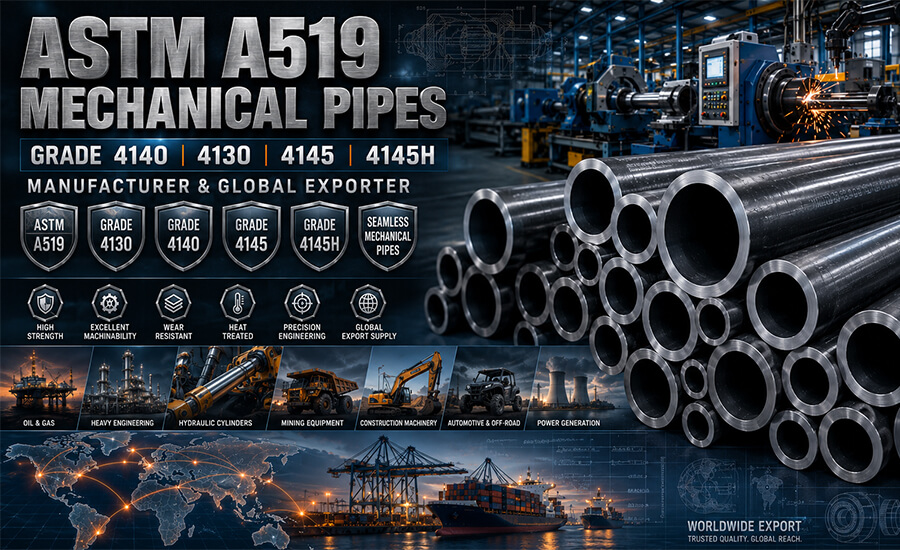
When a manufacturer needs tubes that won’t fail under extreme stress, generic commodity materials won’t cut it. ASTM A519 high-strength mechanical pipes—specifically grades 4140, 4130, 4145, and 4145H—represent engineering solutions for applications where strength, reliability, and performance are non-negotiable.
These are premium alloy steels, fundamentally different from basic carbon steel tubes. Where lower-carbon grades serve general mechanical purposes, these high-strength variants are engineered for demanding environments: high-pressure hydraulic systems, precision drilling equipment, aerospace components, and industrial machinery subjected to severe stress cycling.
The difference between choosing the right grade and settling for inadequate material can determine whether your system operates flawlessly for decades or fails prematurely, creating liability and damaging your reputation.
Nakoda Steel Industry has specialized in manufacturing and exporting these premium ASTM A519 high-strength mechanical tubes for over 15 years. We understand what distinguishes grade 4140 from 4145H, why specification matters in aerospace applications, and how to ensure consistent quality that exceeds customer expectations. This comprehensive guide draws from our real-world experience delivering tubes to demanding industries worldwide.
Whether you’re an engineer specifying materials for a critical application, a procurement manager evaluating suppliers, or a manufacturer seeking reliable sources for high-strength tubes, this guide provides the technical knowledge and practical insights you need to make informed decisions that directly impact your project success.
1. What Are ASTM A519 High-Strength Mechanical Pipes?
ASTM A519 high-strength mechanical pipes are seamless carbon alloy steel tubes engineered for applications requiring exceptional strength, hardness, and durability. Unlike general-purpose mechanical tubing, these grades contain specific alloy elements—primarily chromium, molybdenum, and vanadium—that dramatically increase material properties.
The designation “A519” comes from the ASTM International standard governing seamless carbon steel mechanical tubing. Within this standard, various grades serve different performance needs. Grades 4140, 4130, 4145, and 4145H represent the premium end of this spectrum, designed for applications that cannot tolerate material failure.
These tubes aren’t products of luck or basic manufacturing. They represent deliberate metallurgical engineering where carbon content, alloy composition, heat treatment, and quality control procedures combine to create tubes with yield strengths exceeding 100,000 PSI.
Why High-Strength Matters
In demanding applications, strength directly translates to reliability. A drill string that fails at depth can cost millions in equipment loss and project delay. A hydraulic cylinder that leaks due to material degradation creates safety hazards. These aren’t abstract engineering concerns—they’re real business risks that high-strength grades mitigate.
Stress concentration points that would crack lower-carbon materials remain stable in high-strength alloys. Thermal cycling that causes fatigue failure in standard tubes is managed reliably by properly specified premium grades. The extra cost of premium grades is rapidly recovered through improved reliability and extended service life.
Also Read : stainless-steel-bolts-vs-grade-5
2. Understanding the Alloy Steel Composition
High-strength ASTM A519 tubes owe their exceptional properties to carefully balanced alloy elements. Understanding these compositions helps explain why one grade outperforms another in specific applications.
The Role of Chromium
Chromium strengthens steel through solid solution hardening while improving hardenability—the ability of material to harden deeply when heat-treated. In grades 4140 and 4145, chromium content ranges from 0.80-1.10%, providing the foundation for exceptional strength.
Chromium also improves wear resistance, an important factor in applications experiencing surface contact stress. Drill pipe wear from repetitive rotation or valve components subjected to abrasive conditions benefit from chromium’s contribution to surface hardness.
The Critical Role of Molybdenum
Molybdenum is perhaps the most important alloying element in these high-strength grades, contributing to temper hardness and creep resistance at elevated temperatures. It increases strength without sacrificing toughness—a difficult balance to achieve.
The addition of molybdenum also improves notch toughness, meaning the material resists crack initiation at stress concentration points. In applications with sharp corners or discontinuities, this property is crucial for preventing premature failure.
Vanadium and Other Elements
Vanadium contributes to strength and wear resistance while improving fatigue resistance—the material’s ability to withstand repeated stress cycles. This element is particularly important in applications experiencing vibration or cyclic loading.
Carbon content varies among grades (typically 0.38-0.45%), directly influencing final hardness and strength after heat treatment. Higher carbon means higher potential strength but slightly reduced toughness if not properly heat-treated.
Also Read : p9-vs-p11-alloy-steel-pipe-guide
3. Detailed Grade Comparison: 4140 vs 4130 vs 4145
Each grade serves specific purposes based on performance requirements. Understanding the differences prevents over-specification that adds cost or under-specification that creates reliability risks.
Grade 4140: The Versatile Workhorse
ASTM A519 Grade 4140 is the industry’s most popular high-strength mechanical tube grade. It contains approximately 0.38-0.43% carbon, 0.75-1.00% manganese, 0.80-1.10% chromium, and 0.15-0.25% molybdenum.
After heat treatment, 4140 achieves yield strength around 100,000-150,000 PSI depending on final temper. Tensile strength ranges from 120,000-180,000 PSI. These properties make it ideal for drill pipe, high-pressure cylinders, and precision machinery components.
The beauty of 4140 is balance. It’s strong enough for most demanding applications while remaining machinable without excessive tool wear. It responds predictably to heat treatment, allowing manufacturers to achieve consistent final properties across production runs.
Grade 4130: The Lighter Alternative
Grade 4130 contains slightly less carbon (0.28-0.33%) and less chromium (0.80-1.10%) than 4140. The result is a material with lower final strength (yield strength around 80,000-130,000 PSI) but superior toughness and better weldability.
4130 is preferred in applications where impact resistance matters—like landing gear components in aerospace. It’s also the choice for applications requiring welding, as its lower carbon content means post-weld heat treatment isn’t mandatory.
For general high-strength applications where maximum hardness isn’t critical, 4130 provides excellent value with easier manufacturing and superior fatigue resistance.
Grade 4145: Maximum Strength Option
Grade 4145 represents the premium strength option, containing 0.42-0.50% carbon—significantly higher than 4140. This additional carbon, combined with proper alloy balance and heat treatment, creates yield strengths exceeding 150,000 PSI.
The trade-off is reduced toughness compared to 4140 and 4130. Applications requiring maximum hardness and wear resistance benefit from 4145’s properties. Hydraulic cylinders in extreme environments, high-speed spindles, and precision-critical components utilize this grade.
Grade 4145H: Superior Toughness Variant
The “H” designation indicates a modification enhancing hardenability and toughness. Grade 4145H maintains 4145’s strength while improving impact resistance and fatigue performance. This grade is specified when both strength and reliability are critical—like aerospace fasteners or drilling equipment.
The added cost of 4145H is justified in applications where failure is unacceptable. Aerospace manufacturers often specify this grade due to superior reliability and predictable properties across temperature ranges.
Also Read : astm-a519-grade-1026-mechanical-pipes-complete-specifications-supplier-guide
4. Key Specifications and Properties
Comparing these grades on specific properties helps clarify which suits your application.
Strength Comparison (H3)
| Property | 4130 | 4140 | 4145 | 4145H |
| Yield Strength | 80-130K PSI | 100-150K PSI | 150-180K PSI | 150-180K PSI |
| Tensile Strength | 110-160K PSI | 120-180K PSI | 160-200K PSI | 160-200K PSI |
| Elongation | 20-25% | 15-20% | 12-18% | 15-20% |
Hardness and Wear Resistance
After appropriate heat treatment, these grades achieve different hardness levels. 4140 typically reaches 38-42 HRC (Rockwell hardness). 4145 can exceed 45 HRC with proper tempering.
Higher hardness improves wear resistance but reduces impact toughness. The key is selecting final hardness appropriate for your application. Grinding spindles might specify 4145 at 45+ HRC. Drilling equipment operating in abrasive formations might use 4140 at 35-40 HRC, balancing wear resistance with durability.
Temperature Performance
These alloy steels maintain strength at elevated temperatures better than lower-carbon grades. At 300°F, yield strength drops only slightly. At 600°F, strength reduction becomes notable but remains acceptable for many applications.
4145H maintains superior toughness across temperature ranges, making it the choice for applications experiencing thermal cycling from extreme hot to cold conditions.
5. Manufacturing Precision and Quality Control
The gap between average tubes and premium-grade tubes comes down to manufacturing rigor. ASTM A519 high-strength tubes aren’t casually produced; they require precise control throughout manufacturing.
Raw Material Selection
Superior tubes start with superior raw materials. Steel melting begins with virgin iron and carefully selected alloys to achieve precise chemistry. Each element—chromium, molybdenum, vanadium—is added in measured quantities because variations affect final properties.
Modern suppliers use vacuum degassing to remove gases that might become defects. X-ray fluorescence testing verifies chemical composition before material enters manufacturing. This level of control seems excessive until you consider the consequences of material composition variance in critical applications.
Heat Treatment Precision
Final material properties depend entirely on heat treatment. These high-strength grades must be heated to precise temperatures (typically 1,450-1,550°F depending on grade), held for specific times, then quenched in oil or water to lock in hardness.
After quenching, the material is brittle. Tempering—reheating to lower temperatures (typically 400-1,100°F)—relieves internal stresses while maintaining strength. The final temper temperature determines final hardness and toughness balance.
Overtemper, and you lose hardness. Undertemper, and the material remains excessively brittle. This isn’t guesswork; modern suppliers use computerized furnaces with temperature monitoring to ensure precise control within ±25°F.
Testing and Documentation
Every batch undergoes tensile testing. Samples from the production lot are machined into test specimens, loaded until failure, and actual yield and tensile strength are measured. Results must match ASTM specifications.
Hardness testing verifies material hardness within specified range. Ultrasonic testing detects internal flaws invisible to the naked eye. Eddy current testing finds surface discontinuities that could initiate failure.
Complete documentation accompanies each shipment, showing actual test results, not assumed values. EN 10204 3.1 certificates provide third-party verification that material from your specific lot meets all requirements.
6. Real-World Applications and Performance
Understanding where these tubes succeed in the field helps clarify why proper specification matters.
Drilling and Oilfield Operations
Drill strings operate in extreme conditions: rotating at high speeds, transmitting tremendous torque, exposed to abrasive formation materials. Premium high-strength tubes are essential in this application.
Grade 4140 is the standard choice for drill pipe in most applications. The combination of strength to resist torque and toughness to absorb shock loads from formation changes makes it ideal. When drilling in particularly abrasive conditions (like sandstone with high quartz content), 4145 is often specified for superior wear resistance.
Drill collars—heavier components that provide weight on the drill bit—demand even higher strength. Grades 4145 and 4145H are common in this application because collars experience compression and bending stress simultaneously.
Hydraulic and Precision Cylinders
High-pressure hydraulic cylinders operating at 3,000-5,000 PSI require tubes strong enough to contain pressure safely while remaining machinable to precise dimensions. Grade 4140 is the standard choice.
Internal diameter must be precisely sized and finished. External diameter must be concentric with the internal bore. Wall thickness tolerances might be ±0.015″ on a 2″ diameter cylinder. These precision requirements demand tubes that machine smoothly without chatter or dimensional variation.
Aerospace hydraulic actuators often specify 4145H because failure is unacceptable and the cost premium is insignificant compared to project value.
Automotive and Racing Components
Racing suspension components, transmission shafts, and performance vehicle drivelines utilize grade 4140 for strength without excessive weight. The material is strong enough for extreme loads while remaining relatively light.
Turbocharger compressor shafts rotate at speeds exceeding 100,000 RPM, exposing the material to enormous centrifugal forces. Only high-strength alloys withstand these loads reliably.
Aerospace Applications
Landing gear components, control rod actuators, and fastener applications demand grades 4145H or higher. These applications have zero tolerance for failure. A landing gear collapse is a catastrophic event with fatalities. This is why aerospace suppliers specify premium grades despite substantially higher costs.
7. Selecting the Right Grade for Your Application
Choosing between these grades requires understanding your specific requirements. Over-specification wastes money. Under-specification creates risk.
Stress Analysis Matters
Start with engineering calculations determining actual stress on your component. Peak stress, mean stress, stress concentration factors—all should be calculated based on actual operating conditions.
If calculated stress is 50,000 PSI, grade 4130 is adequate. If calculated stress reaches 120,000 PSI, grade 4140 is required. If stress exceeds 150,000 PSI, grade 4145 becomes necessary.
Many designers use a 2:1 safety factor, meaning if calculated stress is 75,000 PSI, they select material with minimum yield strength of 150,000 PSI. This practice prevents premature failure from unexpected peak loads.
Environmental Considerations
Temperature extremes affect material selection. At elevated temperatures, all grades lose strength, but high-strength grades lose more because their properties depend on heat-treated hardness.
For applications in extreme cold (below -40°F), impact toughness becomes critical. Grade 4130 excels here. Grade 4145 at maximum hardness might be brittle at these temperatures.
Corrosive environments require careful consideration. These grades provide no inherent corrosion resistance. Protective coatings or other corrosion mitigation becomes necessary.
Cost-Benefit Analysis
Grade 4130 might cost 15% less than 4140, which costs 20% less than 4145. But manufacturing cost often matters more than material cost. If grade 4140 requires 2 hours less machining time than 4145 due to superior machinability, the manufacturing savings might exceed material cost differences.
Don’t select grades purely on unit price. Calculate total cost including machining time, heat treatment, testing, and documentation. Often the cheapest material results in highest total cost due to manufacturing complexity.
8. Exporting and Global Sourcing Considerations
Sourcing high-strength mechanical tubes globally requires understanding regulations and verification methods.
International Standards Compliance
ASTM A519 is primarily American but widely recognized globally. European equivalents exist (EN standards), but many international customers specify ASTM because of familiarity and availability.
Some industries require specific standards: Aerospace demands AS9100 certification. Automotive might require ISO/TS 16949. These certifications add cost but enable sales to demanding customers.
Documentation and Traceability
International customers require comprehensive documentation. Mill certificates showing chemical composition and mechanical test results are baseline. Many customers demand third-party verification through independent testing laboratories.
Traceability documentation allows tracking specific tubes back to the production batch and heat. If issues arise years later, traceability enables investigation of root causes.
Quality Assurance Verification
Reputable suppliers welcome third-party verification. Some customers conduct independent testing on received materials. Nakoda Steel fully supports this practice because our quality is our reputation.
Ask potential suppliers about their quality systems, certifications, and willingness to participate in customer verification testing. Suppliers who resist transparency aren’t people you want building components for critical applications.
9. Supplier Evaluation and Quality Assurance
Selecting a reliable supplier for high-strength tubes is as important as selecting the right grade. Poor quality from any grade creates problems.
Certifications That Matter
ASTM certification confirms the supplier manufactures according to specifications. ISO 9001 quality certification documents systematic quality procedures across the organization. ASME certification might be relevant for certain pressure applications.
Don’t accept claims of certification without verification. Contact the certifying body to confirm the supplier holds active certification. Invalid or expired certifications indicate carelessness about compliance.
Technical Capability Assessment
Can the supplier provide your required sizes and quantities? Do they have modern heat treatment equipment maintaining precise temperature control? Can they provide custom heat treatment specifications?
Some suppliers have excellent capability for standard sizes but poor capability for custom specifications. If you need 1.750″ OD tubes in 4145H at a specific temper, verify the supplier can deliver consistently.
Delivery and Support
Reliable delivery matters. A supplier offering slightly lower prices doesn’t help if delivery is late. Ask about lead times, safety stock availability, and their track record meeting commitments.
Technical support also matters. When you have questions about material properties, heat treatment options, or machining recommendations, can you get knowledgeable answers quickly? Suppliers providing genuine technical support add value beyond just delivering material.
10. Common Challenges and Solutions
High-strength tube applications create specific challenges. Understanding common issues helps prevent problems.
Machinability Issues
High-strength alloys are harder to machine than lower-carbon grades. Tool wear accelerates. Cutting speeds must be reduced. Heat generation increases, potentially affecting dimensional stability.
Solution: Use proper tooling designed for high-strength materials. Optimize cutting speeds and feeds for your specific grade and operation. Consider using high-quality cutting fluids that cool and reduce friction.
Suppliers can help by providing tubes with optimal surface finish that reduces subsequent machining difficulty. Some suppliers offer soft-annealed tubes specifically for customers doing extensive machining.
Heat Treatment Sensitivity
High-strength grades are sensitive to heat treatment variations. Slight deviations in final temper create substantial strength variations. This isn’t a quality failure but rather a characteristic of the material.
Solution: Specify final hardness range precisely. Request actual hardness test results with your shipment. If heat treatment must meet specific hardness range (say 40-42 HRC), confirm this specification.
Stress Relief Requirements
After machining, residual stresses from the process remain in the material. In highly stressed applications, these residual stresses can contribute to premature failure through stress concentration.
Solution: Specify post-machining stress relief heat treatment if your application demands it. This adds cost but significantly improves reliability in critical applications.
Corrosion Concerns
These carbon alloy steels provide no inherent corrosion resistance. In marine, chemical, or salt-spray environments, protective coatings are essential.
Solution: Apply appropriate protective coatings early in manufacturing. Some applications utilize stainless steel alternatives, though these are less common in mechanical tubing applications.
KEY TAKEAWAYS
- ASTM A519 high-strength grades (4140, 4130, 4145, 4145H) are engineered for demanding applications where regular carbon steel tubes would fail prematurely.
- Grade 4140 is the versatile workhorse, offering excellent balance of strength, toughness, and machinability for most high-stress applications.
- Grade 4130 excels when impact resistance and weldability matter, making it ideal for aerospace landing gear and applications requiring welded assemblies.
- Grade 4145 and 4145H provide maximum strength for extreme applications but sacrifice some toughness and machinability compared to lower-carbon grades.
- Proper specification depends on engineering analysis, not arbitrary selection or cost-cutting measures that create reliability risks.
- Manufacturing quality directly impacts performance. Premium suppliers invest in heat treatment control, testing, and documentation that distinguishes superior tubes from mediocre alternatives.
- Supplier selection is as important as material selection. Technical support, delivery reliability, and willingness to verify quality all impact your project success.
- Complete documentation and traceability enable verification that material meets specifications and allow investigation if field issues arise.
FREQUENTLY ASKED QUESTIONS
Q1: What’s the main difference between Grade 4140 and Grade 4145?
A: The primary difference is carbon content. Grade 4140 contains 0.38-0.43% carbon while 4145 contains 0.42-0.50% carbon. This extra carbon allows 4145 to achieve higher final strength (150,000+ PSI yield) but slightly reduces toughness. Choose 4140 for most applications requiring high strength with good impact resistance. Choose 4145 when maximum hardness and wear resistance are required despite slightly lower toughness.
Q2: Can these high-strength grades be welded?
A: Yes, they can be welded, but the process is more complex than welding lower-carbon grades. The high carbon content makes the heat-affected zone (area around the weld) susceptible to cracking. Preheat before welding and post-weld heat treatment are typically required. Grade 4130 welds more easily than 4140, which welds more easily than 4145. If your application requires extensive welding, 4130 is the better choice.
Q3: How do I know if my application requires Grade 4145 instead of Grade 4140?
A: Perform engineering stress analysis calculating actual stresses in your component. If calculated stresses exceed 120,000 PSI, grade 4140 is adequate with appropriate safety factors. If calculated stresses consistently exceed 140,000 PSI, grade 4145 becomes necessary. Don’t over-specify based on assumptions; calculate actual requirements.
Q4: What’s the benefit of Grade 4145H over regular Grade 4145?
A: Grade 4145H is modified to enhance hardenability and toughness while maintaining 4145’s strength. The “H” means improved hardness uniformity and better impact resistance across temperature ranges. For aerospace applications where failure is unacceptable, or for components subjected to extreme thermal cycling, 4145H’s extra reliability justifies the cost premium.
Q5: How should I specify heat treatment for the grade I’m ordering?
A: Rather than assuming standard temper, specify your required final hardness range (e.g., 38-42 HRC for grade 4140). Provide tensile strength requirements if critical. Request actual hardness test results confirming delivered material meets your specification. This level of specificity prevents surprises and ensures material properties match your application requirements.
Q6: What certifications should I require from a supplier?
A: Request ASTM certification confirming the supplier manufactures to specification. ISO 9001 quality certification documents systematic quality management. EN 10204 3.1 material certificates with actual test results rather than assumed values are essential. For aerospace applications, ask about AS9100 certification. Verify these certifications are current and active before committing to orders.
CONCLUSION
ASTM A519 high-strength mechanical pipes—grades 4140, 4130, 4145, and 4145H—represent premium materials engineered for applications where standard tubes fail. The difference between these grades isn’t academic; it’s the difference between reliable systems operating for decades and catastrophic failures that damage equipment and reputation.
Selecting the right grade requires understanding your actual stress requirements, environmental conditions, and performance demands. Over-specification wastes money; under-specification creates unacceptable risk.
Nakoda Steel Industry has supplied high-strength ASTM A519 mechanical tubes to demanding industries worldwide for over 15 years. We understand the precision required to deliver tubes meeting aerospace, automotive, and industrial specifications. Our investment in modern heat treatment equipment, rigorous testing procedures, and comprehensive documentation reflects our commitment to quality that customers can trust.
Whether you need grade 4140 for general high-strength applications, grade 4130 for demanding aerospace components, or grade 4145H for extreme environments, choosing a supplier with genuine expertise and commitment to quality directly impacts your project success.