

Specify Grade 304 pipe for a seawater-adjacent plant on the Arabian Gulf, and the first rust-brown pinholes can appear within the first year — sometimes within months. Not because the pipe was defective. Because chloride ions attack the passive film that makes stainless steel stainless, and 304 was never designed to resist them.
The pipe met its certificate. The certificate met the standard. The grade didn’t meet the environment. That distinction — grade versus environment — is where most stainless piping money is wasted or lost.
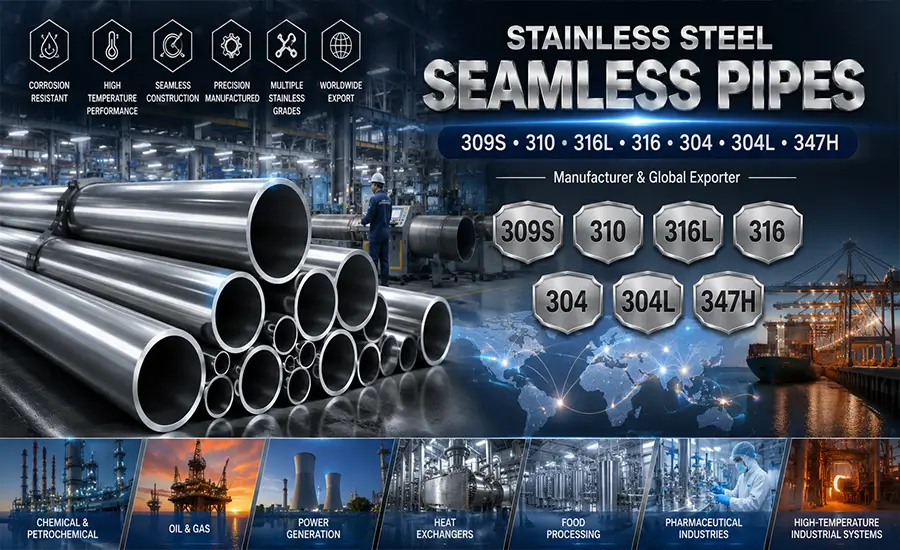
This guide gives you a working selection logic for the seven austenitic grades Nakoda Steel Industry manufactures and exports as seamless pipe — 304, 304L, 316, 316L, 309S, 310, and 347H — including when the cheaper grade is genuinely the right call, what the L and H suffixes actually buy you, which grades survive Middle East coastal and high-temperature service, and the verification steps to take before releasing payment to any supplier.
First, the Selection Logic: Two Questions Decide Almost Everything
Engineers overcomplicate stainless selection. For austenitic seamless pipe, two questions do most of the work:
Question 1: What is the corrosion environment — and are chlorides present? This separates the 304 family from the 316 family.
Question 2: What is the service temperature — and will the pipe be welded? This decides straight grade vs L grade (welding) and pushes you toward 309S/310/347H (high temperature).
Answer both honestly, and the grade usually picks itself. Here’s how.
Also Read : telescoping-tube-guide-what-size-tubing-fits-inside
The Workhorses: 304 and 304L
Grade 304 (18% Cr, 8% Ni) is the world’s default stainless — food processing, water lines, architecture, general chemical service. If chlorides are low and temperatures are moderate, 304 seamless pipe is the economical, correct choice, and paying for 316 is simply wasted molybdenum.
304L drops carbon to 0.03% max. That matters for one reason: welding. During welding, standard-carbon 304 can form chromium carbides at grain boundaries in the heat-affected zone (sensitization), stripping chromium from where corrosion resistance needs it. 304L avoids this without post-weld annealing.
The practical rule: if the pipe will be welded and used as-welded, buy the L grade. Much material today is dual-certified 304/304L — meeting L-grade chemistry and straight-grade strength — which resolves the choice at no premium. Ask your supplier whether their stock is dual-certified; Nakoda Steel Industry supplies dual-certified material wherever the heat qualifies.
The Chloride Fighters: 316 and 316L
Grade 316 adds 2–3% molybdenum to the 304 base. That single addition raises the alloy’s resistance to pitting and crevice corrosion substantially — the standard measure, PREN (Pitting Resistance Equivalent Number), rises from roughly 18–20 for 304 to roughly 24–26 for 316.
For coastal Middle East service — desalination-adjacent piping, cooling circuits, offshore topsides, anything within salt-spray reach of the Gulf or the Red Sea — 316L is the sensible floor, not the upgrade. The Nickel Institute’s published guidance on marine atmospheric service points the same direction: molybdenum grades for chloride exposure.
316L is to 316 what 304L is to 304: low carbon for as-welded corrosion resistance. Same dual-certification logic applies.
One honest boundary: 316L is chloride-resistant, not chloride-immune. Hot, concentrated chloride service (some desalination brine loops, produced-water lines) can exceed even 316L’s limits and calls for duplex or super-austenitic grades — a different conversation. A supplier who tells you 316L solves everything is selling, not advising.
Also Read : stainless-steel-bolts-vs-grade-5
The Heat Grades: 309S and 310
Above roughly 800°C, the game changes from wet corrosion to oxidation and scaling, and chromium content becomes the shield.
309S (~23% Cr, 13% Ni) handles intermittent service to roughly 980°C — furnace components, thermal oxidizers, boiler casings.
310 (~25% Cr, 20% Ni) extends that to roughly 1,035–1,100°C continuous — radiant tubes, kiln internals, high-temperature ducting. The higher nickel also stabilizes the structure against embrittlement across heating cycles.
Between them, the selection is mostly a temperature line and a budget line: 310 costs more because it carries roughly half again the nickel. Below ~950°C continuous, 309S usually serves; above it, 310 earns its price. (Confirm allowable temperatures against your design code and cycle profile — intermittent versus continuous service changes the limits materially.)
Also Read : astm-a519-grade-1026-mechanical-pipes-complete-specifications-supplier-guide
The Refinery Specialist: 347H
347 stabilizes the alloy with niobium (columbium), which locks up carbon before it can form chromium carbides — solving sensitization not by removing carbon (the L approach) but by chemically trapping it. The H suffix then guarantees higher carbon (0.04–0.10%) for creep strength.
That combination — stabilized and high-carbon — is why 347H seamless pipe is the specified material in refinery and petrochemical service between roughly 425°C and 650°C or higher: heater tubes, catalytic reformer piping, steam service where both creep strength and long-term corrosion stability matter. ASME code stress tables above 540°C effectively require H-grade material in this family.
If your specification says 347H, do not accept 347 “equivalent.” The H grade’s minimum carbon and required solution-treatment practice are the point, and they appear on the mill test certificate — or they don’t.
Quick Reference: All Seven Grades
| Grade | Defining feature | Choose it for | Watch out for |
| 304 | 18/8 base alloy | General service, low chlorides | Coastal/marine exposure |
| 304L | ≤0.03% C | As-welded 304 service | Slightly lower strength (unless dual-cert) |
| 316 | +2–3% Mo | Chloride/pitting resistance | Cost when chlorides are absent |
| 316L | Mo + low C | Welded coastal & process piping — the Middle East workhorse | Hot concentrated brines exceed it |
| 309S | ~23% Cr | Intermittent heat to ~980°C | Wet chloride service |
| 310 | ~25% Cr, 20% Ni | Continuous heat to ~1,050°C+ | Price; oversizing when 309S suffices |
| 347H | Nb-stabilized, high C | Refinery service 425–650°C+, creep | Never substitute plain 347 |
How Nakoda Steel Industry Manufactures and Certifies These Pipes
Every stainless seamless order — all seven grades — moves through the same controls Spectro verification of every heat on arrival: chromium, nickel, molybdenum, and for 347H, niobium and carbon, checked against ASTM A312 chemistry before production. Out-of-band heats are rejected, not “averaged.”
- Solution annealing and pickling per grade requirements, with furnace records retained per batch and available to your inspector.
- Testing per ASTM A312/A999: hydrostatic or eddy-current per the standard, tensile and flattening per lot, intergranular-corrosion testing (ASTM A262 Practice E) available on request for welded-service orders — worth specifying for L-grade coastal work.
- PMI on request at dispatch, so your inspector’s XRF gun and our certificate agree before the container closes.
- EN 10204 3.1 certification (3.2 with the third party of your choice — SGS, BV, TÜV, Lloyd’s), heat numbers marked on every pipe.
- Export program: sizes , schedules , lead times , regular shipments to the UAE, Saudi Arabia, Qatar, Oman, Kuwait and wider markets. (Bracketed figures to be verified before publication.)
“Aren’t All ASTM A312 Certificates the Same Anyway?”
A fair challenge — if every mill certifies to the same standard, why does the manufacturer matter?
Because a certificate records tests; it doesn’t prevent shortcuts. The failure modes buyers actually encounter are: dual-certified paperwork attached to single-grade material, solution annealing skipped or under-temperature to save furnace time (invisible until service), 347 supplied against 347H orders, and re-stamped commodity pipe from unknown origin. None of these violate the certificate. All of them violate the pipe.
The defense costs almost nothing: PMI at loading, a mill visit or third-party witness for the first order, furnace records on request, and a supplier who agrees to all three in writing before you pay. Nakoda Steel Industry puts those commitments on every quotation — because in export markets, the suppliers who resist verification are answering your real question.
Takeaway — the 60-second stainless pipe order check
- Chlorides present (coastal, marine, brine)? → 316L floor, not 304
- Welded and used as-welded? → L grade or dual-certified
- Service above ~800°C? → 309S/310 by temperature line
- Refinery duty 425–650°C+? → 347H, never plain 347
- Always: EN 10204 3.1 MTC + PMI at dispatch + furnace records on request
The Grade Is a Promise About an Environment
A stainless grade isn’t a quality tier — it’s a promise matched to a specific enemy: chlorides, heat, carbides, creep. Pick the grade for the environment, verify the material behind the certificate, and seamless stainless pipe is one of the most reliable products in industry. Skip either step, and “stainless” becomes a word on an invoice.
Specifying stainless seamless pipe for a Middle East or international project? Send Nakoda Steel Industry your grade list, sizes, and service conditions. You’ll receive a complete quotation within 24 working hours — with testing commitments, PMI and inspection acceptance stated in writing.
Sources and further reading:
- ASTM International, A312/A312M — Standard Specification for Seamless, Welded, and Heavily Cold Worked Austenitic Stainless Steel Pipes
- ASTM International, A262 — Standard Practices for Detecting Susceptibility to Intergranular Attack in Austenitic Stainless Steels
- Nickel Institute, publications on austenitic stainless steel selection for marine and elevated-temperature service
- EN 10204, Metallic products — Types of inspection documents