

Most hydraulic tube failures don’t begin in service. They begin on the workbench — at the moment a tube that is too hard is forced into a flaring cone and picks up a crack too small to see. The joint passes assembly, holds pressure for a while, and fails later in the field, where a stopped machine costs far more than the tube ever did.
SAE J524 exists to prevent exactly that failure. It is the specification for seamless, fully annealed, low-carbon steel tubing manufactured for bending and flaring — and if you buy hydraulic or fluid-power tube, understanding it protects both your assembly line and your warranty claims.
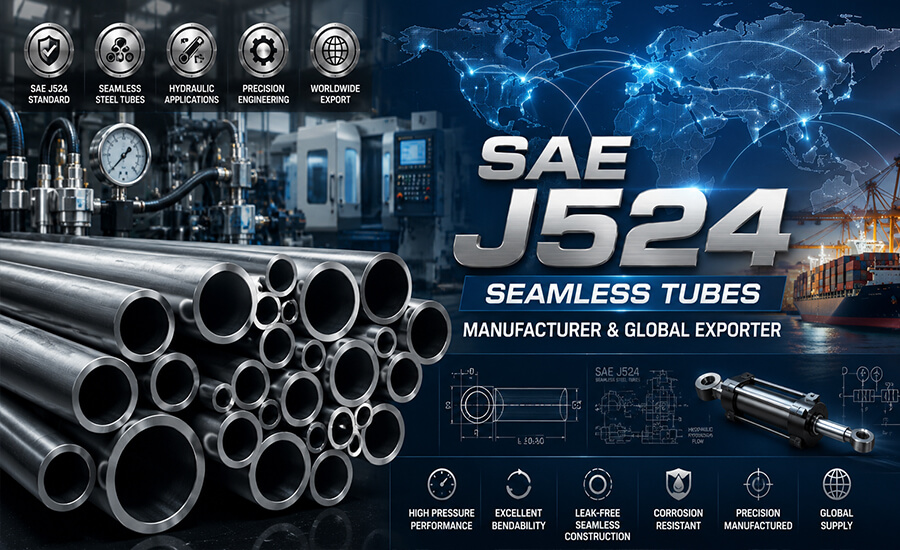
This guide explains what the J524 specification requires, how it differs from the specifications it is most often confused with (SAE J525, SAE J356, ASTM A519), which checks verify genuine compliance, and how Nakoda Steel Industry manufactures and exports SAE J524 tubes to fluid-power buyers worldwide.
What SAE J524 Specifies
SAE International’s J524 standard covers seamless low-carbon steel tubing, cold drawn to size and then fully annealed, intended for applications requiring bending, flaring, or beading — hydraulic lines being the classic case (source: SAE J524, Seamless Low-Carbon Steel Tubing Annealed for Bending and Flaring).
Three requirements define the product:
Seamless construction. The tube is produced without a weld line. In pulsating hydraulic service, a longitudinal weld seam is a potential fatigue-initiation site; the seamless requirement removes it.
Low-carbon chemistry. J524 tube is produced from low-carbon steel in the SAE 1008–1010 range (carbon of roughly 0.05–0.13%). Lower carbon means lower hardness and higher ductility, so the metal flows during flaring instead of tearing.
Full annealing after the final cold draw. Cold drawing achieves precise dimensions and a smooth bore, but it work-hardens the steel. J524 therefore requires annealing after final sizing. In practice, compliant tube is soft — with hardness commonly at or below approximately 65 HRB — which is what allows tight-radius bends and double flares, even with hand tools. (Confirm the exact hardness and test requirements against the current edition of SAE J524 you certify to; standards are revised periodically.)
If a tube misses any of the three — welded instead of seamless, higher-carbon “equivalent” chemistry, or stress-relieved instead of fully annealed — it is not a J524 tube, whatever the label says.
Also Read : pressure-tubing-sae-j524-why-mild-steel-seamless-tubes-are-a-smart-choice-for-hydraulic-lines
J524 vs J525 vs J356 vs ASTM A519
These specifications are frequently substituted for one another in purchase orders. The differences are material, not paperwork:
| Specification | Construction | Typical condition | Appropriate use |
| SAE J524 | Seamless | Fully annealed | Hydraulic/fuel lines where bending and flaring are critical |
| SAE J525 | Welded and cold drawn (DOM-type) | Annealed | Similar service where a proven weld is acceptable, often at lower cost |
| SAE J356 | Welded | As-welded / normalized | General lower-pressure fluid lines |
| ASTM A519 | Seamless | Multiple (including hard-drawn) | Mechanical and structural parts — not automatically suitable for flaring |
Two substitutions cause most problems in practice.
First, accepting ASTM A519 grade 1010 tube as a “J524 equivalent.” The chemistry can match, but A519 permits several supply conditions. If the tube arrives stress-relieved rather than fully annealed, its hardness can exceed what reliable flaring tolerates. The specification is the chemistry plus the condition — not the chemistry alone.
Second, accepting welded J525 against a J524 requirement. For static, low-pulse circuits it may perform acceptably; for high-cycle mobile hydraulics, the seamless requirement exists precisely because of fatigue loading. If your engineering drawing says J524, the substitution decision belongs to your engineer — not your supplier’s convenience.
Also Read : telescoping-tube-guide-what-size-tubing-fits-inside
Where J524 Tubes Are Used
Typical applications, based on what fluid-power buyers actually order this tube for:
- Mobile hydraulics — pressure and return lines on excavators, loaders, and agricultural machinery, bent to fit tight chassis routing
- Industrial fluid power — power packs, presses, and machine tools using 37° flare (JIC-type) connections
- Automotive fluid lines — fuel, brake, and transmission-oil lines formed with double flares at production speed
- Instrumentation and refrigeration lines — where beading and small-radius bends dominate
The common factor: the tube will be formed after purchase, and forming has no tolerance for hard spots.
Also Read : stainless-steel-bolts-vs-grade-5
How Nakoda Steel Industry Manufactures J524 Tubes
At Nakoda Steel Industry, SAE J524 production follows five documented stages. Buyers and third-party inspectors are welcome to witness any of them works.
- Raw material verification. Each incoming heat is checked by spectrometric analysis against the low-carbon band before it enters production. Heats outside specification are rejected — carbon that is too high cannot be annealed into compliance.
- Cold drawing to final size. Multi-pass drawing achieves the dimensional tolerances and bore finish that flare fittings require. Our regularly exported range covers OD in wall thicknesses of . (Verified figures to be inserted before publication.)
- Full annealing in controlled-atmosphere furnaces after the final pass, producing a bright, scale-free bore. Time-temperature furnace records are retained per batch and furnished on request.
- Per-lot testing. Hardness verification against the J524 limit, plus flare and flattening tests on samples from each lot — because the only meaningful way to certify a flaring tube is to flare it.
- Certification and export packing. EN 10204 Type 3.1 mill test certificates linking heat numbers to each bundle; plastic end caps protecting the bore; seaworthy packing; third-party inspection (SGS, BV, TÜV or the agency of your choice) accepted before dispatch. For first-time buyers, we offer a production sample from the running lot before full dispatch, so your own fitters can bend, flare, and section the actual material they will receive. We consider this normal practice, not a favor: a supplier confident in its annealing should have no hesitation putting a sample in your flaring die.
A Common Question: “Can I Buy Cheaper Tube and Anneal It Myself?”
It’s a reasonable idea — annealing is a standard heat-treatment service. In our experience, three practical problems usually erase the saving:
Bore condition. Batch annealing without atmosphere control scales the tube bore. Descaling a small-diameter bore over long lengths is difficult, and residual scale released into a hydraulic circuit damages pumps and valves.
Divided responsibility. If flares subsequently crack, the tube supplier can point to your heat treater, and the heat treater to the steel. Mill-annealed, lot-tested tube keeps accountability in one place — on the manufacturer’s certificate.
Total landed cost. Freight to the treater, treatment charges, re-inspection, and added lead time typically consume the price difference, while leaving you without lot-level flare-test certification.
There are cases where in-house annealing makes sense — high-volume OEMs with their own controlled-atmosphere furnaces do it. For most importers and assemblers, buying the tube certified and annealed at the mill is the lower-risk, and usually lower-cost, path.
Buyer’s checklist: verifying SAE J524 before you pay
- Purchase order states seamless, fully annealed to SAE J524 — not “equivalent,” not “annealed condition available”
- Mill test certificate (EN 10204 3.1) shows per-lot hardness values within the J524 limit
- Flare and flattening test results available for your lot
- Bore is bright annealed and ends are capped on arrival
- A production sample is offered for your own forming trials
- Third-party inspection is accepted without resistance
Conclusion
A flaring die is the most honest inspector in the fluid-power industry: hardened tube cracks, compliant tube flows, and no certificate can argue with the result. Buy from a manufacturer who tests that way before shipping — because you will test that way after receiving, whether you plan to or not.
Sourcing SAE J524 seamless tubes? Send Nakoda Steel Industry your size list and application details. You’ll receive a complete quotation within 24 working hours, including hardness data, per-lot testing commitments, and a production sample offer in writing.