

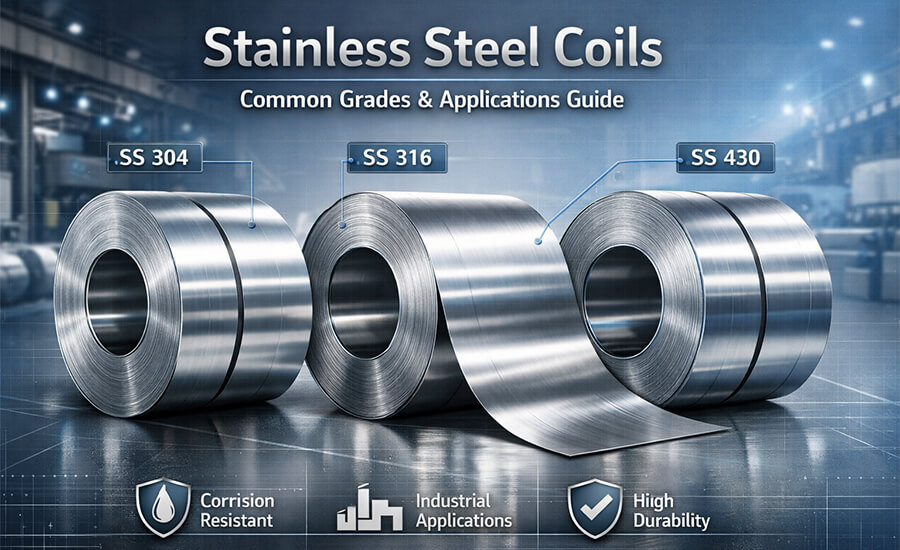
From the structural framework of modern American architecture to the complex machinery powering the food and beverage industry, the backbone of US manufacturing relies heavily on a single, highly versatile product: stainless steel coils. Because coils can be efficiently slit to precise widths, cut into flat sheets, or formed into continuous pipes and tubes, they are an essential raw material for continuous, high-volume production.
At Nakoda International, we know that selecting the right material is the most crucial step in any successful manufacturing project. Whether you are producing commercial kitchen equipment, aerospace components, or automotive exhaust systems, understanding the different grades of stainless steel is essential. Below, we explore the most common types of stainless steel used in coils and how to choose the perfect grade for your specific application.
The Austenitic Family (The 300 Series)
Austenitic stainless steel is the most widely consumed family of stainless steel in the market. Characterized by high levels of chromium and nickel, these grades are non-magnetic, highly formable, and offer excellent resistance to corrosion and extreme temperatures.
- Grade 304 and 304L: Known as the undisputed workhorse of the industry, Grade 304 (often referred to as 18/8 for its 18% chromium and 8% nickel content) is the most common stainless steel. It is widely used in food handling equipment, architectural exteriors, and household appliances due to its excellent blend of corrosion resistance and formability. The “L” variant, 304L, contains lower carbon levels to prevent carbide precipitation (sensitization) during welding, making it ideal for welded tanks and pipes.
- Grade 316 and 316L: Often designated as “marine grade” stainless steel, 316 contains 2-3% molybdenum. This addition drastically improves its resistance to localized pitting and harsh corrosives like chlorides, salt water, and industrial acids. This grade is the premier choice for chemical processing plants, medical devices, and coastal applications.
- Grade 201: While part of the 200 series, this austenitic grade serves as a highly economical alternative to 304. By substituting some of the nickel with manganese and nitrogen, 201 maintains high strength and good corrosion resistance, making it popular for automotive interiors and kitchen appliances.
The Ferritic Family (The 400 Series)
Ferritic stainless steels contain high chromium (typically 10.5% to 27%) but little to no nickel, which makes them a more budget-friendly option. Unlike austenitic grades, ferritic steels are magnetic and cannot be hardened by heat treatment, though they possess excellent resistance to stress corrosion cracking.
- Grade 430: This is the most widely used ferritic stainless steel. It offers strong resistance to mild acids and oxidation up to 1500°F (816°C). Grade 430 is highly favored for consumer products, including automotive trim, dishwasher linings, roofing, and decorative appliance panels.
- Grade 409: Specifically developed for the automotive industry, Grade 409 is a titanium-stabilized steel that is highly formable and weldable. It provides much better oxidation and corrosion resistance than standard carbon steel, making it the industry standard for automotive exhaust systems. Because it can develop light surface rust when exposed to the atmosphere, it is generally not recommended for cosmetic applications.
Duplex Stainless Steels
Duplex grades feature a mixed two-phase microstructure consisting of both austenite and ferrite. This unique structure gives duplex stainless steels exceptionally high yield strength—often double that of standard austenitic grades—while maintaining outstanding corrosion resistance. In coil form, duplex grades (like 2205 or Lean Duplex 2101) are heavily utilized in demanding US industries such as oil and gas, petrochemical processing, and massive municipal water treatment facilities.
Surface Finishes and Dimensions
When sourcing stainless steel coils, the surface finish is just as important as the chemical grade. Coils can be supplied in a standard matte “2D” finish, a bright and reflective “Bright Annealed” (BA) finish for aesthetic applications, or a standard “2B” finish which is the most common for general manufacturing. Coils are also incredibly versatile in dimension, ranging from ultra-thin precision strips down to 0.3mm for delicate stamping, up to thick gauges for heavy structural use.
Why Partner with Nakoda International?
Navigating the complex world of metal alloys requires a trusted and experienced partner. At Nakoda International, we are committed to supplying the highest quality stainless steel coils to our partners across the USA. We understand the rigorous demands of American manufacturing and are dedicated to providing materials that meet strict industry specifications, including ASTM and SAE standards.
Whether your next project requires the heavy-duty marine resilience of 316L, the budget-friendly formability of 430, or the reliable versatility of 304, we have the inventory and expertise to meet your needs. When you choose Nakoda International, you are investing in superior quality, unmatched reliability, and a supply chain specifically tailored to help your business grow.
Contact us today to learn more about our stainless steel coil offerings and how we can elevate your manufacturing process!