

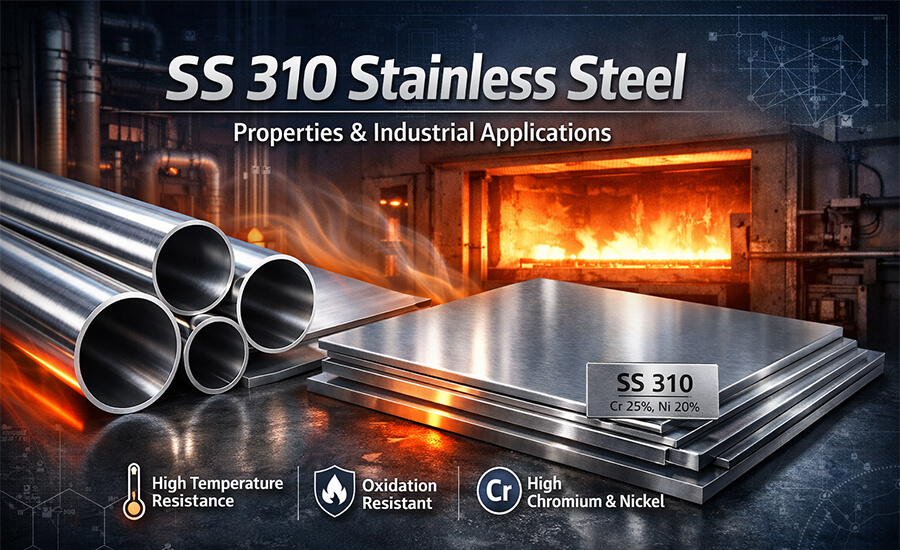
In the demanding world of industrial manufacturing and heavy engineering, material failure is not an option. Whether you are operating high-temperature furnaces in the Midwest or managing chemical processing plants on the Gulf Coast, selecting the right alloy is critical for longevity and safety. Among the myriad of stainless steel grades available, Grade 310 (and its low-carbon sibling, 310S) stands out as a titan of temperature resistance.
At Nakoda Steel Industry, we understand that our clients in the USA require materials that deliver consistent performance under the most grueling conditions. In this article, we dive deep into the properties of SS 310, exploring why it remains a top choice for high-heat applications and how the right 310s stainless steel sheet can add immense value to your operations.
What is SS 310?
Stainless Steel 310 (UNS S31000) is an austenitic heat-resistant alloy designated for high-temperature service. What sets it apart from standard grades like 304 or 316 is its chemical composition. It features a significantly higher content of chromium (24-26%) and nickel (19-22%).
This “high alloy” status is the secret behind its performance. The chromium provides the foundational corrosion resistance and allows the material to form a protective oxide layer, while the high nickel content boosts the alloy’s strength and resistance to oxidation at elevated temperatures.
Key Property: Unmatched High-Temperature Oxidation Resistance
The primary reason industries turn to SS 310 is its ability to withstand heat. This grade generally exhibits excellent resistance to oxidation in temperatures up to 2,010°F (1,100°C) under mildly cyclic conditions.
In continuous service, SS 310 can perform reliably at temperatures up to 2,100°F (1,150°C). This makes it an ideal candidate for environments where lesser alloys would suffer from scaling—a phenomenon where the surface oxide layer thickens and spalls off, leading to rapid material degradation. The high chromium content ensures the formation of a compact, adherent surface scale that prevents this breakdown, keeping your equipment operational for longer periods.
The 310S Advantage: Fabrication and Weldability
While standard SS 310 is robust, modern industrial applications often require extensive fabrication, including welding. This is where Grade 310S (UNS S31008) becomes vital.
SS 310S is essentially the low-carbon version of the alloy, with a maximum carbon content of 0.08%, compared to the 0.25% maximum found in standard 310. This reduction in carbon is crucial for fabrication. It minimizes the risk of carbide precipitation during welding, a defect that can lead to intergranular corrosion and cracking in service.
If your project requires complex forming or welding, sourcing a high-quality 310s stainless steel sheet from Nakoda Steel Industry ensures you get the heat resistance you need without compromising on weld integrity or ease of fabrication.
Corrosion Resistance in Aggressive Atmospheres
Heat isn’t the only enemy in industrial environments; chemical attack is often a concurrent threat.
- Sulfidation: Thanks to its high chromium and moderate nickel levels, SS 310 offers good resistance to sulfidation, a common problem in atmospheres containing sulfur.
- Carburization: The alloy performs well in moderately carburizing atmospheres, such as those found in petrochemical plants, although for very severe applications, even higher nickel alloys might be suggested.
- Aqueous Corrosion: While primarily a heat-resistant grade, the high chromium content (25%) means SS 310 is actually more resistant to aqueous corrosion (wet environments) than many other heat-resistant alloys, provided the environment is not highly concentrated with nitric acid where grain boundary attack could occur.
Mechanical and Magnetic Properties
For engineers calculating structural integrity, SS 310 offers impressive mechanical stability:
- Strength: It retains a larger fraction of its room-temperature strength at elevated temperatures compared to common alloys like Type 304.
- Toughness: Interestingly, SS 310 is not just for heat; it is often used in cryogenic applications. It maintains excellent toughness and low magnetic permeability down to -450°F (-268°C).
- Magnetic Permeability: In its annealed condition, SS 310 is non-magnetic. While cold working can induce some magnetism in other grades, the high nickel content in 310 makes it much more stable and less likely to become magnetic even after processing.
Common Applications in the USA
Given its versatile property profile, SS 310 and 310S are staples in various US industries:
- Thermal Processing: You will find it in annealing covers, burner grids, doors, fans, and muffles.
- Power Generation: It is used for coal gasifier internals and pulverized coal burners.
- Food Processing: Equipment that undergoes high-heat sterilization or cooking processes utilizes 310 for its hygiene and durability.
- Ore Processing: Smelters and steel melting equipment rely on 310 to survive the intense environment of molten metal processing.
Why Choose Nakoda Steel Industry?
Navigating the specifications of high-temperature alloys can be complex. The difference between a standard 310 and a 310s stainless steel sheet might seem minor on paper, but in the welding shop and in the field, it makes a world of difference.
At Nakoda Steel Industry, we pride ourselves on being more than just a supplier; we are partners in your production success. We understand the stringent quality standards required by the American market. When you procure your stainless steel from us, you are guaranteed material that meets rigorous chemical and mechanical standards (such as ASTM A240 and ASTM A276).
We ensure that our 310S inventory is optimized for fabrication, helping you reduce downtime caused by welding complications or premature material failure. Whether you need material for a cryogenic vessel or a furnace retort, our team is ready to supply the exact specifications required for your engineering needs.
Conclusion
Stainless Steel 310 and 310S are the workhorses of the high-temperature world. With their superior resistance to oxidation, sulfidation, and thermal cycling, they provide the reliability essential for heavy industry. By choosing Nakoda Steel Industry, you ensure that your business is built on a foundation of quality, utilizing materials designed to perform when the heat is on.
If you are looking to source high-grade 310s stainless steel sheet or need advice on the right alloy for your high-temperature application, contact Nakoda Steel Industry today. Let us help you build stronger, safer, and more efficient systems.