

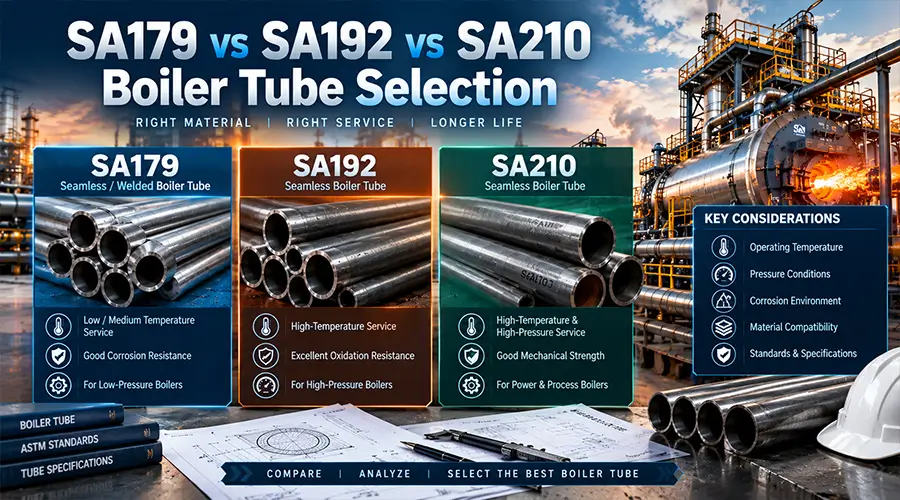
SA179 vs SA192 vs SA210: How to Select the Right Boiler Tube
Pick the wrong tube grade, and a boiler can fail its hydro test. Worse, a tube can bulge or crack months into service, long after the supplier has been paid.
SA179, SA192 and SA210 look almost identical on a mill test certificate. All three are seamless carbon steel tubes, and all three come from ASME Section II. Yet each standard was written for a different job.
SA179 is a cold-drawn, low-carbon tube built for heat exchangers and condensers. SA192 handles high-pressure boiler service. SA210 adds carbon and manganese for extra strength, which suits superheaters, water walls and thinner, lighter tube designs.
In this guide, we compare the three grades on chemistry, mechanical properties, size range, pressure and temperature limits. You will also get a step-by-step selection method, common buying mistakes and an inspection checklist.
The team at Nakoda Steel Industry answers these questions every week for boiler makers, EPC contractors and plant maintenance engineers. This guide puts that practical know-how in one place, so you can choose with confidence.
Table of Contents
- Quick Answer: Which Tube Should You Choose?
- What Is SA179 Tube?
- What Is SA192 Tube?
- What Is SA210 Tube (Grade A-1 and C)?
- SA179 vs SA192 vs SA210: Side-by-Side Comparison
- Key Differences Explained
- How to Choose the Right Boiler Tube: A 6-Step Method
- Real-World Application Examples
- Common Selection Mistakes
- Can You Substitute One Grade for Another?
- Testing, Certification and Inspection Checklist
- Key Takeaways
- Frequently Asked Questions
- Conclusion
Quick Answer: Which Tube Should You Choose?
Choose SA179 for heat exchangers, condensers and coolers where tubes are expanded into a tube sheet. Choose SA192 for low-carbon, high-pressure boiler tubes such as water walls, economizers and boiler banks. Choose SA210 (Grade A-1 or C) when you need higher strength for superheaters or want a thinner, lighter tube wall at the same pressure.
The rest of this guide explains why, and how to confirm the choice for your own design.
What Is SA179 Tube?
SA179 is the ASME version of ASTM A179. It covers seamless, cold-drawn, low-carbon steel tubes for tubular heat exchangers, condensers and similar heat transfer equipment.
The standard covers outside diameters from 1/8 inch to 3 inches (3.2 to 76.2 mm). Every SA179 tube must be cold drawn, then heat treated at 650°C (1200°F) or higher after the final draw. That treatment softens the tube, so it can be expanded into a tube sheet without cracking.
Why Fabricators Prefer SA179
- Low hardness (72 HRB max): The tube expands cleanly into tube sheet holes and seals tight.
- Close tolerances: Cold drawing gives a smooth bore and a consistent wall, which helps heat transfer.
- Easy welding: Low carbon means little risk of hard, brittle zones near the weld.
Simply put, SA179 is a heat exchanger tube first. You will find it in shell-and-tube exchangers, surface condensers, feedwater heaters, air preheaters and lube oil coolers.
What Is SA192 Tube?
SA192 (ASTM A192) covers seamless carbon steel boiler and superheater tubes for high-pressure service. Its chemistry is almost the same as SA179, but the standard is written around pressure parts, not exchangers.
Sizes run from 1/2 inch to 7 inches OD (12.7 to 177.8 mm), with walls from 2.2 to 25.4 mm. Tubes can be hot finished or cold drawn. Most importantly, SA192 is ordered on minimum wall thickness.
That minimum-wall rule matters. In a boiler, the calculated thickness is the floor, and SA192 guarantees the tube never dips below it. That is why water-tube boilers, economizers, water walls and boiler bank tubes so often call for SA192.
What Is SA210 Tube (Grade A-1 and C)?
SA210 (ASTM A210) covers seamless medium-carbon steel boiler and superheater tubes. It also covers boiler flues, safe ends, arch tubes and stay tubes. The standard has two grades: A-1 and C.
Sizes run from 1/2 inch to 5 inches OD (12.7 to 127 mm), with walls from 0.9 to 12.7 mm. Higher carbon and manganese push strength well above SA192. Grade A-1 starts at 415 MPa tensile strength, while Grade C starts at 485 MPa.
More strength means a thinner wall at the same pressure. On a large boiler with kilometres of tubing, that cuts weight and eases handling. As a result, the total tube cost can drop even though the price per tonne is higher.
SA179 vs SA192 vs SA210: Side-by-Side Comparison
The tables below summarise the key requirements of each standard. Always confirm values against the specification edition named in your purchase order.
Chemical Composition (%)
| Element | SA179 | SA192 | SA210 Grade A-1 | SA210 Grade C |
|---|---|---|---|---|
| Carbon | 0.06–0.18 | 0.06–0.18 | 0.27 max | 0.35 max |
| Manganese | 0.27–0.63 | 0.27–0.63 | 0.93 max | 0.29–1.06 |
| Phosphorus | 0.035 max | 0.035 max | 0.035 max | 0.035 max |
| Sulphur | 0.035 max | 0.035 max | 0.035 max | 0.035 max |
| Silicon | Not specified | 0.25 max | 0.10 min | 0.10 min |
Mechanical Properties
| Property | SA179 | SA192 | SA210 Grade A-1 | SA210 Grade C |
|---|---|---|---|---|
| Tensile strength, min | 325 MPa (47 ksi) | 325 MPa (47 ksi) | 415 MPa (60 ksi) | 485 MPa (70 ksi) |
| Yield strength, min | 180 MPa (26 ksi) | 180 MPa (26 ksi) | 255 MPa (37 ksi) | 275 MPa (40 ksi) |
| Elongation in 50 mm, min | 35% | 35% | 30% | 30% |
| Hardness, max | 72 HRB | 77 HRB | 79 HRB | 89 HRB |
Size, Manufacture and Typical Use
| Feature | SA179 | SA192 | SA210 |
|---|---|---|---|
| OD range | 3.2–76.2 mm (1/8–3 in) | 12.7–177.8 mm (1/2–7 in) | 12.7–127 mm (1/2–5 in) |
| Steel type | Low carbon | Low carbon | Medium carbon |
| Manufacture | Cold drawn only | Hot finished or cold drawn | Hot finished or cold drawn |
| Heat treatment | 650°C min after final cold draw | 650°C min on cold-drawn tubes | Required on cold-finished tubes |
| Wall basis | Minimum or average wall, as ordered | Minimum wall | Minimum or average wall, as ordered |
| Typical use | Heat exchangers, condensers, coolers | Water walls, economizers, boiler banks | Superheaters, water walls, high-strength boiler tubes |
| General requirements | SA450 | SA450 | SA450 |
Key Differences Explained
1. Purpose of the Standard
SA179 was written for heat transfer equipment, where tubes are expanded into tube sheets. SA192 and SA210, on the other hand, were written for pressure parts inside fired boilers. That single difference shapes almost every other requirement.
2. Carbon Content and Strength
SA179 and SA192 share the same low-carbon chemistry limits. SA210 allows up to 0.27% carbon (Grade A-1) or 0.35% (Grade C), plus more manganese.
The payoff is strength. SA210 A-1 offers about 28% more minimum tensile strength than SA192, and Grade C offers about 49% more.
3. Pressure Rating and Wall Thickness
For boiler tubes up to 5 inches OD, ASME Section I (PG-27.2.1) sets the minimum wall thickness with this formula:
t = \frac{PD}{2S + P} + 0.005D + eHere, t is the minimum wall, P is the maximum allowable working pressure, and D is the outside diameter. S is the allowable stress from ASME Section II Part D, and e is a code allowance that depends on how the tube end is attached.
Because S rises with tensile strength, SA210 C gives a thinner calculated wall than SA192 at the same pressure and temperature. Designers use this to save weight in large water walls and superheater banks.
4. Temperature Limits
All three grades are plain carbon steels. Above roughly 425–450°C metal temperature, carbon steel loses strength quickly, oxidises faster and can graphitise over long service.
That is why hotter superheater and reheater sections switch to alloy tubes such as SA213 T11, T22 or T91. In practice, SA192 covers water-cooled circuits, while SA210 A-1 or C covers the cooler superheater passes.
5. Code Acceptance
ASME Section I lists the tube specifications it permits for boiler pressure parts in PG-9. SA192 and SA210 are standard choices there. SA179, by contrast, is generally specified for heat exchangers built to ASME Section VIII or TEMA, so check PG-9 before using it in a fired boiler.
6. Hardness and Expandability
SA179 has the lowest hardness cap at 72 HRB, which is ideal for roller expansion. SA192 is close behind at 77 HRB. SA210 C, at up to 89 HRB, is much harder, so expanding it needs tighter control and a tube sheet that is harder than the tube.
How to Choose the Right Boiler Tube: A 6-Step Method
Use this sequence on every new project or retubing job. It takes minutes, and it prevents most costly mistakes.
- Identify the equipment. A heat exchanger, condenser or cooler points to SA179. A fired boiler, HRSG or waste heat boiler points to SA192 or SA210.
- Confirm the design code. Check whether the job falls under ASME Section I, ASME Section VIII, TEMA or the Indian Boiler Regulations (IBR). The code decides which grades are allowed.
- Find the maximum metal temperature. If the tube metal runs above about 450°C, move to an alloy grade instead of carbon steel.
- Run the wall thickness calculation. Calculate the wall for both SA192 and SA210 C. Then compare total weight, price and bending effort.
- Check the joint method. Expanded joints favour softer tubes like SA179 or SA192. Welded joints with SA210 C may need preheat because of the higher carbon.
- Check size and lead time. Common sizes are stocked, but odd sizes in SA210 C may need a dedicated mill run. Factor this into your project schedule early.
Real-World Application Examples
Specifications make more sense when you see them in a plant. Here are typical ways each grade gets used.
- Refinery shell-and-tube cooler: A bundle of 19.05 mm OD × 2.11 mm (3/4 inch, 14 BWG) SA179 tubes is roller-expanded into a carbon steel tube sheet. The low hardness gives leak-tight joints without seal welding.
- Sugar mill bagasse-fired boiler: Water wall and bank tubes, often around 63.5 mm OD, are specified in SA192. The cooler superheater coils use SA210 A-1, while the hottest coils move to an alloy grade.
- HRSG economizer: Finned SA192 or SA210 A-1 tubes sit in the coolest gas zone. Here, designers watch the flue gas dew point closely, because low-temperature corrosion is the bigger threat, not strength.
- Utility boiler water wall: Designers pick SA210 C to cut wall thickness across thousands of metres of membrane panel. The weight saving eases erection and lowers structural load.
- Retubing an old boiler: The safest route is to match the original specification. Upgrading the grade needs a design review and, in India, the boiler inspector’s approval.
Common Selection Mistakes (and How to Avoid Them)
Most tube failures we hear about trace back to the purchase order, not the mill. Watch out for these six errors.
- Using SA179 in a fired boiler. It may be cheaper or in stock, but it is generally not the grade Section I or IBR designs call for.
- Assuming SA179 and SA192 are interchangeable. The chemistry matches, but the wall basis, size range and hardness limits differ.
- Forgetting expansion hardness. SA210 C tubes can crack or leak if rolled into a tube sheet that is softer than the tube.
- Upgrading to SA210 C without new weld procedures. Higher carbon raises the carbon equivalent, so preheat and a qualified procedure may be needed.
- Missing IBR paperwork. Tubes for IBR boilers in India need IBR-approved certification. Without it, the inspector can reject an entire lot.
- Accepting certificates without traceability. Each tube’s heat number must match the mill test certificate. If it does not, the tube is unverified material.
Can You Substitute One Grade for Another?
Sometimes, yes, but only with written approval from the design engineer and, where needed, the inspecting authority. Here is how the common swaps usually play out.
- SA192 in place of SA179: Often workable in an exchanger, since the chemistry is the same. However, check the hardness limit and size tolerances before approving.
- SA210 A-1 in place of SA192: Usually an upgrade in strength. Even so, confirm weld procedures, bending and expansion behaviour.
- SA179 in place of SA192: Generally not acceptable for fired-boiler pressure parts.
Many mills supply dual-certified SA179/SA192 tubes, which meet both standards at once. This gives stockists flexibility, but always confirm that both grades appear on the certificate.
Testing, Certification and Inspection Checklist
All three grades follow the general requirements of SA450. Depending on the grade, tests include tensile, flattening, flaring or flange, and hardness tests. In addition, every tube gets a hydrostatic test or a non-destructive electric test such as eddy current or ultrasonic testing.
Before you accept a delivery, run through this checklist:
- Mill test certificate to EN 10204 3.1, or 3.2 when third-party witness is required
- Heat number stencilled on each tube and matched to the certificate
- Hydrostatic test or NDT record for every tube
- Dimensional report covering OD, wall thickness, length and straightness
- IBR certification for boiler projects in India
- Third-party inspection report, if your client requires one
- Visual check for laps, seams, pits and rust, with end caps in place
When you source through Nakoda Steel Industry, ask for this full document pack with the quotation. Settling paperwork before dispatch is far cheaper than chasing it after the tubes reach site.
Key Takeaways
- SA179 is a cold-drawn, low-carbon tube made for heat exchangers and condensers, sized 3.2–76.2 mm OD.
- SA192 shares SA179’s chemistry but is built for high-pressure boiler tubes and ordered on minimum wall.
- SA210 adds carbon and manganese, giving 415 MPa (A-1) or 485 MPa (C) minimum tensile strength.
- Higher strength lets SA210 C use a thinner wall, which saves weight on large boilers.
- All three are carbon steels; above roughly 450°C metal temperature, switch to alloy grades like SA213 T11 or T22.
- Never swap grades without engineering approval, and always check heat-number traceability and IBR paperwork.
Frequently Asked Questions
What is SA179 tube used for?
SA179 tubes are used in shell-and-tube heat exchangers, surface condensers, feedwater heaters, air preheaters and oil coolers. Their low hardness makes them easy to expand into tube sheets.
Is SA179 the same as ASTM A179?
Yes, in substance. ASME adopts ASTM A179 as SA179 in Section II Part A, sometimes with minor additions. ASME code work requires the SA designation on the certificate.
What is the difference between SA179 and SA192?
Both have the same low-carbon chemistry. However, SA179 is a cold-drawn heat exchanger tube up to 3 inches OD, while SA192 is a high-pressure boiler tube up to 7 inches OD, ordered on minimum wall thickness.
Which is stronger, SA192 or SA210?
SA210 is stronger. SA192 has a minimum tensile strength of 325 MPa, while SA210 Grade A-1 reaches 415 MPa and Grade C reaches 485 MPa.
What is the difference between SA210 Grade A-1 and Grade C?
Grade C allows more carbon (0.35% max vs 0.27% max) and has higher strength. Its minimum tensile strength is 485 MPa against 415 MPa for A-1, and its hardness limit is 89 HRB against 79 HRB.
Can SA179 be used for boiler tubes?
Generally, no. SA179 is a heat exchanger specification, and ASME Section I designs normally call for SA192, SA210 or alloy tubes. Always check the code’s permitted materials list and get engineering approval.
What is the maximum temperature for SA192 and SA210 tubes?
ASME Section II Part D lists allowable stresses at each temperature for both grades. In practice, carbon steel tubes are kept below roughly 425–450°C metal temperature, because oxidation and graphitisation become concerns above that range.
Are SA179, SA192 and SA210 tubes IBR approved?
IBR approval depends on the manufacturer and the inspection route, not just the grade. For boilers in India, buy tubes from an IBR-approved mill with IBR-certified test documents.
Why are some tubes dual-certified SA179/SA192?
The two grades share the same chemistry, so mills can make one tube that meets both standards. This simplifies stocking, but the certificate must clearly list both grades.
What should a boiler tube purchase order include?
Include the grade and edition, OD, wall thickness (minimum or average), length, quantity and finish. Also list the required tests, certification (EN 10204 3.1 or 3.2), IBR needs and any third-party inspection.
Conclusion
SA179, SA192 and SA210 may share a family resemblance, but they are not interchangeable. SA179 belongs in heat exchangers and condensers. SA192 is the dependable low-carbon choice for high-pressure boiler circuits, while SA210 delivers extra strength for superheaters and thinner-wall designs.
The right choice comes down to your equipment, design code, metal temperature and joint method. Follow the six-step method above, and you will rarely go wrong.
If you are still unsure, talk to a supplier who understands the specifications, not just the price list. Nakoda Steel Industry can help you match the grade, size and documentation to your exact project.
Ready to Source the Right Boiler Tubes?
Get the right tube, with the right paperwork, the first time. Nakoda Steel Industry supplies SA179, SA192 and SA210 tubes for heat exchanger manufacturers, boiler makers, EPC contractors and plant maintenance teams.
Share your drawing or bill of materials with our team today. We will recommend the right grade, confirm sizes and lead times, and send a detailed quotation with full test certification.
Request a quote from Nakoda Steel Industry now.https://nakodasteelindustry.com/contact-us/