

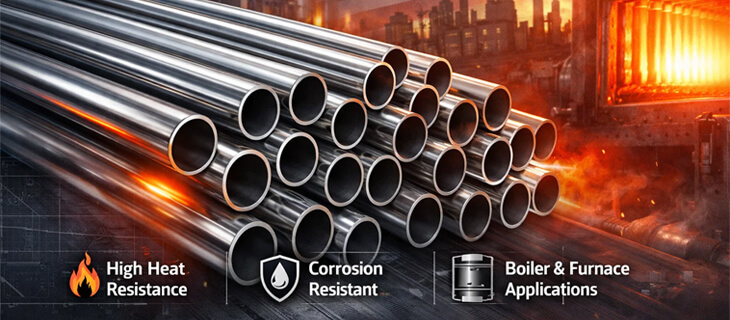
In the complex landscape of American manufacturing and industrial processing, the materials you choose determine the longevity and safety of your operations. From the high-pressure environments of Texas oil refineries to the hygienic standards of food processing plants in the Midwest, stainless steel tubes are the unsung heroes of modern infrastructure.
At Nakoda Steel Industry, we understand that selecting the right tubing isn’t just about dimensions; it is about matching specific metallurgical properties to demanding applications. Whether you are engineering a new heat recovery system or retrofitting a chemical plant, understanding the common applications of high-performance stainless steel is critical.
Here is a look at how specialized stainless steel tubes drive value across major US industries, with a specific focus on high-temperature and heat exchange capabilities.
1. High-Temperature Environments and Furnace Components
One of the most challenging environments for any metal is extreme heat combined with oxidizing atmospheres. Standard carbon steels often fail under these conditions, losing tensile strength or succumbing to scaling. This is where the austenitic class of stainless steel proves vital.
Specifically, Stainless Steel 310s tubes are the industry standard for operations requiring resistance to extreme temperatures. The “S” in 310S indicates a lower carbon content (maximum 0.08%) compared to the standard 310 grade. This subtle chemical alteration provides a massive advantage: it minimizes carbide precipitation during welding.
For industries utilizing industrial furnaces, kilns, or combustion chambers, Stainless Steel 310s tubes offer:
- Temperature Resistance: They withstand continuous service temperatures up to 2000°F (1093°C) and intermittent temperatures up to 2100°F (1149°C) without significant scaling.
- Weldability: Because of the lower carbon content, these tubes are less prone to sensitization and intergranular corrosion after welding, often eliminating the need for post-weld heat treatment.
- Application: You will frequently find Nakoda Steel Industry’s 310S products in radiant tubes, annealing boxes, conveyor belts in heat treatment facilities, and burner components.
2. The Critical Role of Heat Exchanger Tubes
Efficiency is the currency of the energy and chemical sectors. Devices that transfer heat from one medium to another—heat exchangers—are the heart of these facilities. The tubes inside these exchangers must act as a barrier between hot and cold fluids while facilitating rapid thermal transfer.
Heat Exchanger Tubes supplied by Nakoda Steel Industry are engineered to survive where other materials falter. In shell and tube heat exchangers, the tubing is exposed to simultaneous pressure and thermal stress. If a tube fails, it can lead to cross-contamination of fluids or catastrophic pressure loss.
Common applications for our high-grade heat exchanger tubes include:
- Condensers and Evaporators: Used extensively in power generation to condense steam back into water for reuse.
- Chemical Processing: In environments involving acids or alkalis, the high chromium and nickel content in our austenitic tubes provides the necessary corrosion resistance to prevent leaks and downtime.
- Oil and Gas: Cooling hydrocarbons and steam recovery in refineries require tubes that resist both sulfide stress cracking and high-temperature oxidation.
Whether you require seamless tubes for high-pressure boilers or welded options for lower-pressure condensers, the integrity of the Heat Exchanger Tubes you install directly correlates to the efficiency of your plant.
3. Oil, Gas, and Chemical Processing
The United States is a global leader in energy production, and the infrastructure supporting this sector relies heavily on stainless steel. Beyond heat exchange, stainless tubes are essential for:
- Downhole Control Lines: In deep-water drilling, tubes are used to inject chemicals that prevent corrosion or improve flow. These lines must resist the “sour” service environments caused by hydrogen sulfide ($H_2S$).
- Instrumentation: Precision is key in monitoring flow, pressure, and temperature. Seamless stainless steel tubes are used to connect gauges and sensors, requiring clean internal surfaces and tight tolerances to ensure accurate data transmission.
- Flowlines: Transporting crude oil and natural gas often involves handling abrasive and corrosive substances. Stainless steel provides the durability needed to prevent environmental leaks and ensure safe transport.
4. Food, Beverage, and Pharmaceutical Purity
In industries where consumer safety is paramount, the non-reactive nature of stainless steel is non-negotiable.
- Hygienic Transport: In dairy processing, juice bottling, or pharmaceutical manufacturing, fluids must move through lines that are easy to clean and resistant to bacterial growth. High-polish stainless steel tubes allow for Clean-In-Place (CIP) systems, ensuring that lines can be sanitized without disassembly.
- Corrosion Resistance: The frequent use of harsh sanitizing chemicals would corrode lesser metals. Stainless steel resists these cleaning agents, ensuring that no metallic impurities leach into the final product.
Why US Industries Trust Nakoda Steel Industry
Choosing a supplier is as important as choosing the grade of steel. At Nakoda Steel Industry, we are committed to providing value that goes beyond the raw material.
- Quality Compliance: Our products adhere to rigorous international standards such as ASTM A213, ASTM A312, and ASTM A249. Whether you need seamless or welded options, we ensure our tubes meet the strict dimensional and chemical requirements of American engineering projects.
- Material Expertise: From general-purpose 304/316 grades to the specialized Stainless Steel 310s tubes for your high-heat applications, we maintain a diverse inventory to meet specific project needs.
- Reliability: We understand that in sectors like Power Generation and Petrochemicals, downtime is not an option. Our supply chain is optimized to deliver Heat Exchanger Tubes and other critical components when you need them.
Conclusion
Whether you are designing a furnace that needs to withstand 2100°F or a heat exchanger that needs to run efficiently for decades, the quality of your tubing dictates the success of your project.
Don’t compromise on the arteries of your industrial infrastructure. For high-performance solutions, including Stainless Steel 310s tubes and precision Heat Exchanger Tubes, trust Nakoda Steel Industry to deliver the durability and performance your business demands.
Contact Nakoda Steel Industry today to discuss your project requirements and request a quote.