

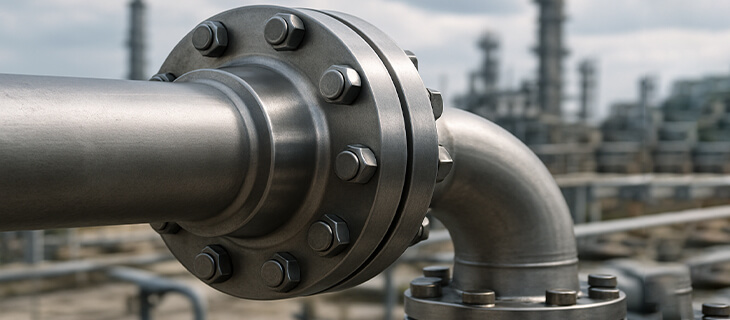
When designing critical industrial systems—especially those exposed to seawater, harsh chemicals, or extreme pressures—relying on standard components can lead to costly, catastrophic failures. If you are involved in oil and gas, desalination, or aggressive chemical processing, you need more than a general-purpose alloy; you need a strategic, high-performance solution.
That solution is found in Super Duplex Flanges.
At Nakoda Steel Industry, we understand that reliability is non-negotiable. This expert guide explains the immense performance and long-term cost advantages of choosing super duplex stainless steel for your demanding flange connections.
1. The Core Benefit: Unbeatable Corrosion Resistance
Super Duplex Stainless Steel (SDSS) is a specialized class of material engineered specifically for severe service conditions where conventional stainless steels often fail.
The secret lies in the duplex flanges’ fundamental metallurgy. Unlike common austenitic grades (like 316L) which have a single phase, duplex steels feature a dual-phase microstructure consisting of approximately equal proportions of ferrite and austenite. This hybrid structure captures the best properties of both phases: excellent toughness from the austenitic phase and very high mechanical strength and outstanding resistance to corrosion from the ferritic phase.
To become “Super Duplex,” the material is heavily alloyed with higher percentages of Chromium (Cr), Molybdenum (Mo), and Nitrogen (N).
The PREN Advantage
The corrosion performance of super duplex is quantified by its Pitting Resistance Equivalent Number (PREN), which is calculated based on its chemical composition.
- Standard 316L stainless steel has a PREN of approximately 24–26.
- Standard duplex (2205) is around 35–37.
- Super Duplex (e.g., S32750/2507) has a PREN greater than 40 (typically 42+).
This elite resistance means that super duplex flanges are qualified for a higher class of corrosive service, especially in high-chloride environments like seawater.
Immunity to Catastrophic Failure Modes
The primary driver for choosing SDSS flanges is their ability to survive environments that would quickly destroy lesser alloys.
- Chloride Stress Corrosion Cracking (SCC): Standard austenitic stainless steels are highly susceptible to SCC when exposed to chloride ions, stress, and temperatures above 60°C (140°F), leading to sudden, brittle failures. Crucially, the dual-phase structure of super duplex makes it virtually immune to chloride-induced SCC, making it the non-negotiable choice for high-pressure, high-stress, chloride-rich applications.
- Localized Pitting and Crevice Corrosion: The high PREN (>40) provides exceptional resistance to pitting corrosion. For instance, while 316L begins to pit in standard chloride solutions at just 10°C–15°C, Super Duplex remains fully resistant even above 50°C (122°F), making it perfect for hot, tropical seawater systems.
2. The Strength Advantage: Economic Value and Down-Gauging
Beyond corrosion resistance, super duplex flanges offer superior mechanical strength, delivering significant cost savings throughout your project lifecycle.
Thinner, Lighter, Stronger Designs
SDSS possesses a minimum yield strength typically double that of austenitic stainless steels. For example, 316L yields at 205 MPa (30 ksi), whereas Super Duplex (S32750) yields at 550 MPa (80 ksi).
This high strength-to-weight ratio allows engineers to employ “down-gauging”—designing flanges and piping systems with thinner walls and reduced cross-sections while maintaining the same pressure rating. One analysis showed that a standard duplex flange could be up to 30% thinner and 40% lighter than a 304 stainless steel equivalent.
Lower Total Cost of Ownership (TCO)
While the initial procurement cost of super duplex is higher than 316L, focusing solely on the unit price is flawed. The true economic value is realized through a lower Total Cost of Ownership (TCO).
The cost savings cascade throughout the entire project:
- Reduced Material Volume: Lighter components mean less stainless steel volume purchased.
- Lower Fabrication Costs: Thinner walls require fewer weld passes and less expensive filler metal, reducing labor hours.
- Reduced Logistics: Lighter finished piping spools lower costs for transportation, crane time, and installation labor.
- Elimination of Downtime: By eliminating common failures like SCC or pitting, you avoid costly replacements and unplanned operational downtime over the 20-30 year lifespan of an asset.
3. Essential Applications of Super Duplex Flanges
Super duplex flanges are the material of choice for non-negotiable applications.
- Offshore Oil and Gas: Used extensively in topside seawater piping, subsea flowlines, and processing vessels where components face high pressures, high-chloride seawater, and potential sour service (H₂S). Grades like S32750 (F53) and S32760 (F55) are explicitly approved for use in sour service under NACE MR0175 / ISO 15156 standards.
- Desalination Plants: They are critical for High-Pressure Reverse Osmosis (SWRO) systems, especially in areas handling hot, highly concentrated chloride brine. The strength of SDSS is essential for operating at high pressures (up to 80 bar / 1200 psi).
- Chemical Processing: Super duplex excels in streams containing aggressive mixtures of acids and chlorides. Specifically, the S32760 (F55) grade is preferred for reducing acid environments, such as those involving sulfuric or hydrochloric acid, due to intentional additions of Copper and Tungsten.
- Pulp and Paper: SDSS is used in digesters and bleach plant equipment, resisting both hot caustic soda and chlorine-based compounds.
Partner with a Trusted Duplex Flanges Supplier
The elite properties of super duplex stainless steel are contingent on stringent, expert fabrication and manufacturing processes. Improper welding or heat treatment can destroy the material’s carefully balanced microstructure, leading to catastrophic embrittlement.
When procuring these critical components, quality and traceability are paramount.
As a leading duplex flanges supplier, Nakoda Steel Industry is committed to providing certified Super Duplex Flanges that meet the highest standards, including NACE compliance for sour service applications. We ensure that every flange adheres to strict dimensional standards and is tested to certify metallurgical integrity.
Ready to upgrade your critical systems? Choosing Super Duplex is an advanced engineering and economic judgment that guarantees a reliable, long-term solution. Trust Nakoda Steel Industry for materials engineered for survival.