

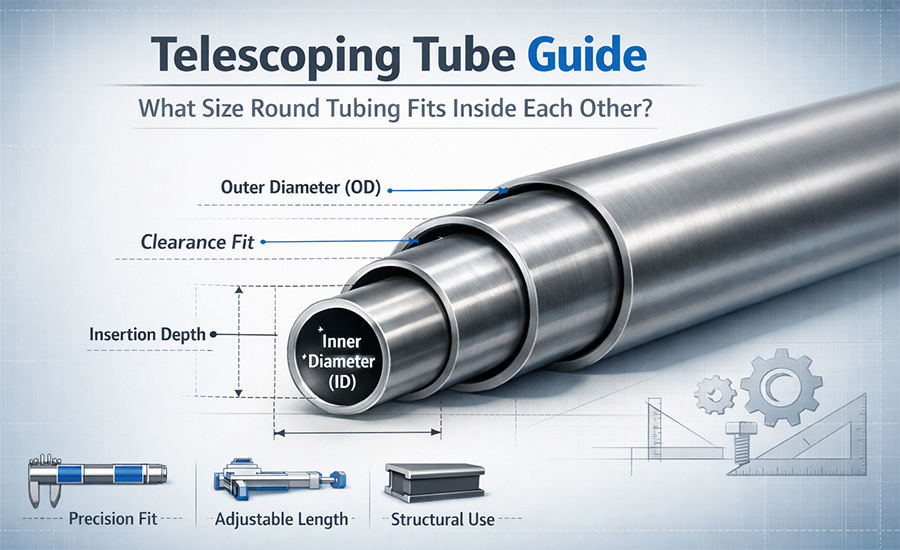
Mastering Telescoping Tube: What Size Round Tubing Fits Inside Each Other?
If you are a fabricator, manufacturer or engineer in the USA, you have likely encountered projects that require variable widths, adjustable heights, or modular assembly. When the final dimensions of a project need to be adaptable, the most effective solution is a process known as telescoping. Telescoping involves sliding one steel tube inside of another to allow for smooth extension and retraction,.
This highly versatile mechanism is found in countless everyday and industrial applications across the country. You will see telescoped metal used in adjustable table legs, safety railings, heavy-duty supports, camera tripods, racking shelving systems, and complex assembly lines. While telescoping square tubing is generally straightforward—often using standard 14-gauge materials with 0.083-inch walls—working with round steel tubing is a much more complex and imprecise process,,.
If you are wondering exactly what size round tubing fits inside each other, you are not alone. At Nakoda International, we regularly help our American partners navigate the complexities of metal sizing. Here is your comprehensive guide to getting the perfect telescoping fit.
The Golden Rule of Calculating Inside Diameter
The first step in telescoping is understanding the exact dimensions of your outer tube. To determine what size round tubing will fit inside, you must calculate the true Inside Diameter (ID).
There is a simple and fundamental mathematical formula for this: you must subtract the wall thickness from the Outside Diameter (OD) twice. Because the wall thickness surrounds the entire perimeter of the tube, subtracting it only once will give you an incorrect measurement. For example, if you are working with a round steel tube that has an 8-inch OD and a 1.5-inch wall thickness, your ID will be 5 inches (8 – 1.5 – 1.5 = 5).
However, in the world of steel fabrication, mathematical perfection on paper does not always translate to a perfect fit in the real world.
The Hidden Traps: Tolerances and Weld Seams
If you simply buy an inner tube with a 5-inch OD to fit into a 5-inch ID outer tube, they will almost certainly get stuck. This happens because of two massive hidden variables in metalworking: manufacturing tolerances and internal weld seams.
First, steel tubing comes with both OD and ID tolerances, and they are not identical. In the manufacturing process, OD tolerances generally tend to run larger, while ID tolerances tend to run smaller. Because of these minor variations, two tubes that mathematically seem like a perfect match will often fail to telescope,.
Secondly, standard welded steel tubing comes with an internal weld seam. This leftover inside weld flash will physically block you from tightly telescoping one tube into another,.
Why DOM Tubing is the Ultimate Solution
To solve the weld seam issue, professionals turn to DOM (Drawn Over Mandrel) tubing. DOM tubing is typically manufactured from 1020 to 1026 or ST52.3 grade electric resistance welded steel,. During the manufacturing process, all of the flash weld is completely removed from the inside of the tube before it is cold-drawn over a mandrel to its final size,,.
Because the weld flash is gone, the interior is incredibly smooth and clean,. Furthermore, the cold-drawing process gives DOM tubing uniform wall thickness, highly controlled hardness, and incredibly exact OD and ID tolerances compared to other steel tubing,. It also boasts high yield and tensile strength, making it highly durable for load-bearing telescoping applications,.
When sourcing materials for adjustable parts, it is critical to partner with knowledgeable dom tubing distributors. At Nakoda International, we supply premium, smooth-bore DOM tubing that helps USA-based businesses bypass the headaches of internal weld seams entirely.
The 0.010” Clearance Rule and Craftsmanship
Even when utilizing high-quality DOM tubing, you still need to leave room for the metal to breathe. As a general rule of thumb, you should plan to allow at least 0.010 inches of clearance between the OD of your inner tube and the ID of your outer tube,.
However, because of the strict nature of metal tolerances, even allowing for a 0.010-inch gap will not absolutely guarantee that your tubes will effortlessly slide together straight out of the box. The only way to definitively guarantee that two tubes will telescope is to physically test them together.
Experts advise being as liberal as possible when selecting sizes for telescoping parts. You should always be prepared to apply a little bit of manual craftsmanship to achieve your desired fit. This craftsmanship might be as simple as gently sanding the OD of the inner tube, or it could require precisely machining the tube down on a lathe or mill. DOM tubing has excellent machining characteristics, making this final adjustment phase highly efficient.
Your Trusted Partner for Steel Tubing
Telescoping round steel tubing requires careful planning, the right math, and the highest quality materials,. By utilizing DOM tubing and allowing for proper clearances, you can build reliable, adjustable mechanisms for any commercial or industrial application.
At Nakoda International, we are dedicated to providing the USA market with top-tier steel products and unmatched expertise. Whether you are engineering heavy machinery or building custom racking systems, we have the exact specifications you need to make your project a success.
Are there any specific sizes or grades of tubing you are currently looking to source for your next telescoping project?