

A Guide to Types of Stainless Steel Used in Coils
For manufacturers and engineers across the USA, stainless steel is synonymous with durability and versatility. From the sleek appliances in a modern American kitchen to the rugged components of offshore oil rigs, this material is the backbone of countless industries. However, when sourcing materials for large-scale production, the form factor matters just as much as the alloy.
At Nakoda Steel Industry, we understand that selecting the right material is critical for your bottom line. While we are widely recognized as a premier carbon steel coil exporter, our expertise extends deeply into the world of Stainless Steel Coils & Sheets.
If you are navigating the complex market of stainless steel coils, understanding the specific grades available—and their distinct applications—is the first step toward project success. Here is a breakdown of the most common types of stainless steel used in coils to help you make an informed decision.
The “Workhorse” Alloys: Austenitic Stainless Steel
The most widely used stainless steels in coil form belong to the austenitic family (the 300 series). These grades are non-magnetic, highly ductile, and known for excellent corrosion resistance due to their chromium and nickel content.
- Grade 304/304L: The Industry Standard Often referred to as “18/8” stainless steel because it contains roughly 18% chromium and 8% nickel, Grade 304 is the most versatile option available. It offers excellent formability, making it the top choice for deep drawing and stamping operations often performed on coils.
- Best Uses: Kitchen equipment, storage tanks, architectural paneling, and automotive trim.
- 304L Variant: The “L” stands for “Low Carbon.” This version is preferred for applications requiring heavy welding, as the lower carbon content prevents carbide precipitation that can lead to corrosion.
- Grade 316/316L: The Marine Choice While 304 is durable, it has a weakness: chlorides. If your project involves marine environments or chemical processing, Grade 316 is the superior choice. It contains 2–3% molybdenum, an element that significantly boosts resistance to pitting corrosion caused by saltwater and industrial chemicals.
- Best Uses: Marine components, chemical processing equipment, pharmaceutical tools, and outdoor enclosures in coastal areas.
- Cost Factor: Due to the addition of molybdenum and higher nickel content, 316 coils typically cost 20–30% more than 304, but the investment prevents long-term failure in harsh environments.
The Cost-Effective Alternative: Ferritic Stainless Steel
Ferritic grades (the 400 series) are magnetic and generally contain high chromium but little to no nickel. This makes them more cost-effective than their austenitic counterparts, though they generally offer lower formability.
- Grade 430 This is the most common ferritic grade used in coils. It provides good resistance to corrosion, particularly against stress corrosion cracking, and is widely used where a high aesthetic finish is required but the environment is not overly aggressive.
- Best Uses: Automotive trim, dishwasher linings, and refrigerator panels.
High-Strength and Specialty Grades
- Grade 410 (Martensitic) For applications requiring high strength and moderate corrosion resistance, Grade 410 is a go-to. Unlike the 300 series, this grade can be hardened by heat treatment, making it ideal for items that need to hold a sharp edge or withstand mechanical stress.
- Best Uses: Cutlery and surgical instruments.
- Duplex 2205 Duplex stainless steels mix austenitic and ferritic structures. Grade 2205 is stronger than both 304 and 316 and offers superior resistance to stress corrosion cracking. It is increasingly used in demanding industrial sectors like oil and gas.
Coil vs. Sheet: Why Choose Coil?
At Nakoda Steel Industry, we often help clients decide between Stainless Steel Coils & Sheets. While they start from the same material, the application dictates the form.
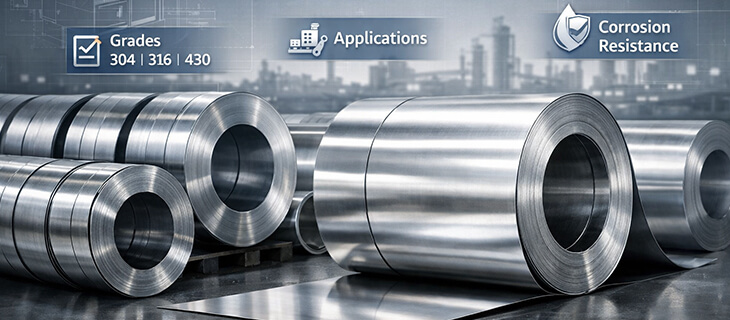
A stainless steel coil is a long, continuous strip wound into a roll. It is produced via hot rolling (for thicker gauges) or cold rolling (for thinner gauges and smoother finishes).
- Efficiency: Coils are the “workhorse” of high-volume manufacturing. They allow for automated feeding into machinery for stamping or cutting with minimal interruption, significantly reducing scrap waste and labor costs.
- Flexibility: While sheets are pre-cut to specific dimensions, coils allow manufacturers to cut lengths exactly as needed for custom projects.
Key Buying Considerations for the US Market
When ordering from Nakoda Steel Industry, consider these specifications to ensure the coil meets your US-based facility’s needs:
- Surface Finish: Coils come in various finishes. “No. 1” is a dull, hot-rolled finish for industrial use. “2B” is a smooth, cold-rolled finish common for general applications. “No. 4” is the brushed finish you often see on kitchen appliances.
- Edge Condition: You can request “Mill edges” (raw edges from rolling) or “Slit edges” (trimmed to a precise width).
- Certification: Always ensure your supplier provides a Mill Test Certificate (MTC). This verifies the chemical composition and mechanical properties, ensuring the steel meets ASTM or AISI standards.
Partner with Nakoda Steel Industry
Whether you are manufacturing automotive parts in Detroit or marine equipment in Florida, choosing the right stainless steel grade is essential for product longevity.
Nakoda Steel Industry is committed to delivering quality and certainty. We are a trusted carbon steel coil exporter and a dedicated supplier of high-grade Stainless Steel Coils & Sheets. Our team can help you navigate the trade-offs between the cost-effectiveness of 430, the versatility of 304, and the durability of 316 to find the perfect match for your production line.
Ready to optimize your supply chain? Contact Nakoda Steel Industry today for a quote or to discuss your material specifications. Let us help you select the steel that builds your business.