

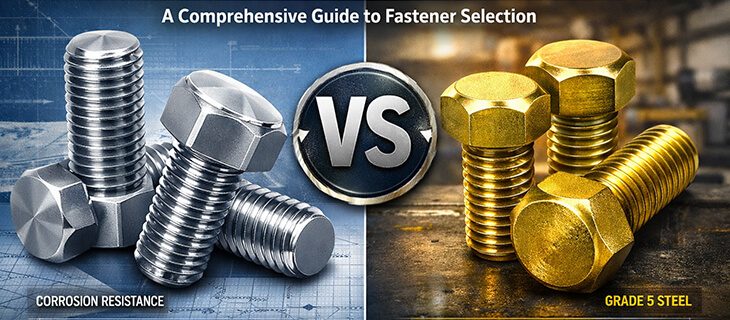
Are Stainless Steel Bolts Stronger Than Grade 5? A Comprehensive Guide to Fastener Selection
In the world of construction, automotive repair, and industrial piping, choosing the right hardware is critical. A common misconception among DIY enthusiasts and professionals alike is that “stainless steel” automatically equates to “stronger.” At Nakoda Steel Industry, we often field questions regarding the mechanical properties of various fasteners. One of the most frequent inquiries we receive is: Are stainless steel bolts stronger than Grade 5?
The short answer is no. In terms of pure tensile strength, a standard SAE Grade 5 bolt is generally stronger than a standard austenitic stainless steel bolt (such as Grade 304 or 316). However, the “right” bolt depends entirely on the application.
This article will explore the technical differences between these materials, explain when to use which, and highlight how specialized materials—like stainless steel 309s tubes—play a vital role in high-temperature industrial environments.
Understanding SAE Grade 5 Bolts
To understand the comparison, we must first define what a Grade 5 bolt is. In the US market, fasteners are often graded according to SAE (Society of Automotive Engineers) standards.
Grade 5 bolts are manufactured from medium carbon steel that has been quenched and tempered. They are easily identified by the three radial lines located on the head of the bolt. These fasteners are the workhorses of the automotive and structural industries because they offer a high strength-to-cost ratio.
Mechanical Properties of Grade 5:
- Tensile Strength: For sizes ranging from 1/4″ to 1 inch, Grade 5 bolts have a minimum tensile strength of 120,000 psi (pounds per square inch),.
- Proof Load: This is the maximum load the bolt can withstand without permanent deformation. For Grade 5, this is typically 85,000 psi,.
- Hardness: They possess a Rockwell hardness of C25-C34,.
Because they are made of carbon steel, Grade 5 bolts will rust if exposed to moisture unless they are plated (e.g., zinc or cadmium). However, these coatings are sacrificial and eventually wear off.
The Reality of Stainless Steel Bolts
Stainless steel fasteners are revolutionary because the addition of Chromium (at least 10.5%) creates an invisible surface layer that resists oxidation and corrosion,. The most common stainless bolts fall into the “Austenitic” family, specifically grades 304 (18-8) and 316.
While stainless steel is superior in corrosion resistance, it lags behind carbon steel in raw strength.
Mechanical Properties of Stainless Steel (304/316):
- Tensile Strength: Standard austenitic stainless steel bolts are typically comparable to SAE Grade 2 or Grade 3 fasteners. While they can be work-hardened to higher strengths, a standard 304 stainless bolt usually holds a tensile strength significantly lower than the 120,000 psi found in Grade 5.
- Strength Comparison: Industry experts explicitly state that despite the durability of austenitic stainless steel, it “will never be as strong as grade 5 hardened steel”.
- Metric Comparison: In the metric system, a Class A4-80 stainless bolt (roughly equivalent to 316) has a minimum tensile strength of 800 MPa (approx. 116,000 psi), which brings it close to Grade 5, but standard commercial stainless bolts (Class A2-70) are weaker, sitting around 700 MPa (approx. 101,000 psi).
When to Choose Which?
The choice between Grade 5 and Stainless Steel comes down to the environment.
- High Stress, Low Corrosion: If you are bolting a winch plate to a truck or securing structural components where shear and tensile loads are high, Grade 5 (or the even stronger Grade 8) is the correct choice,. Using a weaker stainless bolt in a high-stress application could lead to catastrophic failure.
- Corrosive Environments: If the application is marine, chemical, or outdoors where aesthetics matter, stainless steel is superior. Carbon steel Grade 5 bolts will eventually rust, potentially seizing in the hole or failing due to corrosion over time.
Beyond Bolts: High-Temperature Industrial Solutions
At Nakoda Steel Industry, we understand that fasteners are just one part of a larger industrial assembly. Many of our US clients operate in sectors requiring materials that can withstand not just stress, but extreme heat. This is where specialized piping becomes as critical as the bolts that secure it.
While standard 304 stainless is excellent for general corrosion, it may not suffice for furnace parts or heat exchangers. For these elevated temperature applications, we recommend stainless steel 309s tubes.
The Advantages of Stainless Steel 309S: Grade 309S (UNS S30908) is a highly alloyed austenitic stainless steel designed specifically for oxidation resistance.
- Heat Resistance: 309S stainless steel pipe is frequently used for higher temperature applications where other grades might fail. Its oxidation resistance extends up to approximately 1900°F (1038°C) under constant temperature conditions,.
- Chemical Composition: It features a high chromium (22-24%) and nickel (12-15%) content. This chemistry provides superior resistance to oxidation and creep deformation compared to the standard 304 alloy.
- Weldability: The “S” in 309S denotes a lower carbon content (0.08% max) compared to standard 309,. This reduction in carbon improves weldability and minimizes the risk of intergranular corrosion caused by carbide precipitation during the welding process,.
Common Applications for 309S: Because of its unique properties, stainless steel 309s tubes are widely used in:
- Furnace parts and oven linings.
- Heat exchangers and chemical processing industries.
- Handling hot concentrated acids, ammonia, and sulfur dioxide.
Nakoda Steel Industry: Your Partner in Quality
Whether you are calculating the shear strength of a bolt or selecting the correct piping for a petrochemical plant, material specifications matter. Using a stainless bolt where a Grade 5 is required can cause structural failure; using a standard pipe where stainless steel 309s tubes are required can lead to rapid oxidation and system downtime.
At Nakoda Steel Industry, we pride ourselves on supplying products that meet rigorous ASTM and ASME standards. We ensure our clients in the USA receive materials that match their exact engineering requirements, from high-tensile fasteners to specialized heat-resistant tubing.
Summary
To answer the opening question: No, standard stainless steel bolts are generally not stronger than Grade 5 bolts. Grade 5 offers superior tensile strength (120,000 psi) compared to standard austenitic stainless steel,.
- Use Grade 5 when mechanical strength is the priority.
- Use Stainless Steel when corrosion resistance is the priority.
- Use 309S Stainless Steel for piping and tubing in high-temperature environments.
Making the right choice ensures safety, longevity, and efficiency in your projects. For all your industrial steel needs, trust Nakoda Steel Industry to deliver quality and expertise.