

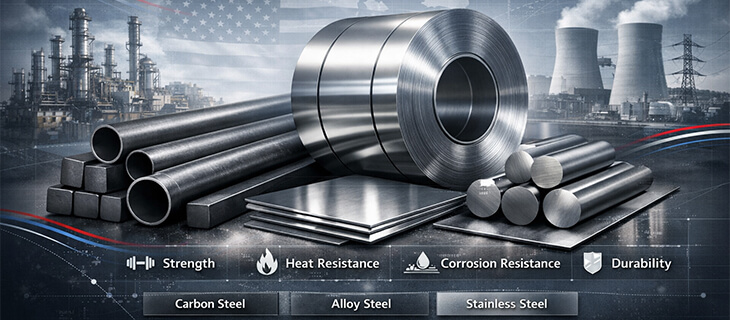
In the complex landscape of American industrial infrastructure—from the sprawling refineries of the Gulf Coast to the power generation facilities of the Midwest—the integrity of your piping system is only as strong as its materials. Choosing the right metal is not just about meeting a spec sheet; it is about ensuring safety, efficiency, and longevity.
At Nakoda Steel Industry, we understand that navigating the alphabet soup of ASTM grades and material properties can be daunting. Whether you are an engineer designing a new steam line or a procurement manager sourcing replacement parts, understanding the fundamental properties of common alloys is essential. This guide breaks down the most critical alloys and their properties to help you make informed decisions for your next project.
The Foundation: Why Alloy Steel?
While carbon steel serves as the workhorse for general applications, it often falls short when temperatures rise or corrosive elements are introduced. This is where alloy steels enter the picture. By adding specific elements like chromium, molybdenum, and nickel to the iron-carbon mix, engineers can dramatically alter the metal’s physical capabilities.
For high-pressure and high-temperature environments, particularly in the energy sector, alloy steel flanges for power plants are indispensable. These components must withstand extreme thermal cycling without losing structural integrity—a property known as creep resistance.
The Heavy Hitters: Chromium-Molybdenum Steels
If you are dealing with high-temperature service, “Chrome-Moly” steels are likely your best option. These are low alloy steels that include specific percentages of Chromium (Cr) and Molybdenum (Mo).
- The Role of Molybdenum: Molybdenum is added primarily to increase the creep strength of the steel, allowing it to withstand temperatures up to 530°C (approx. 985°F). It effectively slows down the coagulation of carbides, which can weaken steel over time under heat.
- The Role of Chromium: Chromium provides exceptional oxidation resistance and improves the steel’s ability to resist corrosion. It also ensures better hardness penetration.
Common Grades to Know: According to ASTM A182 specifications, which cover forged flanges and fittings for high-temperature service, several key grades dominate the market:
- Grade F11 and F22: These are the industry standards for steam power generation. F22 (2¼Cr-1Mo) offers a balance of cost and high-temperature performance.
- Grade F91: This is a high-performance alloy containing about 9% Chromium. It offers exceptional strength and weldability, making it a favorite for modern power plants and refineries. It is specifically designed to resist “creep”—the slow deformation of metal under stress at high temperatures.
- Grade F5 and F9: These grades are utilized where higher corrosion resistance is required alongside temperature handling, often found in petrochemical applications.
Stainless Steels: The Corrosion Fighters
When the primary threat is chemical attack or rust rather than pure heat, stainless steels are the solution. These are generally classified into three groups: ferritic, austenitic, and martensitic.
- Austenitic Stainless (300 Series): Grades like F304 and F316 are the most common. They contain significant amounts of nickel (8-14%) and chromium (16-20%). Nickel stabilizes the austenitic phase, making the steel non-magnetic and highly ductile, while chromium forms a passive oxide layer that prevents rust.
- Pro Tip: For welding applications, look for “L” grades (like F304L or F316L), which have lower carbon content to prevent corrosion in the weld zone.
- Duplex Stainless Steels: Grades like F51 and F53 (Super Duplex) offer a mix of high strength and superior corrosion resistance, particularly against chloride stress corrosion cracking, making them ideal for offshore and marine environments.
Extreme Environments: Nickel Alloys
For the most demanding environments where standard steels fail, the industry turns to high-nickel alloys. A prime example is the INCOLOY® 800 series (800H/800HT).
These alloys typically feature 30-35% nickel and 19-23% chromium. They are engineered for:
- Extreme Heat: They maintain strength and resist oxidation at temperatures well above 1500°F.
- Carburization Resistance: They resist the absorption of carbon, which can make other metals brittle over time.
Preventing Failure Through Material Selection
Why does all this chemistry matter? Because using the wrong material leads to expensive and dangerous failures. In high-pressure pipe flanges, the most common causes of failure include gasket leakage, corrosion, and bolt fatigue.
- Corrosion/Erosion: Using a standard carbon steel flange in a corrosive chemical line will lead to rapid material loss. Selecting a stainless or alloy steel specifically rated for the fluid type prevents this.
- Thermal Fatigue: In power plants, pipes heat up and cool down. Alloy steel flanges for power plants are specifically designed to expand and contract without cracking or loosening the bolts, a common issue caused by thermal cycling.
The Nakoda Steel Industry Advantage
At Nakoda Steel Industry, we know that a flange is never just a flange—it is a critical connection point in your operation. Whether you need the high-creep resistance of F91 for a steam line or the corrosion resistance of F316 for a chemical process, we supply components that strictly adhere to ASTM A182 and ASME B16.5 standards,.
We specialize in sourcing and supplying:
- High-Pressure Alloy Flanges: Grades F11, F22, F5, F9, and F91.
- Stainless Steel Components: From standard 304 to Super Duplex.
- Specialty Nickel Alloys: For your most extreme temperature requirements.
Our commitment goes beyond inventory. We focus on providing value by ensuring our American clients receive materials that meet rigorous tensile and hardness requirements, minimizing the risk of downtime caused by material failure.
Final Thoughts
Selecting the right alloy is a balance of temperature requirements, pressure ratings, corrosion environment, and cost. By understanding the properties of Chromium, Molybdenum, and Nickel, you can ensure your infrastructure is built to last.
Ready to secure your piping infrastructure with high-quality materials? Contact Nakoda Steel Industry today to discuss your project requirements. Let us help you keep your operations running smoothly with the right alloy for the job.