

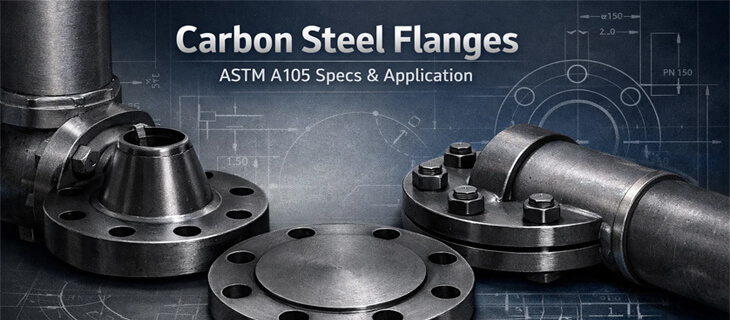
For engineers, procurement managers, and plant operators across the USA, the integrity of a piping system relies heavily on the quality of its connections. Carbon steel flanges remain the industry standard for joining pipes, valves, and pumps due to their exceptional durability and cost-effectiveness. Whether you are managing a refinery in the Gulf Coast or a power generation facility in the Midwest, understanding the specifications of these components is critical for safety and efficiency.
At Nakoda Steel Industry, we understand that selecting the right flange goes beyond just size; it requires a deep understanding of material grades, pressure ratings, and specific application requirements. As premier carbon steel astm a105 flanges manufacturers, we have compiled this guide to help you navigate the technical specifications and applications of carbon steel flanges.
What is a Carbon Steel Flange?
A carbon steel flange is a forged or cast ring designed to connect sections of pipe or other machinery components. It features a carbon steel body that is sealed by bolting and secured via welding or screwing.
Carbon steel is favored in the US industrial sector because it offers excellent strength and durability, making it suitable for structural support frames, industrial machinery, and high-pressure piping systems. Furthermore, carbon steel provides resistance to corrosion and is highly compatible with a wide variety of pipe materials and fluids.
The Gold Standard: ASTM A105 Specifications
When sourcing flanges for ambient and high-temperature service, ASTM A105 is the most widely cited material specification. Understanding the chemical and mechanical properties of this grade is essential for ensuring system compliance.
Chemical Composition ASTM A105 covers forged carbon steel piping components. The standard chemical composition requires a maximum Carbon content of 0.35% and a Manganese range of 0.60% to 1.05%. It also strictly limits impurities, capping Phosphorus at 0.035% and Sulfur at 0.040%.
Mechanical Properties To ensure the flange can withstand industrial pressures, ASTM A105 mandates specific mechanical baselines:
- Tensile Strength: Minimum 70 ksi (485 MPa).
- Yield Strength: Minimum 36 ksi (250 MPa).
- Hardness: Forgings must have a maximum hardness of 197 HBW.
Heat Treatment Materials produced under this specification must be subjected to heat treatment, which may include annealing, normalizing, or quenching and tempering. This process refines the grain structure, ensuring the flange is reliable and durable in various applications.
Common Flange Types and Their Applications
Choosing the correct flange type is as important as the material grade. The design dictates how the flange is attached to the pipe and its pressure-bearing capabilities.
- Weld Neck Flanges: These feature a tapered hub that matches the pipe’s diameter. They are preferred for severe service applications involving high pressure, sub-zero temperatures, or elevated temperatures because the hub provides excellent stress distribution.
- Slip-On Flanges: These slide over the outside diameter of the pipe and are fillet welded. They are easier to align and install than weld necks but are generally not used for the highest stress applications due to their method of attachment.
- Blind Flanges: Manufactured without a bore, these are used to seal the ends of piping systems or provide access covers for pressure vessels. They are subjected to higher bending stresses than other flange types.
- Socket Weld Flanges: Designed for smaller diameter, high-pressure lines, these flanges have a counterbore that creates a socket for the pipe. They are typically used in chemical processes and hydraulic lines.
Pressure Ratings and Dimensions
In the United States, flange dimensions and ratings usually conform to ASME B16.5 (for sizes up to 24 inches) and ASME B16.47 (for larger sizes).
Flanges are categorized by pressure classes: 150 lb, 300 lb, 600 lb, 900 lb, 1500 lb, and 2500 lb. It is vital to note that the maximum allowable working pressure decreases as the operating temperature increases. For example, a Class 150 flange may handle 285 PSIG at -20°F to 100°F, but only 170 PSIG at 500°F.
Critical Considerations: Low Temp and Sour Service
While ASTM A105 is the workhorse for general applications, specific environments require specialized carbon steel grades.
Low-Temperature Service (A350 LF2) If your project is located in a region with extreme cold, such as Alaska or Northern US oil fields, standard A105 may be susceptible to brittle failure. In these cases, ASTM A350 LF2 is the preferred grade. While A105 is suitable for services down to -20°C, A350 LF2 is designed for low-temperature services down to -46°C and requires mandatory Charpy V-Notch impact testing.
Sour Service (NACE Compliance) For industries handling fluids containing Hydrogen Sulfide ($H_2S$), such as oil refineries, carbon steels are susceptible to Sulfide Stress Cracking (SSC). In these environments, materials must comply with NACE MR0103 (onshore) or NACE MR0175 (offshore). This often requires the base metal hardness to be less than 22 HRC (237 HBW) to reduce the risk of in-service cracking.
Why Partner with Nakoda Steel Industry?
At Nakoda Steel Industry, we prioritize quality and compliance. Whether you need standard ASTM A105 components or specialized flanges for high-risk environments, we ensure that our products meet the rigorous standards demanded by the US market.
- Traceability: We ensure material test certificates (MTCs) are available, providing full traceability from the heat number to the finished product.
- Diverse Inventory: We supply a wide range of types including Slip-on, Weld-neck, and Blind flanges in various pressure classes.
- Custom Solutions: From standard ASME B16.5 dimensions to custom designs calculated per ASME Section VIII Division 1, we can meet your specific project needs.
Conclusion
Carbon steel flanges are a reliable, durable option for piping systems in the chemical, petrochemical, and oil and gas industries. By understanding the nuances of specs like ASTM A105 and ASME B16.5, you can ensure the longevity and safety of your infrastructure.
As leading carbon steel astm a105 flanges manufacturers, Nakoda Steel Industry is ready to support your next project with high-quality components engineered for performance. Contact us today to discuss your specifications.