

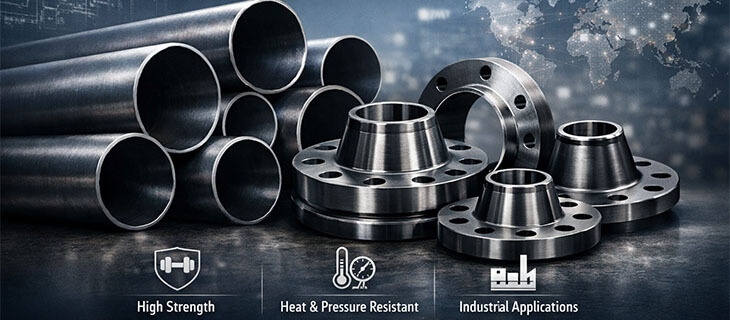
In the complex landscape of American infrastructure—from the sprawling refineries of the Gulf Coast to the power plants energizing the grid—the integrity of a piping system is only as good as its materials. For industries operating under extreme pressure, high temperatures, or corrosive conditions, standard carbon steel often isn’t enough. This is where alloy steel pipes and tubes become the indispensable backbone of operations.
At Nakoda Steel Industry, we understand that selecting the right piping solutions is not just about procurement; it is about ensuring safety, efficiency, and longevity. This guide explores the engineering behind alloy steel pipes, their specific grades, and the critical role of flanges in maintaining system integrity.
What Exactly Are Alloy Steel Pipes?
While carbon steel is the industry standard for many applications, alloy steel takes performance a step further. Alloy steel pipes are created by mixing carbon steel with specific alloying elements such as chromium, molybdenum, nickel, manganese, and silicon.
These added elements function like a specialized recipe, chemically improving the steel’s mechanical properties. The result is a material with significantly enhanced strength, toughness, wear resistance, and—crucially for industrial applications—superior corrosion resistance. Because of these characteristics, alloy steel pipes are the preferred option for harsh environments where regular steel would fail to stand up to the elements.
Manufacturing Matters
The quality of a pipe is often dictated by its manufacturing process. At Nakoda Steel Industry, we recognize the distinction between welded and seamless pipes. While welded pipes are generally more affordable, seamless pipes—manufactured through an intricate extraction process—offer excellent durability and reliability, justifying their use in high-stakes environments.
Decoding the Grades: P5, P11, and P91
In the United States, the benchmark for quality is the ASTM (American Society for Testing and Materials) standard. These standards ensure reliability and compatibility across industries. When sourcing pipe, understanding the “P-grades” is essential for matching the material to the application.
- Alloy Steel P5: Primarily consisting of chromium (4-6%) and molybdenum, P5 pipes offer a balance of durability and affordability. They are highly resistant to oxidation and are commonly used in refineries and petrochemical plants for applications requiring moderate temperature resistance.
- Alloy Steel P11: Known for overcoming high pressures, P11 pipes contain chromium, molybdenum, and silicon. They are a staple in boilers, pressure vessels, and steam systems because they resist thermal fatigue and corrosion effectively.
- Alloy Steel P91: This is an advanced grade known for exceptional strength and creep resistance. Made with a complex combination of nitrogen, vanadium, molybdenum, and chromium, P91 pipes are designed for ultra-high temperature and high-stress environments, such as nuclear power plants and supercritical power generation.
The Critical Connector: Alloy Steel Flanges
Even the strongest pipe is useless without secure connections. This is where alloy steel flanges come into play. A flange is a protruded rim or ridge used to connect pipes, valves, and equipment, allowing for easy maintenance and inspection.
In the US market, flange dimensions and pressure ratings are governed by the ASME B16.5 standard. The “Class” of a flange (e.g., Class 150, 300, 600, up to 2500) indicates the maximum pressure it can withstand at specific temperatures. For example, a Class 300 flange can handle significantly higher pressure than a Class 150 flange at the same operating temperature.
Types of Alloy Steel Flanges
Selecting the right flange design is as important as the material grade:
- Weld Neck Flanges: Designed for high-stress applications, these are welded directly to the pipe to reduce turbulence and erosion.
- Blind Flanges: Essential for safety, these solid discs are used to seal off the end of a piping system.
- Slip-On Flanges: These slip over the pipe and are welded in place, ideal for lower-pressure applications.
Using high-quality alloy steel flanges ensures that the connection points share the same thermal and mechanical properties as the pipes, preventing weak points in the line.
The Rise of Sustainable Alloy Steel Flanges
Modern industry is not just about strength; it is about sustainability. The concept of sustainable alloy steel flanges and piping focuses on the lifecycle of the material.
The production of steel alloys involves energy-intensive processes, such as extraction and crushing. However, the durability of alloy steel directly contributes to sustainability. By utilizing high-grade alloys like P91 or corrosion-resistant flanges, facilities reduce the frequency of material failure and replacement.
Furthermore, Life Cycle Assessments (LCA) highlight that optimizing the manufacturing process—specifically the electrical energy requirements—can significantly reduce the carbon footprint of these products. At Nakoda Steel Industry, we are committed to supplying products that offer longevity, ultimately reducing waste and maintenance energy over the lifespan of your project.
Where Are These Materials Used?
The versatility of alloy steel makes it vital for several key sectors:
- Oil and Gas: From drilling rigs to refineries, alloy steel pipes resist the high pressure and corrosive conditions found in sour gas applications and offshore drilling.
- Power Generation: In plants burning fossil fuels or nuclear material, these pipes transport steam under high pressure. Their resistance to extreme temperatures ensures efficient electricity generation.
- Chemical Processing: Industries handling acids and reactive substances rely on alloy steel to prevent hazardous leaks and withstand corrosive properties.
Partnering with Nakoda Steel Industry
Navigating the specifications of ASTM grades, ASME pressure classes, and material compositions can be complex. At Nakoda Steel Industry, we bridge the gap between technical complexity and supply chain reliability.
Whether your project requires the high-temperature resilience of P91 pipes or the precise pressure handling of alloy steel flanges, we provide solutions that meet rigorous international standards. By choosing the right materials, you ensure not only the safety of your personnel but also the long-term efficiency of your operations.
Ready to upgrade your infrastructure? Contact Nakoda Steel Industry today to discuss your piping and flange requirements.