

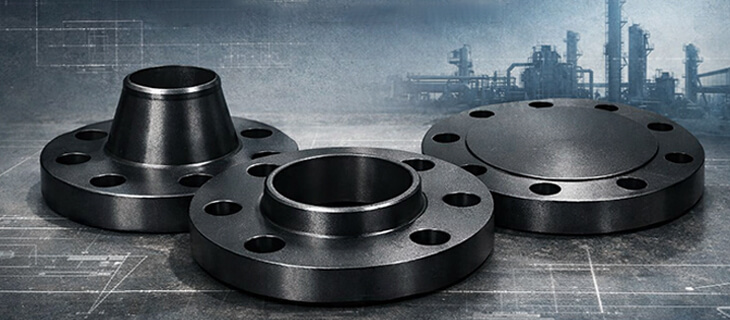
In the complex landscape of American industrial infrastructure—from the oil fields of Texas to the refineries of the Midwest—the integrity of a piping system relies heavily on its connections. Among the most critical components in these systems are carbon steel flanges. For procurement managers and engineers across the USA, understanding the specific properties of grades like ASTM A105 is essential for ensuring safety and operational efficiency.
At Nakoda Steel Industry, we understand that sourcing high-quality forged components is about more than just dimensions; it is about trusting the metallurgical integrity of the product. As leading carbon steel ASTM A105 flanges manufacturers, we have compiled this guide to help you navigate the specifications, applications, and pressure ratings essential for your projects.
Understanding the Standard: What is ASTM A105?
When discussing carbon steel flanges for industrial use in the US, the most prevalent specification you will encounter is ASTM A105. This standard covers forged carbon steel piping components, including flanges, fittings, and valves, specifically designed for ambient- and higher-temperature service in pressure systems.
Chemical Composition and Mechanical Properties
To ensure durability, ASTM A105 mandates strictly controlled chemical compositions. The standard requires a maximum Carbon content of 0.35%, along with Manganese (0.60–1.05%), Phosphorus ($\le$ 0.035%), Sulfur ($\le$ 0.040%), and Silicon (0.10–0.35%).
Mechanically, A105 flanges are built for strength. The material must exhibit a minimum tensile strength of 485 MPa (70 ksi) and a minimum yield strength of 250 MPa (36 ksi). Furthermore, the material must maintain a Brinell hardness maximum of 187 HB, ensuring it is hard enough to withstand high pressure but ductile enough to avoid brittle failure under standard operating conditions.
Manufacturing and Heat Treatment
ASTM A105 components are forged, which provides a denser, stronger structure compared to casting. While heat treatment is not mandatory for all A105 components, specific applications require normalizing to refine the grain structure and improve mechanical properties. Normalizing is generally recommended or required for:
- Flanges above Class 300 pressure rating.
- Flanges larger than 4 inches in nominal size.
- Forgings used in specific high-temperature services.
At Nakoda Steel Industry, we ensure that our manufacturing processes align strictly with these standards to eliminate internal stresses and ensure consistent performance.
Selecting the Right Flange Type
Carbon steel flanges come in various configurations, each designed to solve specific piping challenges.
- Weld Neck Flanges: Distinguished by a long tapered hub, these provide reinforcement and are ideal for high-pressure and high-temperature applications where the system may experience vibration.
- Slip-On Flanges: These have a slightly larger diameter than the pipe, allowing them to slip over it before welding. They are easier to align and generally used in low-to-medium pressure applications.
- Blind Flanges: Solid discs used to seal the end of a piping system. They are critical for pressure testing and maintenance access.
- Socket Weld & Threaded Flanges: Typically used for small-bore piping. Threaded flanges are useful where welding is hazardous or impossible, while socket welds are used for high-pressure small-diameter lines.
Navigating Pressure Classes (ASME B16.5)
In the US market, flange dimensions and pressure ratings are governed by ASME B16.5 for sizes up to 24 inches. It is vital to understand that a “Pressure Class” (e.g., Class 150, 300, 600, up to 2500) does not represent a fixed pressure capability. Instead, the Maximum Allowable Working Pressure (MAWP) decreases as the operating temperature increases.
For example, a Class 150 flange made of A105 steel might hold 285 psi at ambient temperatures, but that capability drops significantly as temperatures rise towards 100°F and beyond. Engineers must consult the pressure-temperature rating tables (Group 1.1 materials for Carbon Steel) to verify that the chosen flange class exceeds the system’s design pressure at its maximum operating temperature.
High-Temp vs. Low-Temp: A105 vs. A350 LF2
A common query we receive at Nakoda Steel Industry pertains to the difference between ASTM A105 and ASTM A350 LF2. While both are forged carbon steels, their applications differ significantly based on temperature.
- ASTM A105: Designed for ambient to high-temperature service. It does not require Charpy V-Notch impact testing by default.
- ASTM A350 LF2: Specifically designed for low-temperature service (down to -50°F / -46°C). It requires Charpy impact testing to ensure the material does not become brittle and fracture in freezing conditions.
If your project involves cryogenic storage, LNG, or operations in freezing climates, LF2 is the required specification. For general oil, gas, and power generation where heat is the primary factor, A105 is the industry standard.
Key Applications in US Industries
Carbon steel flanges are the workhorses of the industrial sector. Their high durability and cost-effectiveness make them the material of choice for:
- Oil & Gas Pipelines: Connecting pipe sections over long distances.
- Refineries & Petrochemicals: Handling hydrocarbons under varying pressures.
- Power Generation: Connecting boilers and high-pressure steam lines.
- Shipbuilding: Used in marine engineering for various fluid systems.
Because carbon steel is susceptible to corrosion in certain environments (such as sour service or offshore applications), these flanges often require protective measures. This can include specific coatings, painting, or galvanizing to prevent rust and prolong lifespan.
Why Choose Nakoda Steel Industry?
Sourcing components for critical infrastructure requires a partner who prioritizes quality assurance and specification compliance. As specialized carbon steel ASTM A105 flanges manufacturers, Nakoda Steel Industry offers:
- Strict Adherence to Standards: We manufacture to ASME B16.5 and B16.47 dimensions, ensuring our flanges mate perfectly with existing US infrastructure.
- Material Integrity: We ensure our A105 and A105N (Normalized) flanges meet all tensile, yield, and hardness requirements.
- Comprehensive Range: From Slip-Ons for utility lines to heavy-duty Weld Necks for high-pressure reactor connections, we cover the full spectrum of industrial needs.
Whether you are designing a new facility or procuring maintenance parts for an existing plant, ensuring your flanges meet the rigorous ASTM and ASME standards is the first step toward operational safety.
Contact Nakoda Steel Industry today to discuss your project requirements and receive a quote for high-quality carbon steel flanges.