

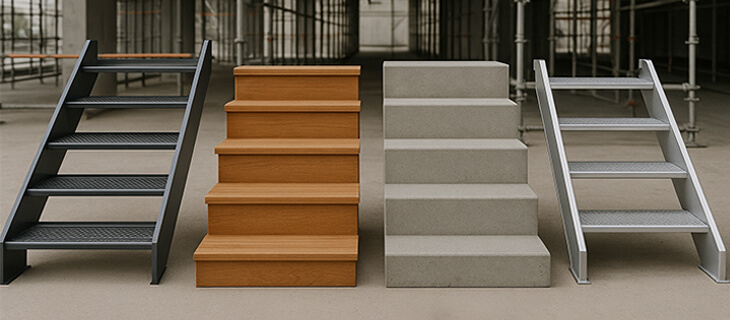
In the United States, a staircase is a significant architectural element, serving not only as a necessary connector between floors but also as a centerpiece that dramatically affects a structure’s aesthetic, safety, and long-term durability. Choosing the right materials requires balancing design preference, expected traffic, maintenance willingness, and critical structural strength.
This guide explores the foundational components and popular materials available to ensure your next project—whether a modern interior ascent or a robust exterior run—is built to last.
The Core Component: Selecting Your Stair Stringer Material
The stair stringer material is arguably the most important decision, as stringers are the structural elements that support the ends of the stair treads. This choice dictates the overall strength, flexibility, and longevity of the entire assembly.
The Strength of Steel
Steel has gained immense popularity for stair construction in both commercial and residential buildings. It is often preferred over other materials due to its flexibility and outstanding durability. Steel stringers are often fabricated from channels, rectangular hollow sections, or plate. Steel is exceptionally strong, allowing it to withstand heavy foot traffic and support large loads.
Steel is particularly advantageous for modern and industrial designs, offering excellent versatility as it can be fabricated into various shapes and styles. For contemporary aesthetics, such as floating staircases, stainless steel stringers are a great choice because they offer the necessary strength and durability while maintaining a clean, elegant appearance. Installed metal stairs generally cost between $150 to $275 per step.
The Versatility of Wood
Dimension lumber remains a common material for stair stringer construction. For stability and consistency, however, design professionals often turn to engineered wood products, known as Structural Composite Lumber (SCL).
These products, such as Laminated Veneer Lumber (LVL) or Laminated Strand Lumber (LSL), are engineered to resist bowing, shrinking, and splitting, resulting in a stringer that is straight and consistent. When using wood, designers might notch the stringer to attach risers and treads, but often they “sister” another full-depth piece of lumber or engineered lumber alongside the notched piece to serve as the main structural member.
While wood stairs offer a warmer, more natural finish, wood stringers are generally weaker than metal and are prone to faster deterioration or pest issues, even when treated.
Choosing the Right Treads: Durability Meets Design
Stair treads are the horizontal surfaces you step on. These components must be safe, durable, and aesthetically pleasing. Materials alone can range widely in price, from $40 to $400 per step.
- Steel Treads: If the stringers are steel, the treads are often steel as well. Steel treads are typically made from grating (common in industrial settings) or pans (often used in commercial structures, where concrete can be poured into the base for a solid feel).
- Hardwood and Wood Treads: Wood is the most popular material for interior stairs due to its affordability and classic aesthetic, costing around $100 to $250 per step installed. Hardwood species like oak, maple, or walnut are highly durable for high-traffic areas. Wood is also quieter than metal when walked upon.
- Composite Materials: Made from a blend of wood fibers and plastics, composite materials are a durable, low-maintenance alternative, especially for outdoor use. Composites resist insect damage, fading, and rot better than traditional wood. They can be secured to wooden stringers. Installed composite stairs typically cost $110 to $200 per step.
- Concrete and Stone: For unrivaled durability and low maintenance, particularly for exterior applications, concrete and stone are the “gold standards”. Precast concrete steps cost $100 to $350 per step installed, while stone steps (like granite or slate) are more costly but offer a timeless look and extreme longevity, averaging $300 to $900 per step installed.
Essential Safety and Structural Requirements (USA)
When designing a staircase in the USA, compliance with local building codes is mandatory, covering means of egress, allowable materials, and structural integrity.
- Structural Loads: Stair stringers and treads must meet structural design criteria to resist minimum live loads. For most applications, this is 100 pounds per square foot (psf), although it may be 40 psf for one- and two-family dwellings. The design of stringers, treads, and their connections is typically left to a structural engineer, as the code does not provide prescriptive design tables.
- Safety and Finish: Regardless of the material, safety and slip resistance are paramount. Materials like polished stone or hardwood can be slippery, requiring textured finishes or non-slip coatings.
Partnering with Nakoda Steel Industry: The Foundation of Durability
At Nakoda Steel Industry, we only provide raw material, specializing in the robust metal components necessary for building strong, enduring staircases across the USA.
For contractors, fabricators, and structural engineers prioritizing durability and longevity, we supply the raw steel required to create high-performance structural components. Whether your design demands the superior strength of steel stair stringer material fabricated from channels or rectangular hollow sections, or raw plate steel for custom pan treads, our focus is on delivering the foundational metals that ensure structural integrity.
The choice of using steel as your base material guarantees versatility, allowing for the integration of aesthetic finishes like wood treads onto a sturdy metal frame. By sourcing high-quality raw steel from Nakoda Steel Industry, builders can ensure their staircases meet demanding U.S. structural codes (e.g., 100 psf live load requirements), giving homeowners peace of mind that their permanent fixture is built upon an unyielding, industrial-strength core.
Choosing your stair material is like choosing the bones of a skeleton: if the bones (stringers) are made of the strongest material, the rest of the body (treads and risers) can confidently support any weight or design you choose.