

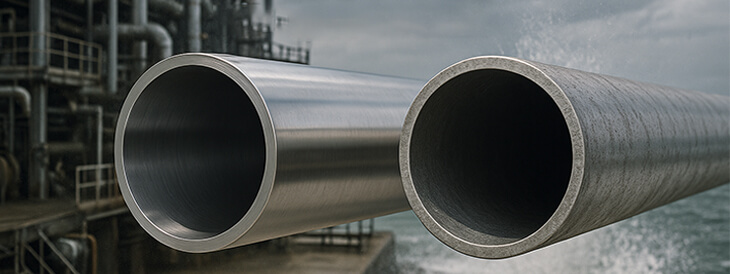
I. Intro: More Than Just Shiny Metal – A Sneak Peek into the World of Stainless Steel Pipes
Ever wonder what’s really flowing through the veins of our modern world? It’s not just water and oil, but also progress, innovation, and the very essence of our industrialized society. And silently orchestrating it all, from your morning coffee machine to massive chemical plants, is an unsung hero, a network of metallic arteries keeping things moving: stainless steel pipes!
We’re not talking about just any stainless steel. Today, we’re diving deep into the two titans of the pipe world: 304/304L and 316/316L stainless steel. But what alchemical magic makes them so special, so ubiquitous? Why do they pop up everywhere, from the mundane to the most critical applications?
Prepare to have these industrial workhorses demystified. We’ll explore their intriguing past, dissect their crucial present, and even dare to peek into their exciting (and surprisingly high-tech) future. Consider this a metallurgical musing, a contemplation on the silent infrastructure that underpins our world.
II. A Blast from the Past: How Stainless Steel Got Its Shine
The story begins, as many great material stories do, with a spark of scientific curiosity. Back in the early 1800s, scientists, driven by that insatiable human desire to understand, stumbled upon chromium’s remarkable ability to bestow “rust-fighting” superpowers upon iron. Imagine the initial wonder – a metal that refuses to succumb to the relentless oxidation that plagues its brethren!
But the real “Aha!” moment had to wait. Fast forward to the early 1900s, a period of intense industrial ferment. Harry Brearley, while searching for a better alloy for gun barrels (a surprisingly noble pursuit!), inadvertently gave us “rustless steel” (more accurately, martensitic stainless steel). However, the true revolution was brewing elsewhere. Almost simultaneously, the “18/8” austenitic stainless steel – our beloved 304 – made its debut in Germany at Krupp, a name synonymous with industrial power. But it was W.H. Hatfield in the UK who truly refined it, recognizing its immense potential and setting the stage for its global dominance. This wasn’t just an incremental improvement; it was a game-changer.
And the story doesn’t end there. The 1920s witnessed the birth of 316, with its secret weapon: molybdenum. This wasn’t just a tweak; it was a strategic enhancement, allowing 316 to tackle even nastier corrosive challenges, opening doors to applications previously deemed impossible.
Of course, the metal itself is only half the story. Early pipe manufacturing evolved from rudimentary techniques like simple welding to the seamless wonders we see today, each innovation meticulously paving the way for stainless steel’s now-ubiquitous industrial takeover. These weren’t just pipes; they were conduits of progress.
III. The Dynamic Duo: Getting to Know 304/304L and 316/316L
Let’s pull back the curtain and introduce our dynamic duo properly.
The Everyday All-Star: 304 & 304L
- At its heart, 304 is the classic “18/8” stainless steel – approximately 18% chromium and 8% nickel, a recipe that delivers a potent blend of toughness, corrosion resistance, and exceptional versatility. It’s the dependable workhorse of the stainless world.
- But what about that mysterious “L” suffix? The “L” Factor signifies a lower carbon content. Why is this important? Less carbon means happier welds. During welding, high carbon content can lead to the formation of chromium carbides at grain boundaries, depleting chromium and causing intergranular corrosion (a nasty form of attack) when things get hot. 304L sidesteps this potential pitfall.
- The Lowdown: It boasts good strength, is relatively easy to shape and form, and, intriguingly, is generally non-magnetic (though cold working can induce some magnetism).
The Heavy-Duty Champion: 316 & 316L
- This is where 316 truly distinguishes itself. The secret? Molybdenum. That addition of 2-3% molybdenum acts like a superhero against chlorides (think saltwater, a notorious corrosion instigator!) and a wide array of aggressive acids. It’s the stainless steel you call in when the environment gets really challenging.
- And yes, there’s an “L” here too. 316L doubles down on weldability, making it the go-to choice for critical, heavily welded structures destined for harsh, corrosive environments.
- The Specs: Expect even better corrosion resistance than 304, commendable strength at elevated temperatures, and that signature stainless steel toughness.
How They’re Made (No Magic, Just Engineering!):
- Seamless: These pipes are born from a solid billet of steel, which is then meticulously pierced, stretched, and rolled into a perfect, uninterrupted tube. The absence of a weld seam makes them ideal for high-pressure applications, where structural integrity is paramount.
- Welded: In contrast, welded pipes start as flat sheets of stainless steel. These sheets are carefully rolled into a tubular shape, and then a precise weld is applied along the seam to create a continuous pipe. This method offers a cost-effective and versatile alternative to seamless pipes.
IV. Where Do These Super Pipes Live? Their Widespread Reign
The true testament to these alloys lies in their ubiquity. Let’s explore the diverse landscapes where these stainless steel pipes reign supreme.
304/304L: The Jack-of-All-Trades
- Kitchen King: Look around your kitchen. Your sink, cookware, brewery tanks – these are all likely crafted from 304 stainless steel. Its hygienic properties and resistance to mild corrosives make it ideal for food and beverage applications.
- Industrial Backbone: Beyond the kitchen, 304 forms the backbone of numerous industrial processes, from general chemical processing to architectural elements (think sleek handrails!). It’s also a common sight in everyday plumbing systems.
- Why 304L? Whenever extensive welding is involved, particularly in chemical processing environments, 304L ensures the long-term integrity of the structure by mitigating the risk of intergranular corrosion.
316/316L: The Specialist in Extreme Conditions
- Ocean’s Embrace: Often dubbed “marine grade,” 316 is the go-to choice for offshore oil rigs, boat fittings, and desalination plants – environments where constant exposure to saltwater demands exceptional corrosion resistance. However, it’s crucial to remember that even 316 isn’t invincible in warm seawater; careful design and maintenance are still vital.
- Chemical Gauntlet: When dealing with the really harsh stuff – strong acids, chloride-rich concoctions – 316 steps up. It’s a staple in pharmaceutical and petrochemical plants, where process fluids can be incredibly aggressive.
- Body & Beyond: Perhaps surprisingly, 316 (often 316L) finds its way into medical implants, surgical tools, and ultra-clean pharmaceutical lines. In these applications, the surface is often electropolished to achieve a near-perfect sterile finish.
Current Buzz: Both grades are experiencing booming demand across various sectors. Infrastructure development, the burgeoning energy sector (especially green energy initiatives like wind and hydrogen!), and global construction projects are all driving increased consumption of these essential materials.
V. Not Without Its Scrapes: Debates & Dirty Laundry
Despite their remarkable qualities, the world of stainless steel pipes isn’t without its complexities and challenges. Let’s address some of the debates and potential pitfalls.
The Great Debate: Cost vs. Performance
- “Why buy a Cadillac when a Honda will do?” This question often arises when choosing between 304 and 316. Specifying 316 when 304 would suffice can lead to costly “over-engineering.” Conversely, opting for 304 in an environment demanding 316 can result in catastrophic “under-engineering” and premature failure.
- Price Tag: The addition of molybdenum makes 316/316L approximately 20-30% more expensive than 304/304L. The key question: is that extra cost justified by the specific demands of your application?
The Quality Quandary:
- Spotting a Fake: Here’s a sobering thought: 304 and 316 look virtually identical to the naked eye. How can you be sure you’re getting the grade you’ve specified? While magnets can offer a very rough indication (304 is typically non-magnetic, but cold working can change that), they are not a reliable test. Material Test Certificates (MTCs) are your friend. Demand them, scrutinize them, and ensure they align with the specified alloy.
- Production Perfection: Even with the correct alloy, manufacturing defects can compromise performance. Uneven wall thickness, ovality (a deviation from perfect roundness), and subtle weld defects are constant battles for manufacturers striving for quality.
The Eco-Conscious Conundrum:
- Heavy Footprint: Let’s be honest: making stainless steel is an energy-intensive process, with significant carbon emissions associated with both the melting and refining of raw materials and the mining of those materials.
- The Green Lining: But wait! Stainless steel is 100% recyclable and boasts an exceptionally long lifespan – potentially decades, or even centuries, in some applications. This inherent durability and recyclability make it a true champion of the circular economy. The debate, therefore, centers on balancing the initial environmental impact with the long-term lifecycle benefits.
Ethical Sourcing Headaches: Tracing raw materials through complex global supply chains to ensure fair labor practices and environmentally responsible mining operations is a growing and increasingly critical challenge. Consumers and industries alike are demanding greater transparency and accountability.
VI. Crystal Ball Gazing: What’s Next for Our Steel Superstars?
The story of stainless steel pipes is far from over. Let’s gaze into the future and explore some of the exciting developments on the horizon.
Smarter Pipes, Smarter Future:
- AI & IoT: Imagine a world where pipes are not passive conduits, but intelligent, self-monitoring systems. Sensors embedded in pipes can transmit real-time data on temperature, pressure, and even subtle signs of corrosion. AI-powered quality control systems can detect microscopic flaws during manufacturing, and predictive maintenance algorithms can anticipate potential failures before they occur.
- Automated Perfection: Robots and advanced welding techniques (such as laser welding and hybrid laser-arc welding) are enabling faster, more precise, and ultimately stronger pipe production.
Greener, Cleaner Production:
- Recycling Renaissance: Expect to see an even greater emphasis on pipes manufactured from recycled stainless steel scrap, reducing the demand for virgin raw materials and minimizing the environmental impact of production.
- Eco-Innovation: The industry is actively pursuing energy-efficient furnaces, cleaner production processes, and greater transparency in the supply chain.
New Horizons:
- Hydrogen Economy: As the world transitions towards cleaner energy sources, hydrogen is emerging as a promising fuel. Stainless steel pipes, with their inherent resistance to hydrogen embrittlement, are crucial for the safe and efficient transportation of this future fuel.
- Advanced Alloys: While 304/316 will remain dominant, expect to see increased use of specialized “duplex” and “super duplex” stainless steels for ultra-demanding applications requiring even greater strength and corrosion resistance.
- 3D Printing: Yes, even pipes are entering the realm of additive manufacturing! 3D printing allows for the creation of complex, custom-designed pipe geometries tailored to specific and highly specialized needs.
Enduring Legacy: These foundational grades aren’t going anywhere; they’re simply getting an upgrade, ensuring they remain crucial to industries for decades to come.
VII. Conclusion: The Enduring Strength of Stainless Steel
From their humble beginnings as laboratory curiosities to their current status as indispensable materials, 304/304L and 316/316L stainless steel pipes have consistently proven their worth. They are the silent workhorses of our modern world, enabling countless industries and underpinning our daily lives.
They’re more than just pipes; they’re a testament to the power of material science, constantly evolving to meet the ever-toughening challenges our world throws at them, one perfect weld at a time. They remind us that even the most seemingly mundane objects can hold within them a story of innovation, resilience, and enduring strength.
Ready to specify your needs?
Connect with an industry leader that supplies a full range of high-quality welded and seamless stainless steel pipes and tubes in all the grades discussed today: 304/304L and 316/316L.
Visit Nakoda Steel Industry to secure the reliable, certified, and quality-assured stainless steel pipes that your project deserves