

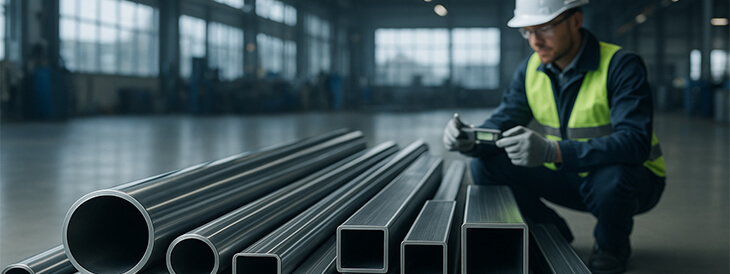
From the chassis of a vehicle to the frame of industrial machinery, mechanical steel tubing is an unseen yet essential component that provides structural integrity to countless products we rely on daily.
Unlike standard pipes designed primarily for transporting fluids, mechanical tubing is specifically engineered for structural and mechanical purposes. It is manufactured to meet precise performance requirements for strength, dimensional accuracy, and surface finish.
Characterized by its high strength-to-weight ratio, consistency, and remarkable versatility, mechanical steel tubing serves as a foundational component for an extensive range of engineering and fabrication projects, offering a unique combination of performance and reliability.
1. The Core Strengths: What Makes Mechanical Tubing the Engineer’s Choice?
In manufacturing and fabrication, the strategic selection of materials with superior physical properties is paramount to a project’s success. Mechanical steel tubing, typically produced from carbon steel grades like 1010 or 1020, is frequently chosen because its inherent characteristics translate directly into performance, efficiency, and durability in the final application.
- Precision and Strength: Mechanical tubing is manufactured to exact dimensional tolerances for its outside diameter (OD), inside diameter (ID), and wall thickness. While several types exist, the market includes two primary categories: welded and seamless
.
- Welded Tubing (ERW & DOM): The process often begins with Electric Resistance Welded (ERW) tubing. To achieve the highest level of precision, this ERW tube can undergo a transformative finishing process. Drawn Over Mandrel (DOM) is not a type of tubing, but rather a finishing process.
It begins with a high-quality ERW tube, which is then cold-drawn through a die and over a mandrel. This cold-working refines the steel’s grain structure, significantly improving dimensional accuracy, providing a uniform wall thickness, enhancing its strength-to-weight ratio, and making the internal weld seam virtually invisible.
- Seamless Tubing: As an alternative to welded products, seamless mechanical tubing is produced from a solid steel billet that is heated and pierced to create a hollow form. The absence of a weld seam makes it an ideal choice for high-pressure applications like hydraulic cylinders, where structural integrity under stress is critical.
- Superior Fabricability: The consistent dimensions and material properties of mechanical tubing make it exceptionally easy to work with. It is designed to be easily bent, welded, punched, and machined. This superior fabricability simplifies manufacturing processes, allowing for efficient and repeatable production of complex parts and structures while maintaining structural integrity.
- Versatility in Shape and Size: While round tubing is common, mechanical tubing is available in a wide variety of shapes, including square, rectangular, oval, and other specialty forms.
This diversity gives engineers and designers significant flexibility, enabling them to select the optimal profile for specific structural needs, whether for architectural features, trailer construction, or custom machinery frames.
These inherent strengths make mechanical tubing a cornerstone material across the vast range of industries it serves.
2. A World of Uses: Highlighting Key Mechanical Steel Tubing Applications
The unique combination of strength, precision, and versatility makes mechanical steel tubing a preferred material in nearly every industrial sector. An exploration of key mechanical steel tubing applications reveals its profound impact on the design and function of products ranging from heavy machinery to everyday consumer goods.
Automotive and Transportation
- Chassis and frame components
- Side door beams and roll cages
- Suspension components, steering columns, and axles
- Propeller shafts and drive shafts
- Trailer construction (utility, livestock, and cargo)
Industrial and Agricultural Machinery
- Hydraulic cylinders and robotic arms
- Conveyor systems and racking
- Tractor attachments (e.g., front-end loaders, backhoes)
- Livestock handling equipment (gates, fences, panels, and chutes)
Construction and Energy
- Structural support framework and scaffolding
- Augers and components for heavy equipment
- Fencing and barriers
- Solar panel supports
- Components for wind turbines
Commercial and Recreational Equipment
- Fitness and exercise equipment
- Playground structures and swing sets
- Furniture components
- Hand trucks
This wide array of uses demonstrates not just what mechanical tubing can do, but how critical the quality of that tubing is to ensuring performance and safety.
3. Beyond the Blueprint: Why Material Quality and Specifications are Crucial
While a sound design is the foundation of any project, its ultimate success, safety, and longevity depend entirely on the integrity of the raw materials. The case of a failed hydraulic excavator arm cylinder serves as a stark, real-world example of what can happen when material specifications are not met.
An investigation into the catastrophic failure of the cylinder tube revealed that the component had cracked and broken into several pieces. A chemical analysis found that the material used in the broken tube contained over three times the maximum allowed silicon (1.74%) and more than double the specified limit for sulfur (0.094%) when compared to the required ST52 carbon steel specification.
As an expert diagnosis would suggest, these excess impurities resulted in a material with lower hardness and reduced strength, contributing to issues like brittleness and poor weldability, rendering the tube incapable of withstanding the operational stresses of the excavator.
This example underscores a critical principle: adhering to material specifications, such as ASTM A-513 for mechanical tubing, is not a minor detail. Partnering with a supplier who guarantees material quality is essential for preventing costly equipment downtime, ensuring operator safety, and achieving the intended performance and lifespan of the final product.
4. Partner with Nakoda Steel Industry for Your Project Success
Ensuring your project’s success begins with material verification. At Nakoda Steel Industry, we are committed to providing high-quality mechanical tubing certified to meet rigorous industry standards like ASTM A-513, ensuring your projects are built for superior performance and lasting durability.
Our focus on quality and reliability means you can build with confidence, knowing your components will stand up to the most demanding applications.
For inquiries or to place an order, contact us through the contact form on our website. Let us be your trusted partner in achieving project success.