

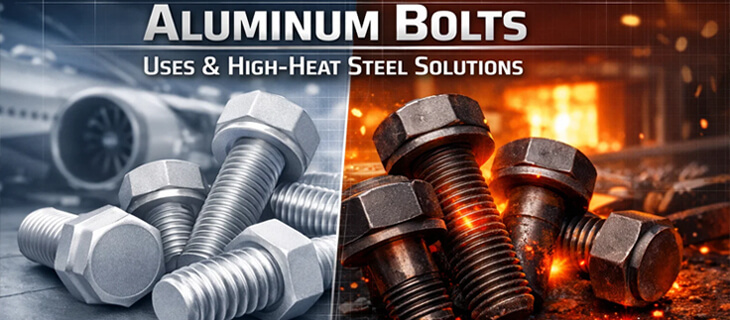
In the diverse landscape of American manufacturing and engineering, selecting the right fastener is never just about holding two pieces of material together. It is about balancing weight, strength, conductivity, and resistance to the environment. While steel has traditionally been the “go-to” metal for heavy-duty applications, aluminum bolts have carved out a critical niche in modern industry.
At Nakoda Steel Industry, we understand that every project requires specific material properties to succeed. Whether you are dealing with the lightweight requirements of aerospace or the high-temperature demands of industrial processing, knowing when to choose aluminum over other alloys is essential for efficiency and safety.
The Case for Aluminum Fasteners
Aluminum bolts are prized primarily for their high strength-to-weight ratio. They are approximately one-third the weight of steel, making them indispensable in industries where every ounce counts. Additionally, aluminum naturally forms a protective oxide film that makes it resistant to corrosion in many environments, particularly atmospheric conditions.
So, where exactly will you find these specialized fasteners holding the world together?
1. The Automotive Industry: The Drive for Lightweighting
In the US automotive sector, “lightweighting” is the current standard. Manufacturers are constantly seeking ways to reduce vehicle weight to improve fuel efficiency and meet stringent emissions standards.
Aluminum bolts are increasingly replacing steel fasteners in engines and transmission fittings. By using aluminum bolts to secure aluminum housings (such as gearboxes or engine blocks), engineers achieve a 60% weight reduction compared to steel fasteners. Furthermore, using aluminum bolts on aluminum components solves the problem of thermal expansion mismatch. When the engine heats up, the bolt and the housing expand at the same rate, maintaining a stable clamping force and preventing preload loss.
2. Aerospace and Aviation
The aerospace industry demands materials that can withstand the rigors of flight while minimizing payload weight. While high-strength rivets are common for skins, aluminum bolts are used in structural applications where components may need to be disassembled or where specific clamping forces are required.
In aircraft construction, compatibility is key. Using aluminum fasteners to join aluminum structural components helps avoid galvanic corrosion—a chemical reaction that occurs when dissimilar metals (like carbon steel and aluminum) are in contact in the presence of moisture. However, engineers must be careful; aluminum bolts are generally not used in high-tension areas where the superior strength of titanium or high-strength steel is required.
3. Electronics and Thermal Management
Aluminum is non-magnetic and highly conductive, both electrically and thermally. This makes aluminum bolts an excellent choice for electronic applications. They are frequently used in electrical contact joints because they offer low contact resistance and high conductivity.
Furthermore, in thermal management systems, such as mounting heat sinks to circuit boards, aluminum screws can be utilized. While machine screws (M2–M4 sizes) are standard for heatsinks, using aluminum fasteners ensures that the mounting hardware does not interfere magnetically with sensitive electronic components.
4. Marine Applications
The marine environment is notoriously harsh. Saltwater and sea spray can destroy standard iron-based fasteners in a short period. Aluminum’s natural passivation layer allows it to perform exceptionally well in marine atmospheres.
Aluminum fasteners are often used for deck fittings and superstructures on boats. However, a word of caution for our maritime clients: “bimetallic corrosion” is a real threat. If you bolt an aluminum part with a stainless steel screw (or vice versa) without proper insulation washers, the aluminum will corrode rapidly. Therefore, aluminum bolts are best used to join aluminum parts, ensuring longevity in coastal environments.
When Aluminum Isn’t Enough: Handling Extreme Heat
While aluminum bolts are champions of lightweight applications, they have limitations. Aluminum loses strength significantly as temperatures rise, making it unsuitable for environments exceeding 400°F–500°F.
For industrial applications involving extreme heat—such as furnaces, waste incinerators, and power generation boilers—you need materials engineered to survive the inferno. This is where Nakoda Steel Industry steps in with our high-performance solutions.
The Power of Stainless Steel 309S
When your project moves from the lightweight requirements of a car chassis to the intense heat of a petrochemical refinery or a kiln, you require Stainless Steel 309S Tubes.
Alloy 309S is a high-chromium, low-nickel austenitic stainless steel designed specifically for high-temperature environments. Here is why 309S is the industry standard for thermal processing:
- Extreme Temperature Resistance: 309S resists oxidation at temperatures up to 1900°F (1038°C) under constant temperature conditions,. This makes it vastly superior to standard stainless steels like 304 or 316 in heat-intensive zones.
- Weldability: The “S” in 309S stands for lower carbon content. This reduction in carbon minimizes carbide precipitation during welding, ensuring that the tubes remain tough and corrosion-resistant even after fabrication.
- Corrosion Resistance: The high chromium content (22-24%) allows Stainless Steel 309S Tubes to withstand sulfur-bearing atmospheres and oxidation that would rapidly degrade other materials,.
Applications for 309S
At Nakoda Steel Industry, we supply these vital components for:
- Furnace Components: Burners, fans, and piping systems.
- Chemical Processing: Catalytic recovery systems and refinery equipment.
- Power Generation: Coal burners and boiler tube hangers.
Choosing the Right Partner
Whether you are designing a lightweight bracket requiring aluminum fasteners or retrofitting a furnace that demands the thermal resilience of Stainless Steel 309S Tubes, the material quality dictates the success of your project.
At Nakoda Steel Industry, we are committed to providing the US market with top-tier metallurgical solutions. We understand that in your business, failure is not an option—whether that means a bolt shearing off or a tube oxidizing in a furnace.
Contact Nakoda Steel Industry today to discuss your material needs. From lightweight precision to heavy-duty heat resistance, we ensure you have the right steel for the job.